
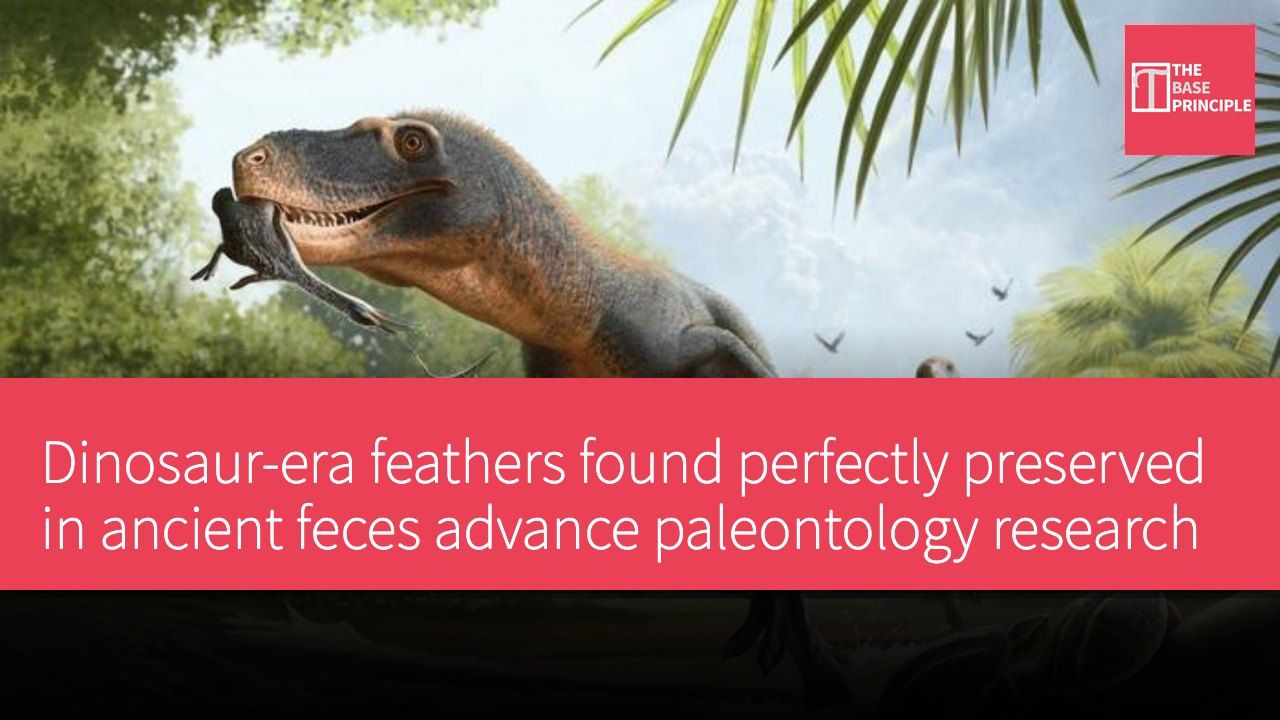
- Perfectly preserved three-dimensional feathers found in ancient feces advance paleontology research.
- These feathers belonged to an ancient flightless bird similar to modern loons.
- Research shows the feathers had underwater adaptation features closely related to modern birds.
- The primitive feathers of the ornithurine birds had poor insulation, possibly leading to their extinction.
In paleontology, finding feathers is extremely rare, and discovering them inside an animal's abdomen is a preservation miracle. This proves that a top predator once consumed a bird. Sixty-six million years later, its fossilized feces are rewriting evolutionary history. The latest research shows that a piece of ancient feces has preserved the best-preserved three-dimensional feathers ever found from the dinosaur era. This golf ball-sized nodule was discovered in Montana's famous Hell Creek Formation, hidden from view until micro-CT scanning revealed its contents: trout scales, bird leg bones, and feathers.
These feathers belonged to an ancient flightless bird—the ornithurine, which dived and fished like modern loons.
The astonishing discovery in ancient feces
The study's lead author, Jingmai O’Connor, associate curator of fossil reptiles at Chicago's Field Museum, said, "This is such a beautiful, well-preserved feather from such an unexpected source, and it's exciting that it might help us answer this big question in paleontology." In 2016, researcher David DeMar, Jr. found the reddish-brown nodule and discovered a tiny fossilized feather under a microscope. This was a rare find for the Hell Creek Formation, which has been searched for 150 years.
Subsequently, scientists tested its mineral composition and conducted detailed CT scans, allowing them to see the hidden contents within the rock.
Nate Carroll, from the Carter County Museum in Ekalaka, Montana, and a co-author of the study, said, "Although the preservation is better than many of the feathers I've studied in Burmese amber, this is a rock—and a rather nondescript one at that. I suspected it might be a coprolite until we put it into the micro-CT scanner at the University of Southern California's medical campus, and the feather structure in this fossilized feces became apparent." He added, "Every hour of processing revealed another feather, another scale, another bone, all in stunning three-dimensional detail."
As a researcher who relies on distant amber mines, realizing that a fossilized coprolite from my hometown could provide such an excellent specimen is a game-changer.
The evolutionary features of the feathers
Analysis shows that the feathers had underwater adaptation features similar to those of today's water birds. The ornithurine birds were closely related to modern Neornithes birds but formed a distinct group. They also diverged from the most common birds of the Cretaceous period—the enantiornithines. Some scientists believe that aquatic habitats helped some birds survive the mass extinction. However, ornithurine birds also lived by the water but still went extinct. O’Connor believes the difference in feathers explains why Neornithes survived. Researchers found that these feathers exhibited a peculiar evolutionary mix.
These feathers were partly adapted for diving but retained the primitive down typical of non-avian dinosaurs.
These primitive feathers provided poor insulation against the cold. Neornithes had advanced feathers that kept them warm during the winter after the asteroid impact. The lack of good insulation may have led to the extinction of the ornithurine and enantiornithine birds. O’Connor noted, "The ornithurine birds retained a primitive feather type, and these feathers' insulating efficiency was probably not as good as that of modern down feathers, which could explain why they went extinct along with the enantiornithines." The study was published in the journal Current Biology.
New breakthroughs and challenges in paleontology research
This study reveals the rare discovery of feather fossils in paleontology and provides important evolutionary clues. Ancient feces not only preserved three-dimensional feathers but also showed the underwater adaptation features of these feathers, offering a new perspective on the living environment of ancient birds. The extinction reasons of the ornithurine birds also provoke in-depth thinking about feather evolution and its heat preservation ability, which is of great significance for exploring the origin of modern birds. The publication of this research not only promotes the understanding of paleontology but also challenges our traditional concepts of biological adaptive evolution.