
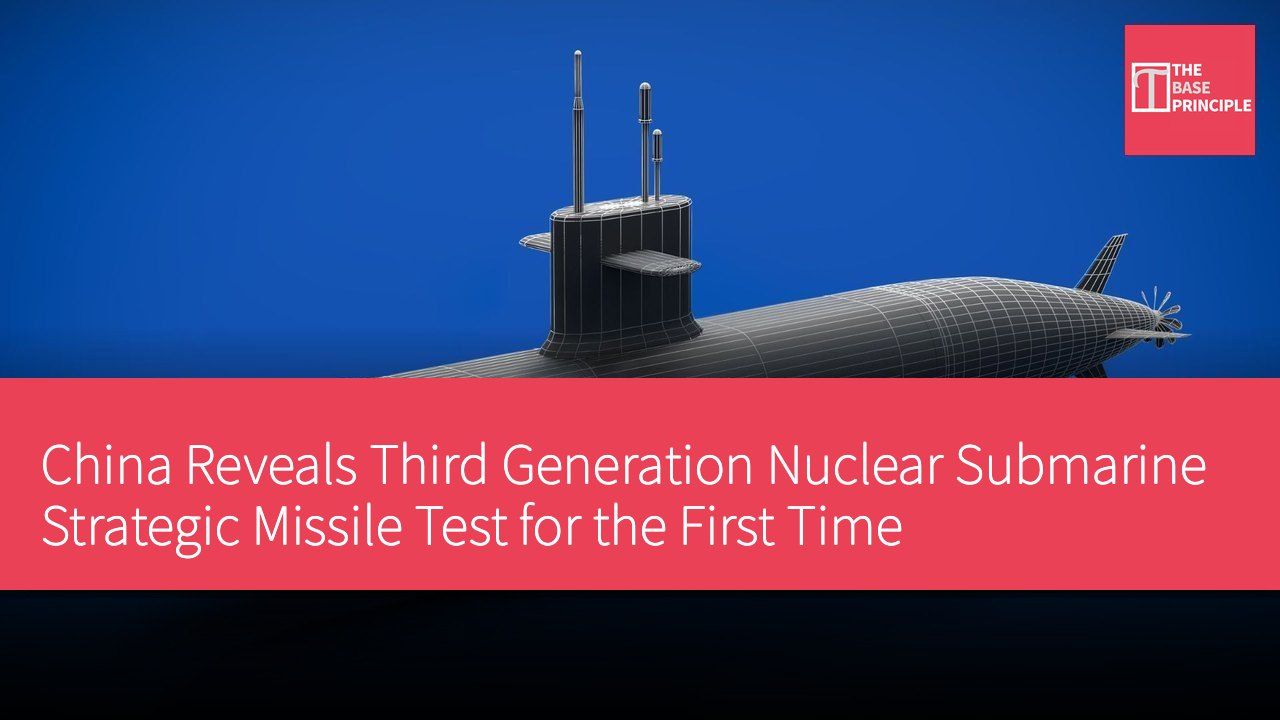
- China has disclosed the deployment of third generation nuclear submarines and their intercontinental ballistic missile mission for the first time.
- Nuclear-powered submarines can operate underwater for months without refueling, enhancing naval combat capabilities.
- China operates at least six ballistic missile submarines, which may be equipped with newer missiles.
- China is expanding its nuclear submarine launch capabilities and constructing new vessels to support unmanned underwater vehicles.
China has publicly disclosed the deployment of its third generation nuclear submarines in the Pacific for the first time and announced their intercontinental ballistic missile (ICBM) mission. According to a statement released by the state news agency Xinhua last Saturday, "The Changzheng series nuclear submarines have reached the third generation and have successfully organized test launches of submarine-launched strategic missiles." To strengthen naval defense, the People's Liberation Army of China has utilized the third generation submarines for these ICBM tests for the first time.
Prior to Saturday's announcement, Beijing showcased its sea-based nuclear capabilities in July, which drew strong criticism from regional countries including Japan and Australia. The latest statement included photos of missile tests conducted in July, according to The Japan Times. Similar to those tests, the latest mission is also noteworthy as it involved a nuclear-powered submarine, which can operate underwater for months without refueling. Unlike conventional submarines, these submarines use nuclear reactors, allowing them to travel greater distances and patrol for extended periods.
Strategic Significance of Nuclear Submarines
Ballistic missile submarines hidden underwater are primarily designed for strategic nuclear deterrence. They are difficult to detect and can be ready to respond at any time if necessary. To date, China has not officially confirmed the types of submarines or the deployment of ballistic missile submarines. Following the July tests, Chinese state media did not specify which submarines were involved. Defense analysts believe that the 094 class ballistic missile submarine may have conducted the launch. It is believed that China operates at least six such submarines, capable of carrying JL-2 missiles, and potentially equipped with the newer JL-3 missiles, which have a range sufficient to strike parts of the United States from waters near China.
Beijing has also begun introducing more advanced 095 class submarines while continuing to develop the next generation 096 class submarines. According to a report by the state news agency Xinhua in July, the missile was launched at 12:01 PM local time during a routine military exercise. The report noted that the test was not aimed at any country or specific target, and relevant governments had been notified in advance.
Role of Unmanned Underwater Vehicles
Meanwhile, China is expanding its nuclear submarine launch capabilities by constructing a second vessel to support the operation of unmanned underwater vehicles (UUVs). This new vessel shares several features with its counterpart, including a flight deck, a hangar located behind the forward superstructure, and structures for handling underwater vehicles. The vessel is being constructed at the Guangzhou shipyard and appears smaller than similar vessels identified earlier in Shanghai. Satellite imagery shows that this vessel emerged from the shipyard's covered dry dock on October 2 of this month.
Large unmanned underwater vehicles can perform tasks such as seabed mapping, mine detection, and surveillance. They may also support operations involving submarines and surface vessels. Some UUV designs can accommodate other payloads, including weapons, although the specific payloads for these vessels have not yet been confirmed.
Development and Regional Impact of Third Generation Nuclear Submarines
The disclosure of China's third generation nuclear submarines marks a significant enhancement of its naval power, particularly in terms of nuclear deterrence capabilities. The stealth and sustained submersion capabilities of these submarines present a strategic threat, impacting the security environment of neighboring countries. Additionally, the introduction of unmanned underwater vehicles demonstrates China's advancements in naval technology, which not only enhances its maritime combat capabilities but may also alter future naval warfare dynamics. As these technologies develop, regional countries need to reassess their defense strategies to address potential challenges.