
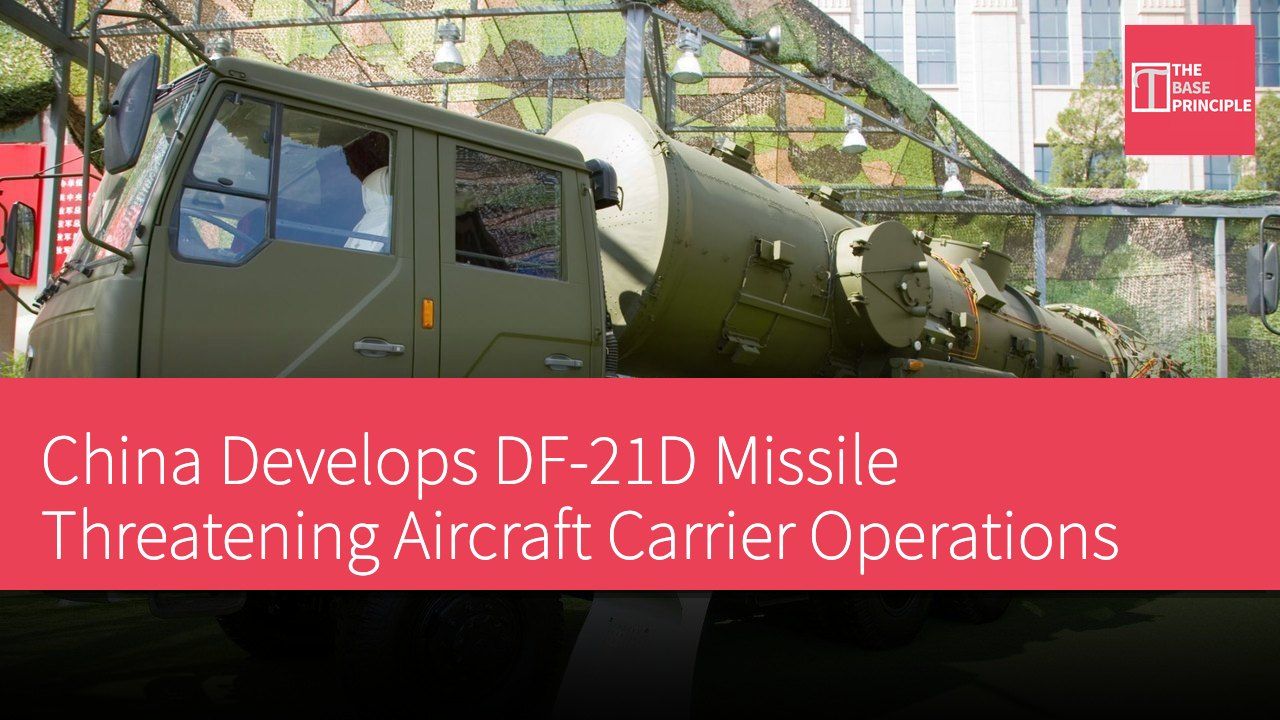
- The DF-21D, known as the "carrier killer," is specifically designed to target large naval vessels.
- The DF-21D has a range of over 1,500 kilometers, threatening vessels far from China's coastline.
- Effectively striking an aircraft carrier requires reliable targeting information, a process known as the targeting "kill chain."
- The risks introduced by the DF-21D complicate operational decision-making for aircraft carriers.
Aircraft carriers enable navies to deploy air power at sea without relying on nearby air bases. China has developed the DF-21D missile to threaten the vessels that make these operations possible. Known as the "carrier killer," the DF-21D is a land-based anti-ship ballistic missile designed to target large naval vessels at sea. Its reputation stems from its long range, maneuverable reentry vehicles, and challenges to carrier defense systems. However, this nickname describes its intended mission. Whether it can successfully strike a moving aircraft carrier in wartime depends on far more than the missile itself.
The DF-21D belongs to China's Dong Feng missile series. Unlike variants designed to strike land targets, the DF-21D carries a conventional warhead specifically for targeting vessels, including aircraft carriers. According to the U.S. Congressional Research Service, the missile has a range exceeding 1,500 kilometers (approximately 932 miles). This allows China to threaten naval vessels far from its coastline using land-based launchers. The distinction from anti-ship cruise missiles is crucial. Cruise missiles typically fly powered through the atmosphere, while ballistic missiles travel along a high parabolic trajectory, with their reentry vehicles descending toward the target.
This introduces another direction and type of attack for naval planners to defend against.
Attack Characteristics of the DF-21D
The U.S. Congressional Research Service notes that prior to the emergence of these weapons, the U.S. Navy had not faced high-precision ballistic missiles capable of accurately striking moving naval vessels. Mere range is insufficient to explain the "carrier killer" label. Aircraft carriers can change course and speed, meaning their position at launch may differ from where the missile arrives. The Pentagon's 2024 report on China's military capabilities highlights that a feature of the DF-21D is its maneuverable reentry vehicle, which can adjust its flight path upon reentering the atmosphere. This maneuverability supports the missile's anti-ship role, although publicly available data has not confirmed its accuracy against defended aircraft carriers under combat conditions.
The DF-21D can also be launched from mobile ground launchers. These vehicles can reposition, making them harder to detect and target than fixed launch sites. The mobility adds another layer of complexity for forces attempting to eliminate the threat before launch. These features explain why the missile has garnered attention: it combines long-range strike capabilities with a system designed to engage non-stationary vessels.
Challenges in Targeting Aircraft Carriers
To effectively strike an aircraft carrier, a missile must have reliable targeting information. China must first detect the vessel, identify its type, determine its location, and maintain sufficient tracking information to support the strike. This information must be transmitted to the launch unit, while the reentry vehicle must locate the target vessel. This process is commonly referred to as the targeting "kill chain." A failure at any stage can undermine the attack. Carrier groups also have defensive options. The U.S. Congressional Research Service discusses missile interceptors, electronic warfare, deception, and various measures to obscure the vessel's location, all of which are ways to counter anti-ship ballistic missiles.
While no measures can guarantee complete protection, their existence means that the DF-21D's range cannot be viewed as an automatic exclusion zone.
The significance of such a missile lies in the risks it introduces. A credible threat to aircraft carriers may complicate decisions regarding their positioning, protection, and the execution of missions by onboard aircraft. This is why the name "carrier killer" has endured. The DF-21D was built as a core tool to challenge U.S. naval power, but its expected capabilities should not be confused with guaranteed wartime outcomes.
Impact of the DF-21D on Naval Strategy
The development of the DF-21D missile marks a significant advancement in China's naval strategy. This missile not only possesses long-range strike capabilities but also challenges the operational paradigm of traditional aircraft carriers. With the emergence of the DF-21D, the U.S. Navy must reassess its defensive strategies, as the missile's mobility and precision strike capabilities increase the threat to aircraft carriers. The flexibility of carriers on the battlefield juxtaposed with the threat posed by the DF-21D creates a complex military confrontation, which has far-reaching implications for future naval strategic planning.