
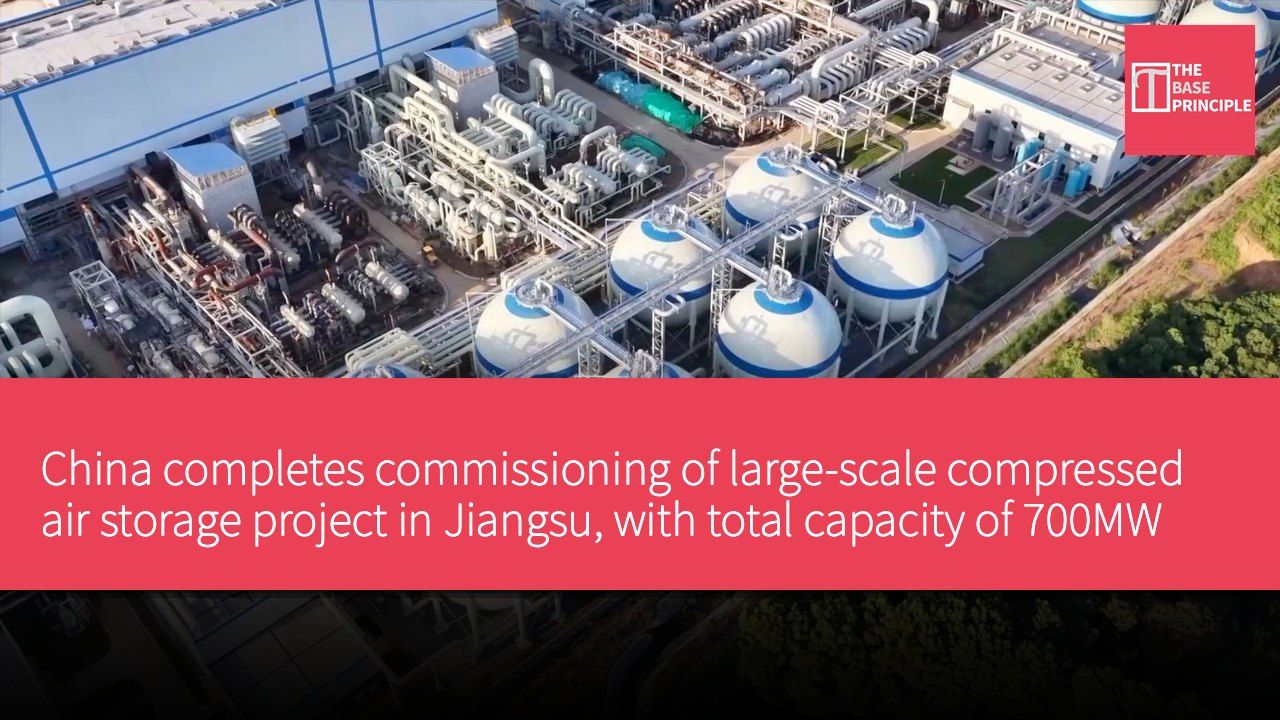
- A large compressed air energy storage project in Jiangsu has been fully commissioned, with a total capacity of 700MW.
- The facility uses salt caverns as storage chambers, helping prevent air from escaping.
- The project includes Asia's largest thermal storage water tank array, reducing energy losses.
- China is expanding the use of salt cavern storage to meet rising electricity demand.
China has fully commissioned two units of a large-scale compressed air energy storage project in Jiangsu province, marking a new step forward for large-capacity storage built inside underground salt caverns. According to a CCTV News report, the Huaneng Jintan salt cavern compressed air energy storage Phase II project reached the milestone on Saturday. Located in Changzhou in eastern China, each unit has a capacity of 350 megawatts (MW). Once fully built and operational, the facility's energy conversion efficiency is expected to exceed 70%. The project has been described as a "super battery" for the grid.
Compressed air energy storage uses surplus power from low-demand times to power machines that force air into underground salt caverns, where it is held until the grid needs additional electricity. During periods of high demand, the compressed air is released and used to drive turbines for power generation. The Jintan facility uses deep salt caverns as storage chambers; the dense, impermeable salt formations help prevent the stored air from escaping over long periods. When electricity demand is low, surplus grid power compresses air to more than 130 atmospheres, or roughly 1,910 pounds per square inch (psi), before injecting it into the underground salt caverns. When demand rises, the stored air is released and fed into the power generation system.
How compressed air energy storage works
The project captures heat generated during compression and stores it for later use, helping reduce energy losses in the generation cycle. This thermal management system includes what CCTV News describes as Asia's largest single thermal storage water tank array for compressed air storage. The system features 16 spherical tanks, each holding 3,500 cubic meters of water (about 925,000 gallons), for a combined storage capacity of 56,000 cubic meters (about 14.8 million gallons).
The project also includes a main gas treatment system designed for continuous operation. It is equipped with the largest single intake and injection well for compressed air energy storage in China. Engineers say the well can handle up to 2.16 million cubic meters of air per hour (76.3 million cubic feet). The well has received special anti-corrosion and sealing treatments, measures designed to support long-term operation and reduce the risk of air leakage.
Background: China's expansion of salt cavern storage
With electricity demand growing and renewables taking a larger share of the power mix, China is expanding the use of salt cavern storage. Operators can monitor data from surface equipment and the underground salt caverns in real time at a control center. The salt caverns are about 1,000 meters (3,280 feet) below ground. Centralized digital management allows the facility to monitor the storage system and respond as grid conditions change. Its scale reflects China's push to expand physical energy storage within an evolving grid.
Item Specification Capacity per unit 350 MW Compressed air pressure More than 130 atmospheres Number of water tanks 16
Future potential of compressed air energy storage technology
As renewable energy expands, compressed air energy storage technology is demonstrating its importance in balancing grid demand. The technology can not only effectively store surplus electricity but also release energy during periods of high demand, improving grid stability. The Jiangsu project showcases China's advances in energy storage technology, particularly the innovation of using underground salt caverns, which can boost energy efficiency while reducing environmental impact. As the technology matures, it is expected to be more widely adopted globally.