
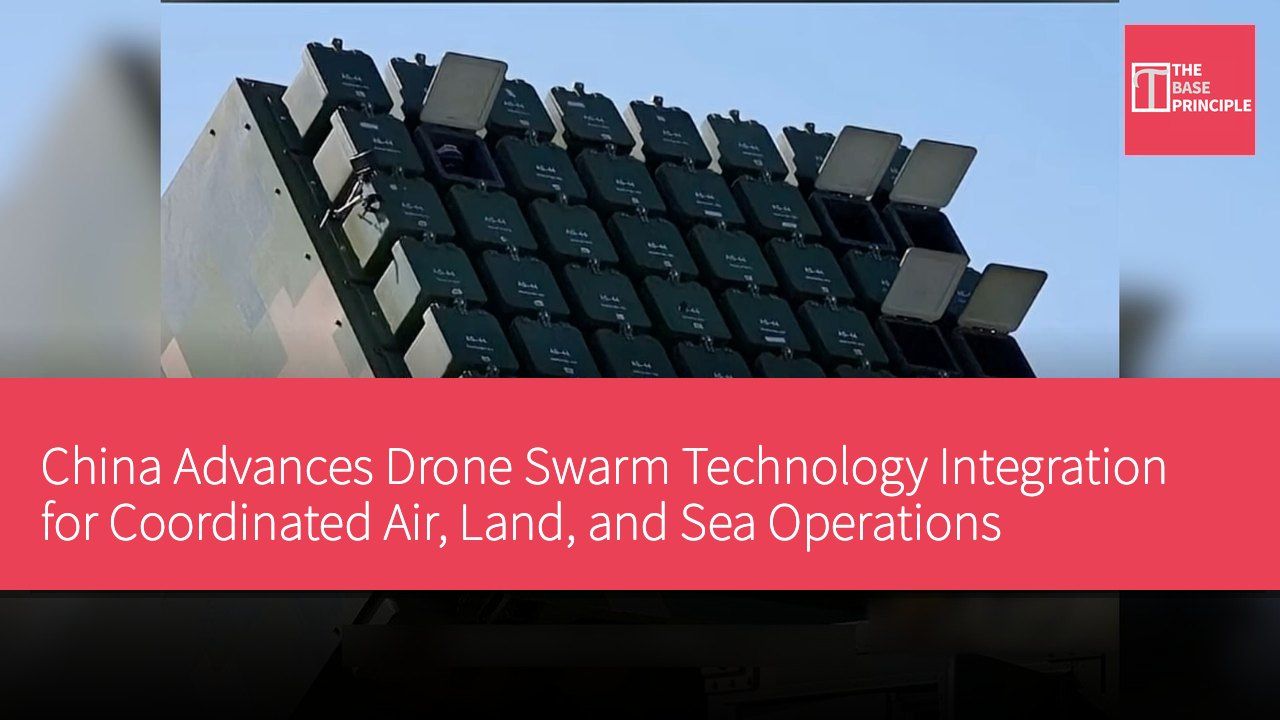
- China's drone swarm technology is evolving toward coordinating air, land, and sea systems.
- CETC emphasizes that drone swarms need capabilities like survivability and situational awareness.
- Achieving heterogeneous all-domain swarms faces technical challenges, requiring coordination across different platforms.
- Rapid industry growth has led to redundant development, necessitating common standards and testing in the future.
China is moving beyond deploying large numbers of identical drones in swarms toward a more ambitious goal: a network that can coordinate unmanned systems in the air, on land, and at sea, according to the country's leading developer of drone swarm technology. In a recent article by the China Electronics Technology Group Corporation (CETC), its Intelligent Technology Research Institute described drone swarms not merely as numerous aircraft flying together but as a distributed system where individual platforms communicate, coordinate, make local decisions, and collectively generate capabilities. This assessment offers a rare insight into how Chinese researchers view the current state and future direction of the country's swarm technology.
From hundreds of drones to intelligent networks, China has made significant progress in homogeneous swarms, which involve large numbers of similar drones operating together. CETC states that these systems have demonstrated decentralized network functions, dynamic reorganization, and adaptive algorithms that allow swarms to recover in the face of individual losses, communication interruptions, and electromagnetic interference. CETC identifies five capabilities that determine whether these systems can operate effectively: survivability, situational awareness, planning and decision-making, mission execution, and autonomous learning and evolution. The institute says China has developed mature capabilities in some of these areas but acknowledges that significant challenges remain.
Current Status of Drone Swarm Development
In terms of survivability, homogeneous swarms reportedly can reconfigure their networks and continue operating after the loss of individual nodes or communication interruptions. However, maintaining this resilience when different types of unmanned systems operate across multiple domains remains a challenge. One of the main advantages of swarms is their ability to combine information from multiple platforms. CETC states that China's distributed sensing systems can fuse data collected by multiple drones to overcome the limitations of a single aircraft. These swarms can autonomously filter targets, identify camouflage, and determine target locations while building a broader picture of the surrounding environment.
However, researchers admit that detecting and identifying small, concealed objects in conditions of heavy background interference and strong electromagnetic interference is significantly more difficult. The same pattern emerges in the decision-making process. China's swarm systems have demonstrated autonomous formation changes, path planning, collision avoidance, and dynamic task allocation, but more advanced capabilities, such as developing new tactics in unfamiliar environments against a powerful adversary, are still under development.
Challenges of Heterogeneous All-Domain Swarms
According to a report by the South China Morning Post, CETC describes the ultimate goal as a heterogeneous all-domain swarm, where different unmanned platforms can collaborate in the air, on land, and at sea. This could eventually enable aerial drones, ground vehicles, and maritime systems to provide different sensors, mobility, and payloads to the same network, rather than operating as separate systems. However, achieving this goal is far more difficult than coordinating identical drones. Different platforms have different communication needs, sensors, movement characteristics, and operating environments, and they must also interoperate with military units from different services.
CETC states that current systems can support a wide range of combat cycles, from reconnaissance and electromagnetic suppression to precision strikes and battle damage assessment, but coordination across air, land, and sea and adaptability for joint operations remain gaps. The institute also notes that swarm AI has progressed from fixed programming to adaptive optimization and experiential learning through reinforcement and adversarial iterations. However, fully autonomous real-time evolution and more advanced forms of collective intelligence remain future goals.
The development path outlined by CETC is relatively clear: first, mature systems composed of identical drones, then address the technical issues involved in coordinating different platforms, and ultimately connect unmanned systems across operational domains. Recent demonstrations have shown why this technology is attracting attention. As reported by the Global Times, China's Central Television in March showcased the Chinese ATLAS drone swarm operating system, including the Swarm-2 ground combat vehicle, command vehicle, and support vehicle. In July, Chinese researchers also used a drone swarm to conduct multi-dimensional observations of a typhoon's landfall.
Future Directions for Industry Development
CETC also warns that the industry's rapid growth has led to overlapping projects, redundant development, and an overemphasis on demonstrations rather than measurable capabilities. Therefore, the institute believes that future progress will depend not only on better algorithms but also on establishing common standards, interoperable interfaces, realistic testing, and improved resistance to electromagnetic interference. For now, China's most mature capability seems to be coordinating large numbers of similar drones, while transforming these swarms into a distributed network operating across air, land, and sea is a more challenging goal.
Item Specifications Drone Type Homogeneous Drones Operational Scope Air, Land, Sea Core Capabilities Survivability, Situational Awareness, Autonomous Learning
Future Challenges of Drone Swarm Technology
China has made significant progress in drone swarm technology but still faces multiple challenges. The transition from homogeneous swarms to heterogeneous all-domain swarms requires solving coordination issues between different platforms, which involves differences in communication needs and operating environments. Additionally, the industry's rapid growth also brings the risk of project overlap and redundant development. Future success depends on establishing common standards and improving the system's resistance to interference. Overcoming these challenges will have a profound impact on China's application of unmanned systems and military strategy.