
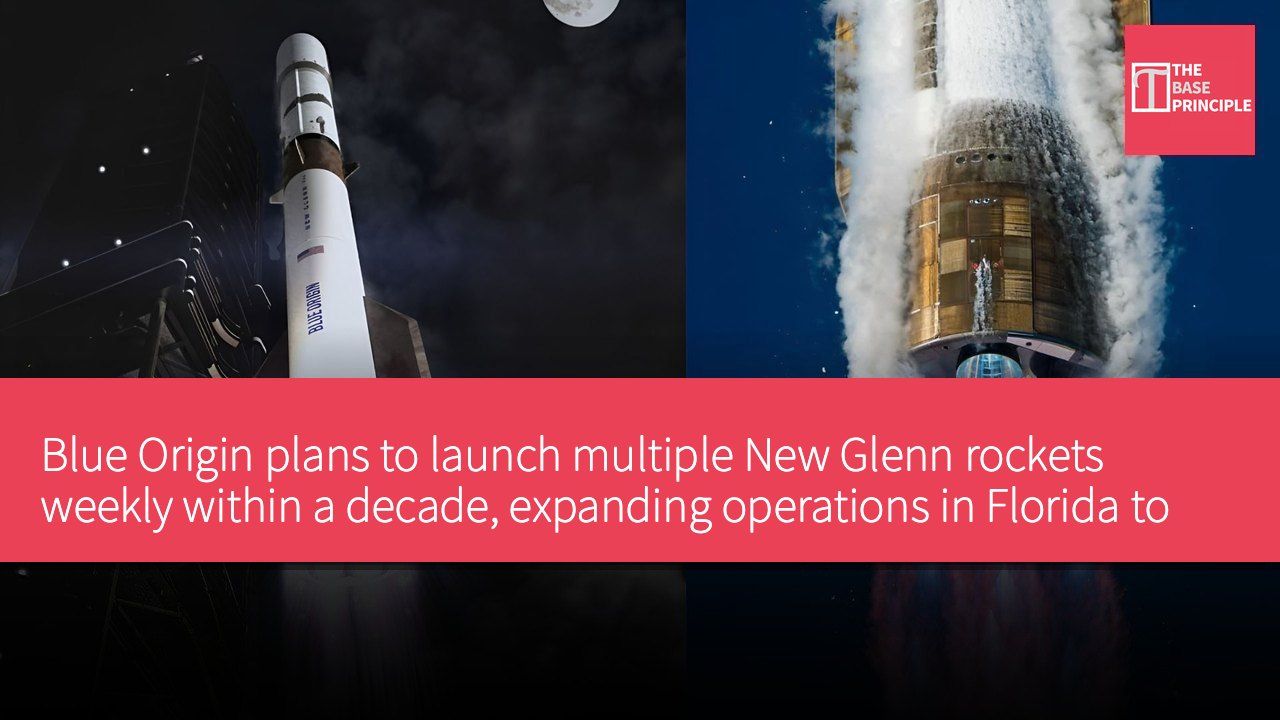
- Blue Origin plans to expand its operations in Florida to support a faster launch cadence.
- The expansion includes new manufacturing facilities and launch pads, aiming for multiple New Glenn launches per week.
- The company will produce most components in-house while maintaining support for external suppliers.
- Achieving high launch frequency relies on parallel manufacturing capabilities and mission preparations.
Blue Origin is expanding its operations in Florida to support a faster launch schedule, aiming for multiple New Glenn launches per week by the end of the century. The plan includes a $330 million manufacturing expansion, additional launch pads, and new facilities for payload processing and booster refurbishment. The company has stated that it has invested over $3 billion in infrastructure in Florida. Its operations now cover more than 20 locations across Brevard and Orange counties, supported by over 5,000 employees and 500 suppliers.
This expansion aims to address a core challenge in commercial spaceflight: increasing launch frequency requires more than just additional rockets. Manufacturers must produce hardware more quickly, ground teams must prepare missions in parallel, and reusable boosters must return to service efficiently.
Expanding Manufacturing Capabilities to Support Launches
Blue Origin is expanding its 1.37 million square foot Rocket Park manufacturing campus near NASA's Kennedy Space Center. This $330 million project will increase the capacity to produce New Glenn 9×4 second stages, expected to be completed by the summer of 2027, supporting an annual production of up to 150 upper-stage rockets. Such output will provide substantial manufacturing capability for the company's pursuit of higher flight rates. The facility will also be equipped with automated machining, welding, material handling, and inspection systems, which can enhance production consistency and help workers identify defects earlier.
Additionally, further investments in chemical processing, fairing preparation, tooling, and storage will support the flow of hardware through the manufacturing process. Blue Origin also plans to produce nearly all components and systems in-house while maintaining support for external suppliers.
Enhancing Launch Infrastructure and Mission Preparation
However, simply manufacturing more rocket hardware will not increase launch frequency unless teams can simultaneously prepare multiple missions. Blue Origin is developing a customer integration facility in collaboration with the U.S. Space Force at Cape Canaveral Space Force Station. This complex will feature four payload processing bays, two encapsulation bays, and a dedicated area to handle multiple payloads simultaneously. Launch infrastructure is also being expanded. Blue Origin is restoring LC-36A to address anomalies that occurred earlier this year, while LC-36B will serve as the operational base for New Glenn 9×4, accommodating both New Glenn's 7×2 and 9×4 configurations, including national security missions.
Additionally, a vertical integration facility under construction will support 9×4 vehicles and enable parallel vehicle and payload preparations. The company has also requested an increase in the annual launch limit for LC-36 from 12 to 50.
The reusable first stage of New Glenn requires a recovery network capable of supporting repeated flights. Cape Canaveral currently has Jacklyn, the rocket's offshore landing platform, and Blue Origin is also developing two additional platforms. The new vertical integration facility will handle recovered boosters, where teams will inspect the returned stages and prepare them for refurbishment before subsequent missions. In addition to rocket production, Blue Origin operates facilities in Cocoa, Merritt Island, Orlando, and Titusville, supporting manufacturing, thermal protection systems, tooling, logistics, and material handling.
Its lunar sustainability program also relies on Florida facilities to manufacture, integrate, and test hardware. Since 2019, the company's nonprofit Club for the Future has reached nearly 700,000 Florida students and 65,000 educators.
Blue Origin's expansion reflects the infrastructure needs required for high launch frequency. Manufacturing capabilities, parallel mission preparations, and faster booster turnaround will determine how effectively the company can translate its ambitions into more frequent flights.
Item Specification Manufacturing Expansion Investment $330 million Rocket Park Area 1.37 million square feet Annual Production Cap 150 upper-stage rockets
Impact of Expansion Plans on Future Launch Frequency
Blue Origin's expansion plans demonstrate its commitment to the commercial spaceflight market, particularly in increasing launch frequency. With enhanced manufacturing capabilities and expanded infrastructure, the company hopes to stand out in a competitive market. Effective mission preparation and rapid booster turnaround will be key factors in achieving its goals. Additionally, increased in-house production can improve efficiency and reduce reliance on external supply chains, further accelerating overall operational speed.