
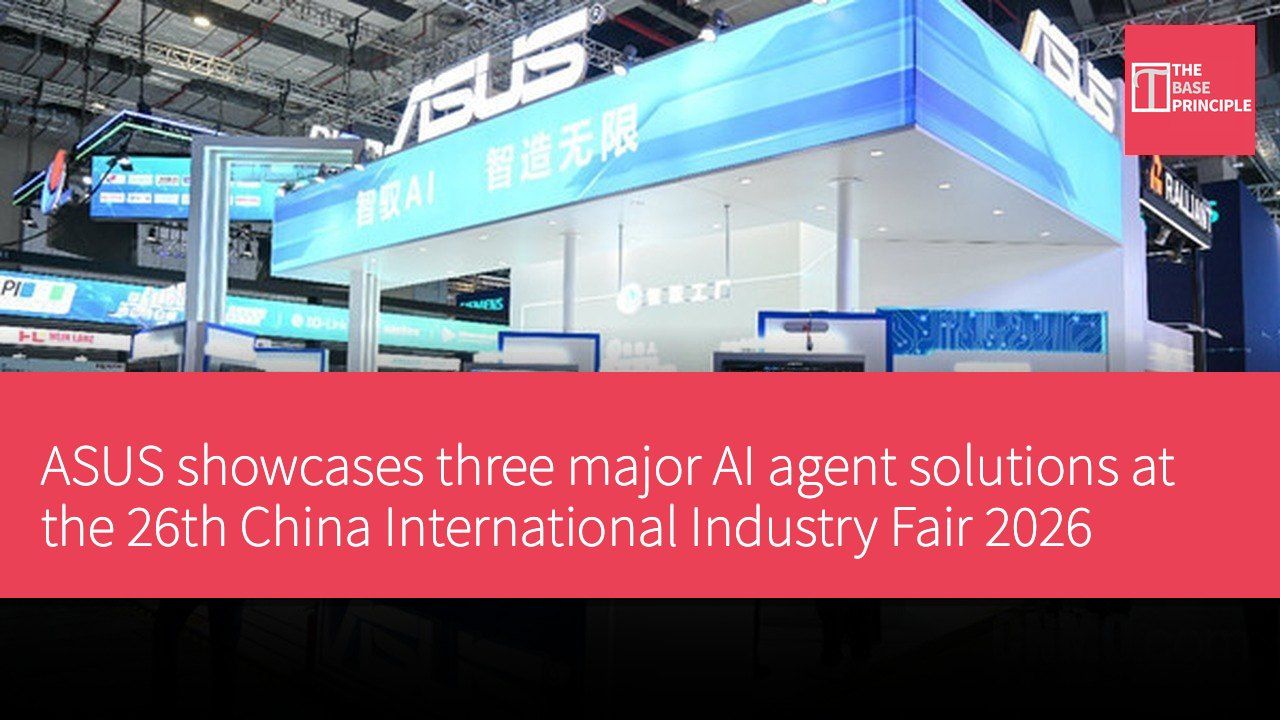
The 26th China International Industry Fair (CIIF) is currently underway at the Shanghai National Exhibition and Convention Center. As a premier event in the domestic industrial sector, it has attracted numerous enterprises to exhibit. In the industrial automation exhibition zone, ASUS showcased three major AI agent solutions built on the Ascent GX10 desktop supercomputer and the NUC 16 Pro mini PC, covering three directions: embodied robotics, local large model clusters, and edge-cloud hybrid intelligent terminals, advancing AI agents from concept to an engineering implementation stage capable of on-site demonstration and rapid validation.
ASUS Booth Solution One: Embodied Intelligent Control Hands-on Platform
One of the core highlights of this booth is an embodied intelligence hands-on platform for master-slave robotic arms built on the ASUS Ascent GX10 desktop supercomputer — the NVIDIA robotic arm master-slave teleoperation system. The entire platform relies on the GX10 for all local compute, performing visual perception, action reasoning, and force-control feedback calculations in real time, enabling the operator to control the master arm while the slave arm synchronously replicates the motion. The process requires no cloud compute support, allowing a full edge-side end-to-end demonstration on the booth floor, intuitively showcasing the real-time responsiveness of a locally driven large-model robot.
Developers can use this platform to rapidly validate various embodied intelligence scenarios such as robot agents, visual grasping, and remote teleoperation. On one hand, it addresses high-risk operational scenarios, enabling remote control without human presence on site; on the other, it allows collection of teleoperation data in the lab for training robotic arm models in real environments, significantly lowering the capital and time barriers for embodied intelligence project prototyping and scenario iteration.
ASUS Booth Solution Two: GX10 Cluster Enterprise Low-Cost Intelligent Development Tool
The second solution employs four ASUS Ascent GX10 mini desktop supercomputers paired with a Xintu Heterogeneous E1001 switch to build a lightweight local compute cluster, deploying the GLM 5.3 Flash large model. Through multi-node compute collaboration that distributes inference load, it achieves excellent generation performance: 30-35 tokens per single concurrent request, and a stable overall token output of 100-110 tokens in 8-10 concurrent scenarios. The entire solution uses only desktop-class equipment, requires no large data center, and features simple deployment with controllable hardware costs.
On-site demonstrations include high-concurrency Q&A, ultra-long text generation, and multi-turn AI agent autonomous dialogue, intuitively proving that a small desktop cluster can handle high-performance large model inference tasks. Targeting enterprise AI R&D, industrial knowledge bases, and intelligent business agent development scenarios, it provides users with a reference template for deploying low-cost, local, private large model clusters.
ASUS Booth Solution Three: NUC Edge-Side Intelligent Workflow
The third solution uses the NUC 16 Pro mini PC as the intelligent agent terminal base, locally deploying the Qwen 3.6-35B-A3B MoE large model and pre-installing multiple Skill plugins adapted for industrial and development scenarios; leveraging the WorkBuddy agent orchestration framework, it constructs a hybrid AI architecture where local compute and remote cloud compute operate collaboratively.
The system can intelligently split and schedule tasks: routine tasks such as document parsing, data preprocessing, simple command execution, and local knowledge base retrieval are performed directly on the NUC locally, consuming no cloud tokens; only when faced with heavy tasks such as deep complex reasoning or cross-domain complex decision-making does it invoke remote compute resources on demand. This hybrid agent solution balances local privacy and security with cloud-based strong reasoning capabilities, effectively saving cloud token expenditure and reducing task response latency. Targeting factory workstation intelligent assistants, on-site operations agents, and R&D automation assistant scenarios, it turns a single mini PC into an AI terminal capable of autonomously executing multi-step tasks, providing a flexible, low-threshold terminal solution for lightweight agent deployment in industrial settings.