
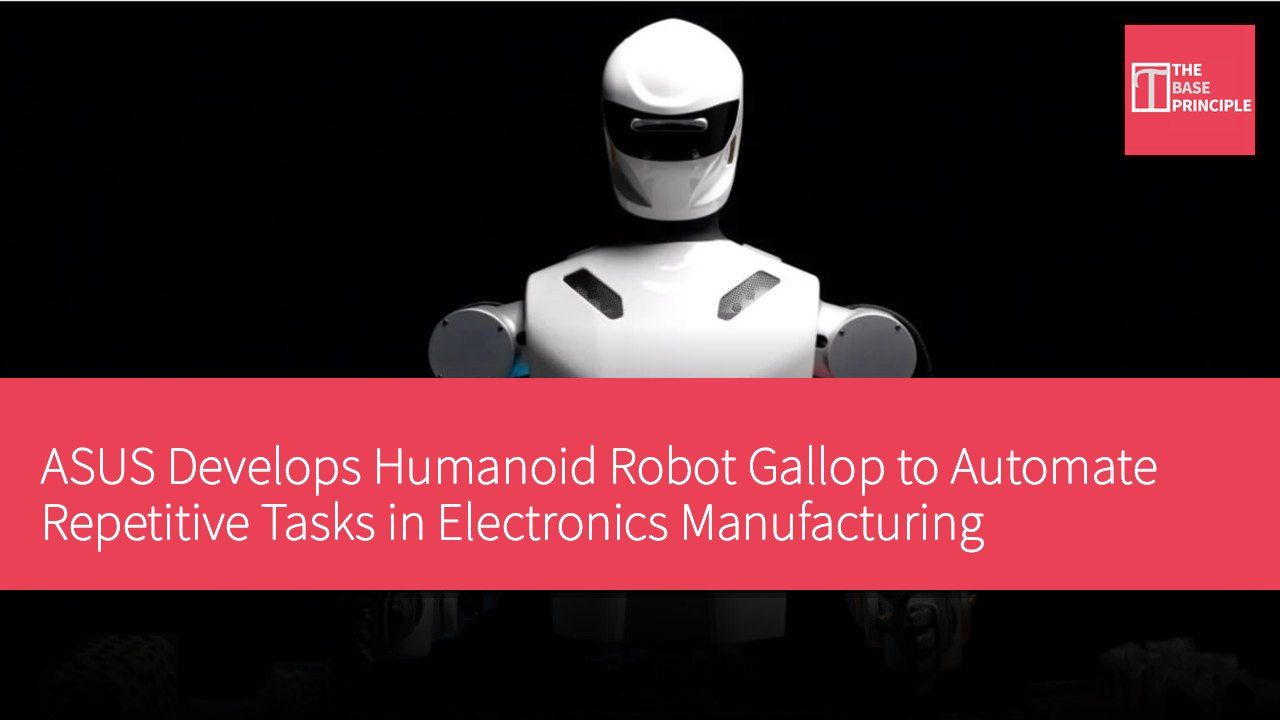
- ASUS is developing the Gallop humanoid robot to automate tasks in electronics manufacturing.
- The Gallop pilot program will start in 2027, with a market launch in 2028.
- The robot is trained using human demonstrations and virtual reality to learn operational skills.
- ASUS aims for Gallop to handle repetitive tasks without replacing factory workers.
Taiwanese tech company ASUS is developing a humanoid robot named Gallop, aimed at automating repetitive tasks in electronics manufacturing. The robot's customer pilot program is expected to launch in 2027, with a commercial release targeted for the second half of 2028. The robot is currently being tested at an electronics manufacturing services (EMS) factory within the ASUS Group, learning to package motherboard components at workstations designed for human workers. According to ASUS, the development of Gallop aims to demonstrate that humanoid robots can reliably perform actual factory operations, rather than just completing simulated demonstrations.
Gallop's initial tasks include packaging 15 different types of motherboard components, many of which are small, thin, and packaged in transparent plastic bags. The task poses challenges for traditional robotic grippers due to the varying shapes and flexible materials involved. ASUS stated that the choice of this workstation is to test whether Gallop can independently manage most operations without the continuous presence of human workers.
Training Process for Gallop
ASUS has developed a training process that combines human demonstrations, simulations, and practical exercises. With consent, experienced factory workers wear small head-mounted cameras to record their execution of specific tasks. Gallop uses this information to learn the necessary movements and handling techniques. Simulation software then generates variations of the demonstrations to help the robot adapt to subtle differences in working conditions. The training process also includes virtual reality (VR), where operators wear headsets and gloves to guide Gallop through tasks using the same components and cameras found at actual workstations.
Once deployed, the experiences recorded by the robot will also feed back into its training process.
ASUS has set a goal for Gallop to achieve a 99.5% task success rate within 20 seconds, matching the time required for human workers to complete the same operations.
AI Architecture of Gallop
ASUS has divided Gallop's AI architecture into four layers: planning, monitoring, skills, and control. The planning layer interprets the surrounding environment and breaks down operations into individual steps. An independent monitoring AI oversees these actions and can revise plans if issues arise. The skills layer manages actions such as reaching, grasping, and placing objects, while the control layer operates the robot's arms and hands. The architecture uses fixed interfaces between the different layers, allowing ASUS to swap AI models when improved versions become available without redesigning the entire robot. The system runs on a single NVIDIA Jetson AGX Thor computer inside Gallop, equipped with standard robotic software.
ASUS is developing the robot's body and dexterous hands in-house. The hands are particularly important as they need to manipulate small components while utilizing tactile sensing to understand physical contact. Other components, including motors, are sourced from established industry partners. Gallop currently operates from a fixed base and is equipped with two arms. ASUS plans to release a wheeled version within the next year, integrating its internally developed dexterous hands. The company also intends to showcase the robot to customers at the 2027 Taipei International Computer Show (Computex) and plans for pilot deployments.
Electronics manufacturing will be its first target market, although ASUS also sees potential applications in hospitals and other service environments. The company believes that skills learned at one workstation can transfer to other operations involving similar pick-and-place activities. ASUS stated that Gallop's purpose is to handle repetitive and physically demanding tasks, not to replace factory workers. Employees involved in training the robot can transition to roles such as robot setup, supervision, and performance improvement. Gallop is set to launch in early 2026, with ASUS aiming for customer pilots in 2027 and a market release in the second half of 2028.
However, whether the robot can meet its factory performance goals remains a crucial aspect of its development.
Item Specification AI Architecture Planning, Monitoring, Skills, Control Computing Platform NVIDIA Jetson AGX Thor Target Success Rate 99.5% Training Method Human Demonstration, Simulation, Practice
Potential Impact of Gallop on Electronics Manufacturing
ASUS's Gallop humanoid robot focuses on automating repetitive tasks in electronics manufacturing, showcasing the potential of technology to enhance production efficiency. By combining human demonstrations with high-tech training methods, Gallop aims to overcome challenges that traditional robots struggle with. This not only helps alleviate the physical burden on factory workers but could also transform the operational model of future factories, allowing human employees to shift towards more creative and supervisory roles. As technology advances, Gallop's success may drive automation applications in other industries.