
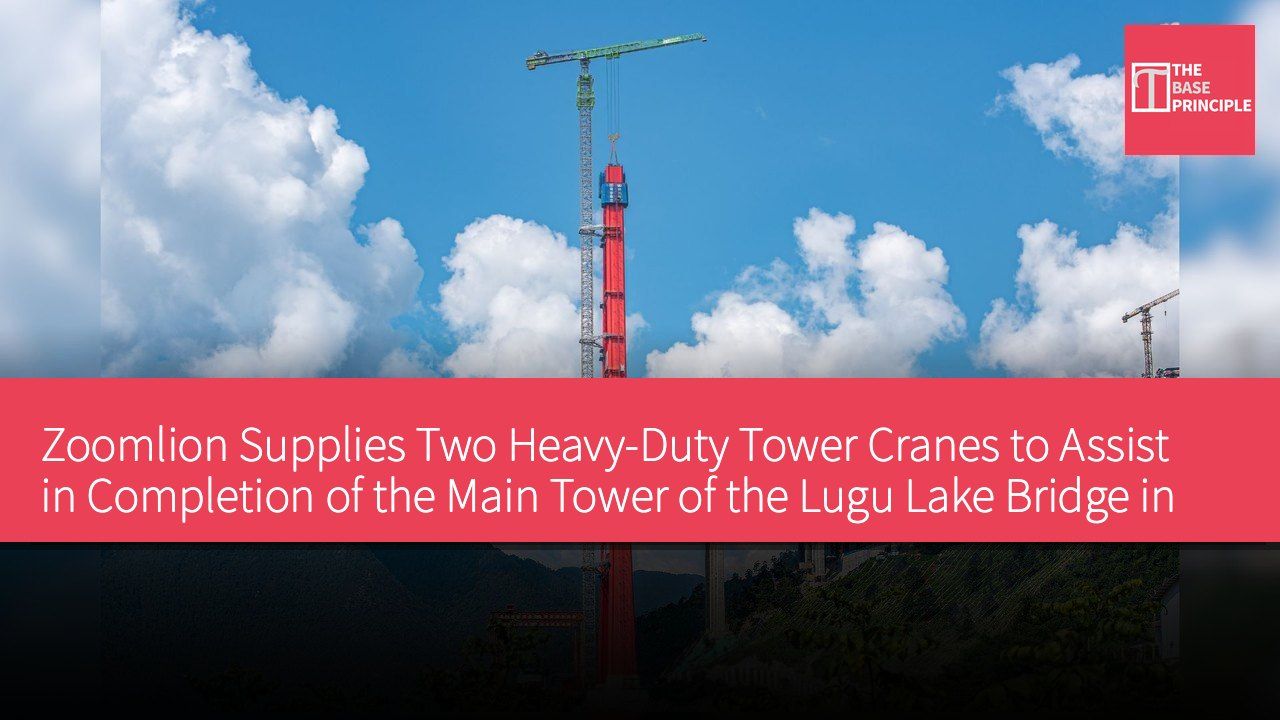
- Zoomlion provided two heavy-duty tower cranes for the Lugu Lake Bridge to assist in the construction of the main tower.
- The R4300-200 crane has a lifting capacity of 200 tons and a boom length of 80 meters.
- Real-time camera technology allows operators to remotely monitor and precisely adjust lifting operations.
- Zoomlion's experience will guide its work on other high-rise constructions.
Chinese construction equipment manufacturer Zoomlion has provided two heavy-duty tower cranes for the construction of the Lugu Lake Bridge in southwestern China, aiding the construction team in completing the 283-meter main tower on the Shangri-La side. According to Zoomlion, the tower reached its topping-out milestone on September 29. This bridge is part of the expressway from Xichang to Shangri-La, and precise lifting and positioning of large structural components are crucial due to the mountainous construction environment. The project utilized two R4300-200 tower cranes from Zoomlion, which served the two main towers of the bridge.
Crane Design and Functionality
These machines are designed for high-altitude heavy lifting, combining high load capacity, automated safety systems, and remote operation capabilities.
The R4300-200 has a maximum lifting capacity of 200 tons (220 short tons) and is equipped with an 80-meter (262-foot) long boom. Zoomlion states that the crane includes over 20 intelligent safety and control features, including an anti-collision system, a function that automatically adjusts operational speed based on load, and mechanisms designed to prevent suspended loads from slipping. These capabilities were particularly important during the final 103 meters (338 feet) of construction on the Shangri-La side tower, where the construction team needed to position the last steel and concrete sections on the central girder, with changing wind speed conditions adding to the challenges of maintaining load stability and alignment.
Real-time cameras allow operators on the ground to remotely monitor lifting operations and control the crane, providing visibility for component positioning while enabling precise adjustments during the installation process.
Zoomlion reported that the segmented lifting work on the tower was completed safely. The announcement did not specify the total length of the bridge or when the entire route is expected to open. This bridge project follows Zoomlion's work on a 380-meter (1,247-foot) tower for the Central Bank of Turkey at the Istanbul International Financial Center. Unlike the bridge towers, the Istanbul project involved constructing a high-rise building that combines a steel frame with precast concrete in a constrained urban construction site. According to Zoomlion, the project required 1,260 heavy lifts, including steel columns weighing up to 48.2 tons (53.1 short tons).
To meet these demands, the company customized its L760-50 luffing tower crane, which has a maximum lifting capacity of 50 tons (55 short tons) and a maximum boom length of 60 meters (197 feet). Its modular tower sections are 2.3 meters (7.5 feet) long on each side and can be transported in standard shipping containers. Each crane also required 10 customized connections to the building to comply with local seismic requirements.
Technical Support and Construction Efficiency
The variable frequency drive system adjusts lifting, rotation, and boom movements, allowing for smoother starts and stops and finer adjustments when positioning heavy components. A wind speed monitoring system provides alerts and reduces operational speed when preset thresholds are exceeded. Zoomlion also utilized remote monitoring technology in the Istanbul project to track equipment performance. This system transmits 28 operational parameters, including load data, component temperature, operating hours, and fault codes. These measurements help the team assess equipment wear and plan preventive maintenance. Zoomlion's research and development team collaborates remotely with engineers in Turkey to diagnose issues and support maintenance, aiming to reduce downtime.
The company stated that its equipment selection and technical support have enabled the main structure to continue construction at a pace of one floor every five days. Support also includes crane placement, installation feasibility studies, and dismantling simulations.
Zoomlion noted that experiences from the bridge and Istanbul projects are guiding its work on other high-rise constructions, including the 377-meter (1,237-foot) Ciel Dubai Marina hotel, the 400-meter (1,312-foot) Al Habtoor Tower in Dubai, and the 331-meter (1,086-foot) Oasis Central Towers in Indonesia. These projects showcase different demands for tower crane engineering. Bridge construction requires precise placement of structural parts on exposed job sites, while high-rise construction may necessitate compact equipment configurations, customized building connections, and ongoing coordination as the structure rises.
In both scenarios, the crane's capacity is only part of the challenge. Control systems, wind speed monitoring, installation planning, and maintenance support also influence the safe and efficient positioning of heavy components at height.
Item Specifications R4300-200 Maximum Lifting Capacity 200 tons (220 short tons) R4300-200 Maximum Boom Length 80 meters (262 feet) L760-50 Maximum Lifting Capacity 50 tons (55 short tons) L760-50 Maximum Boom Length 60 meters (197 feet)
Zoomlion's Technological Applications in High-Rise Construction
Zoomlion's cranes played a critical role in the construction of the Lugu Lake Bridge, particularly in the precise lifting and positioning of heavy objects at height. The intelligent safety systems and remote operation capabilities of these machines not only enhanced construction efficiency but also ensured safety on site. Furthermore, the experience gained from applying these technologies will benefit the company's performance in other high-rise construction projects, demonstrating Zoomlion's competitiveness in the global construction market. As urbanization accelerates and the demand for high-rise buildings continues to grow, these technologies will become vital assets for future construction.