
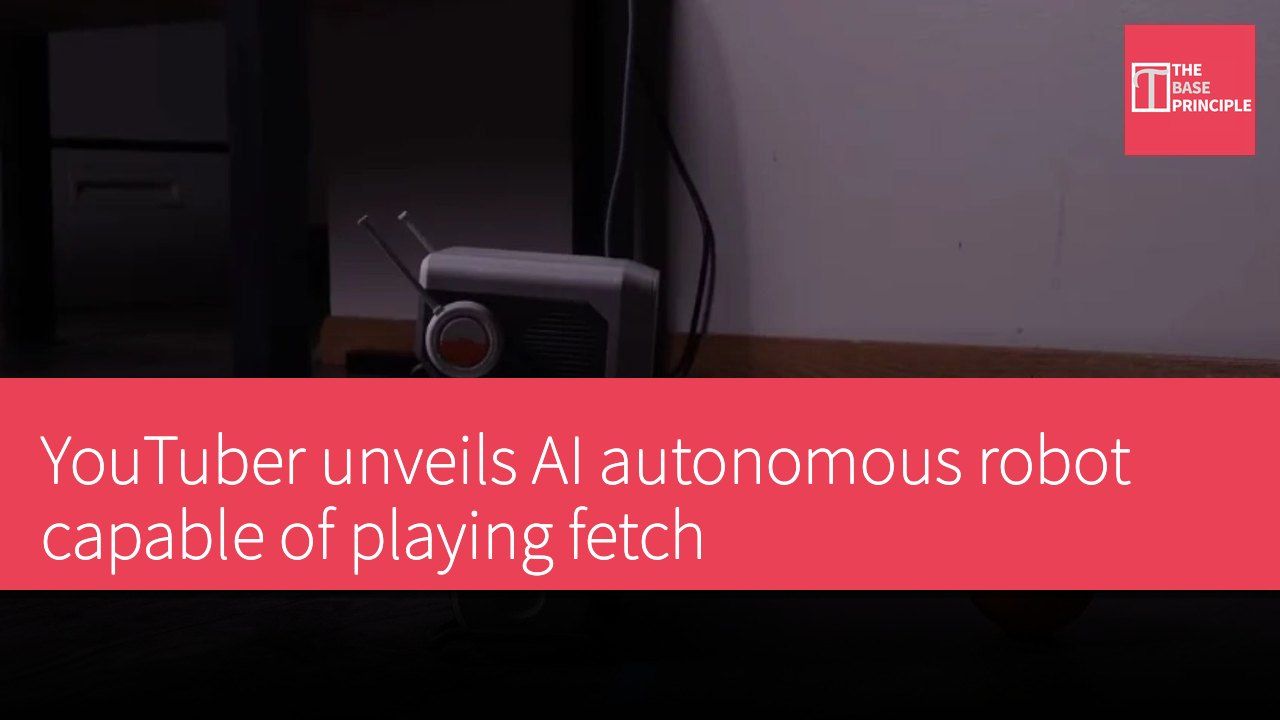
- Fetch is an AI robot capable of independently playing fetch.
- The robot uses an Arduino UNO Q board and computer vision technology for object recognition.
- The model is trained to recognize orange balls and human gestures, adjusting its actions based on the environment.
- The project has been released as open source for interested individuals to reference and use.
A YouTuber has revealed a new type of artificial intelligence autonomous robot that can independently complete an entire game of fetch. The robot, named Fetch, is manufactured by its namesake. It operates on an offline closed-loop hardware stack and is driven by bare-metal Arduino Uno logic. It can recognize orange balls and retrieve them without human input, returning them to its owner. The robot's 3D-printed parts are secured with just a few screws, and its design is user-friendly. When an orange ball enters its field of vision, the 3D-printed arm extends to grab the ball.
The motorized wheels equipped on the robot are responsible for movement. After retrieving the ball, Fetch scans the room to locate its owner. Simply raising a hand allows it to recognize and return the ball.
Technical Background of Fetch
This robot's ability to perform these tasks is due to its autonomous technology. Fetch can distinguish between objects and human gestures, enabled by artificial intelligence. The robot utilizes an Arduino UNO Q board equipped with a camera and computer vision. It has two processors, one responsible for analyzing images and detecting objects, while the other controls the robot's motors and servos. Sector 07 trained the computer vision using Edge Impulse. The compact device employs the YOLO-Pro model for object detection.
This model is specifically trained to recognize orange balls and human hands, capturing 200 images of various objects under different lighting conditions, floor textures, and backgrounds to assist the robot in identifying objects in diverse environments.
After training, the model creates a bounding box around detected objects. Based on the object's position, the robot rotates its wheels to move towards the orange ball or locate the owner's hand. It also calculates how far the robotic arm should be to either grab or release the ball.
Robot Features and Challenges
Fetch is equipped with many interesting features. The front of the robot has animated eyes, and its ears can move according to different situations, responding vocally using audio clips created by ElevenLabs. Some issues arose during the design and construction process. During testing, the robot sometimes struggled to detect the ball in bright light conditions and had difficulties releasing the ball. However, these problems were resolved by adjusting the motor speed, grasping time, and detection settings. The robot is now fully capable of independently playing fetch.
The manufacturer has released the project as open source, allowing interested individuals to access printing files, code, components needed to build the robot, and assembly instructions on the Arduino Project Hub.
Significance of Fetch Robot's Autonomous Technology
The design of the Fetch robot demonstrates the potential of artificial intelligence in autonomous operations, particularly in object recognition and human interaction. By utilizing advanced computer vision technology, Fetch can effectively operate in dynamic environments, which is significant for the future development of smart home devices. Additionally, the open-source approach fosters community engagement and innovation, enabling more individuals to learn and improve such technologies, thereby advancing the accessibility and progress of robotics.