
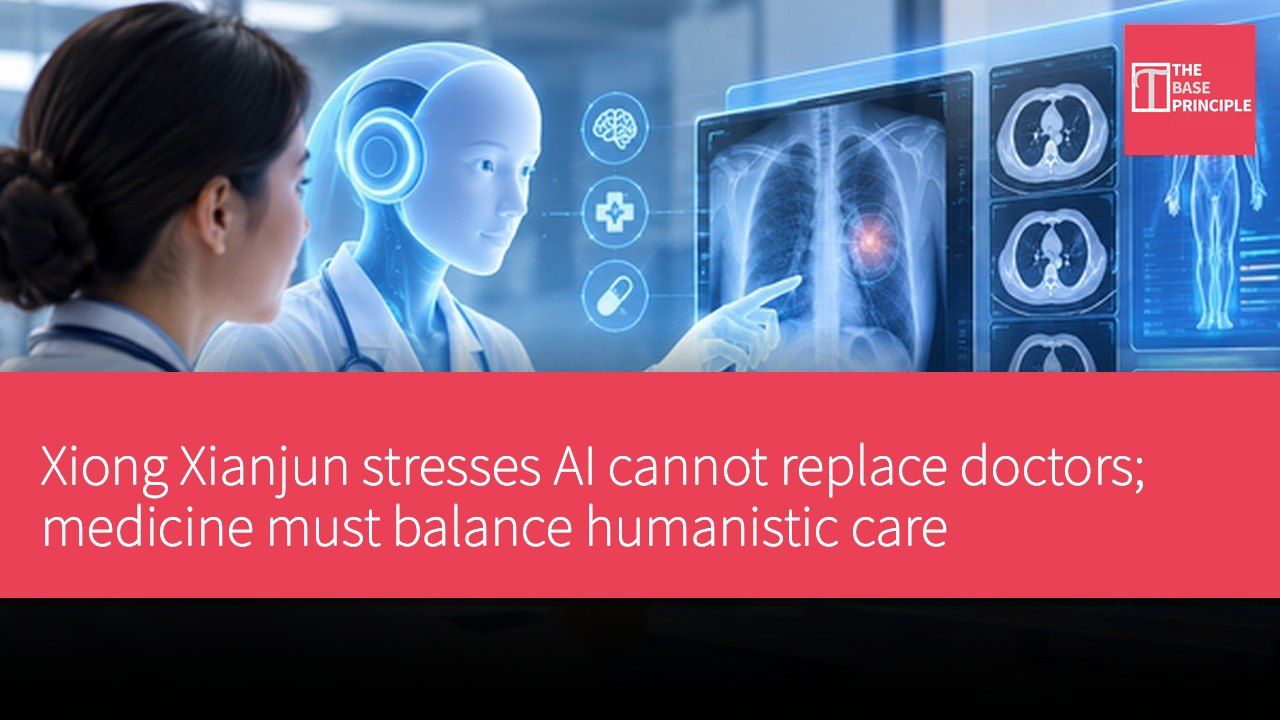
According to media reports, Xiong Xianjun, former director of the Pharmaceutical Service Management Department of the National Healthcare Security Administration and a lecturer at Peking Union Medical College, recently shared his views on the application of artificial intelligence (AI) in healthcare. He noted that AI technology could deliver major breakthroughs in new drug innovation and medical innovation, and serve as a valuable辅助 tool in clinical care, helping doctors with diagnosis and improving diagnostic accuracy. At the same time, however, he stressed that AI can never replace doctors.
Xiong Xianjun pointed out that medicine is not purely a technical matter; it also encompasses a large degree of humanistic care, something AI cannot address. From a scientific or healthcare management standpoint, the emergence of AI doctors is impossible, and therefore AI hospitals cannot exist. This assessment directly addresses the ongoing debate over whether AI can replace doctors amid the current AI healthcare boom.
AI's role in healthcare will keep growing
In recent years, AI has become increasingly embedded in areas such as medical image recognition, assisted diagnosis and drug development. A number of technology companies and medical institutions have rolled out AI-assisted diagnostic systems, and some products have reached or even surpassed the accuracy of human doctors in identifying specific conditions. In Xiong Xianjun's view, however, these capabilities still fall within the category of tools; AI's role is to assist doctors, not replace them. The empathy, communication skills, judgment about individual patient differences required during diagnosis, and the ethical considerations involved in treatment decisions are areas that technology struggles to cover.
As AI technology continues to渗透 medical settings, defining AI's boundaries and clarifying the collaborative relationship between doctors and AI will be issues the industry must keep confronting. At least in Xiong Xianjun's view, in medicine, AI can only ever be a tool.