
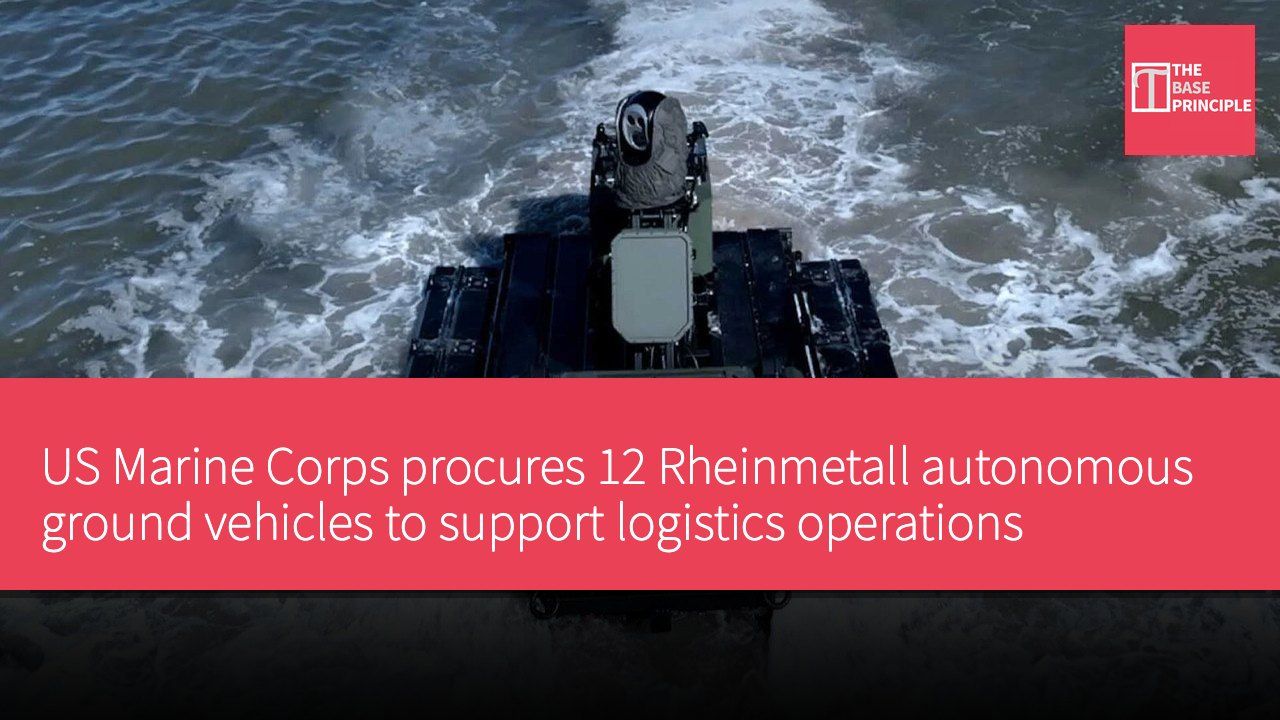
- The US Marine Corps will receive 12 autonomous ground vehicles to support logistics operations.
- These vehicles represent Rheinmetall's most advanced Mission Master configuration to date.
- The new configuration enhances vehicle capabilities, supporting the integration of multiple mission payloads.
- The Mission Master SP will improve the Marine Corps' expeditionary mobility and reduce personnel exposure risks.
Rheinmetall USA, the American division of German defense firm Rheinmetall, has secured a $7.28 million contract to supply autonomous ground vehicles to the US Marine Corps. The company will manufacture and deliver 12 Mission Master SP autonomous unmanned ground vehicles (A-UGVs), five sets of amphibious kits, related Marine Corps equipment, and other support items. These vehicles will help the service test autonomous logistics and expeditionary mobility technologies. The Defense Logistics Agency will execute the procurement, with defense equipment supplier ADS Inc. serving as the prime contractor.
The equipment will support the US Marine Corps Warfighting Laboratory's operational evaluation and capability development efforts.
Advancements in Autonomous Ground Vehicles
According to Rheinmetall, these vehicles represent the most advanced Mission Master configuration the company has developed to date. They incorporate the company's autonomous driving technology and the lessons learned during four years of collaboration with the Marine Corps. Matt Warnick, CEO of Rheinmetall USA, stated, "This award marks an important milestone in our long-term partnership with the US Marine Corps. For four years, we have worked closely with the Marine Corps to mature, refine, and advance autonomous ground capabilities."
The Mission Master SP brings together all these lessons learned and demonstrates Rheinmetall's commitment to delivering cutting-edge, reliable, and mission-ready autonomous systems.
Pietro Mazzei, President and CEO of Rheinmetall Canada, added, "This collaboration among Rheinmetall colleagues enables the US Marine Corps to deploy the Mission Master SP in its most advanced configuration to date." He noted, "The added amphibious capability marks an important milestone in ensuring our systems meet the evolving needs of littoral and expeditionary operations."
Enhancing Marine Corps Operational Capabilities
Each Mission Master SP is built around Rheinmetall's PATH autonomous system, enabling military vehicles to perform missions with less human involvement. The new configuration also includes enhanced vehicle capabilities and the ability to support the integration of different mission payloads. The five amphibious kits will allow the unmanned vehicles to operate in water and littoral environments. This capability is particularly relevant for the Marine Corps, as they must transport personnel, equipment, and supplies between vessels, beaches, and inland locations during expeditionary missions. These vehicles can support logistics operations without exposing Marine Corps personnel to every hazardous part of resupply actions.
Rheinmetall states that these systems can also improve mobility and extend the operational reach of manned and unmanned forces.
The contract covers more than just the delivery of vehicles and kits. Rheinmetall will also provide support equipment, project management, training, capability development, and engineering services. Rheinmetall USA will lead the effort, with Rheinmetall Canada acting as the original equipment manufacturer supporting the program. As the Marine Corps explores how autonomous systems can help disperse forces, these vehicles will undergo further experimentation. The program may also support Rheinmetall's long-term plans to expand autonomous vehicle manufacturing in the United States.
The company intends to establish an autonomy center focused on production, integration, and future vehicle development.
For the Marine Corps, the Mission Master SP provides a platform to examine how unmanned vehicles can carry supplies, improve expeditionary mobility, and limit force exposure in hazardous environments. These trials will help shape how the service deploys autonomous ground systems in future littoral and battlefield operations.
Impact of Autonomous Systems on the Marine Corps
The Mission Master SP autonomous ground transport vehicles provided by Rheinmetall mark a significant advancement in the Marine Corps' logistics support and operational capabilities. These vehicles can operate in multiple environments and reduce personnel exposure in hazardous actions, thereby enhancing operational efficiency. With the introduction of autonomous systems, the Marine Corps can more effectively address future battlefield challenges and explore how to leverage these technologies to increase its operational flexibility and safety.