
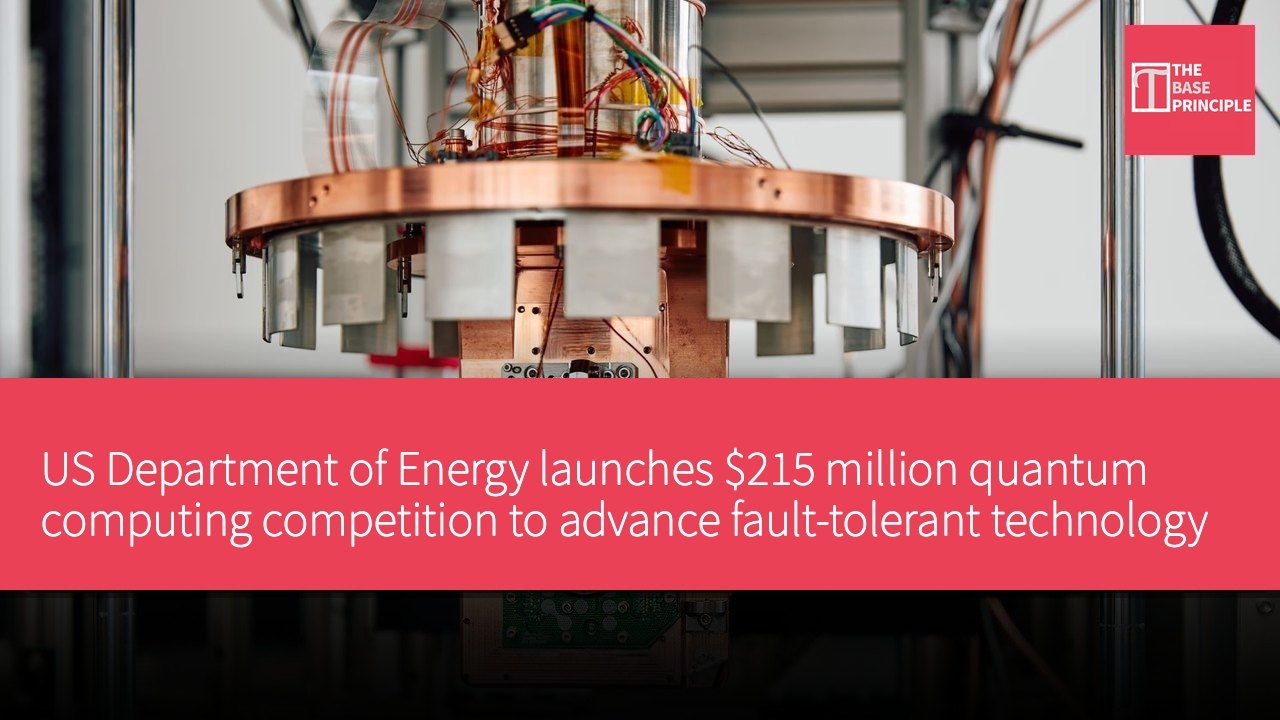
- The US Department of Energy has launched the Quantum Genesis competition with up to $215 million in funding.
- The competition aims to develop fault-tolerant quantum computers that can address problems beyond conventional computing.
- Participants must demonstrate systems with at least 100 logical qubits.
- The DOE is also establishing a $45 million quantum high-performance computing verification and testing laboratory.
The US Department of Energy (DOE) has launched a competition offering up to $215 million in funding to accelerate the development of fault-tolerant quantum computers capable of tackling scientific problems beyond the reach of conventional computing. The Quantum Genesis Q Competition is soliciting proposals from private-sector companies to build and deploy science-relevant quantum computers with at least 100 logical qubits capable of executing hundreds of millions of fault-tolerant operations. The agency announced the program on September 17.
Today's quantum computers, built from fragile physical qubits extremely sensitive to noise and imperfections, remain a long way from useful machines. Fault-tolerant quantum computing seeks to overcome this by encoding information across multiple physical qubits to create more reliable logical qubits, using error correction so that calculations can continue even when individual errors occur. This distinction is what makes the DOE's target significant. Rather than focusing on the number of physical qubits in a machine, the competition centers on systems capable of demonstrating useful computation with at least 100 logical qubits.
The importance of fault-tolerant quantum computing
According to the DOE, these systems should be capable of performing hundreds of millions of fault-tolerant operations and demonstrating applications in fields such as chemistry, materials science, physics and applied mathematics. The target builds on the DOE's broader Quantum Genesis initiative, announced in June, which aims to develop and deploy a science-relevant fault-tolerant quantum computing capability by 2028.
The competition's award structure
The competition will proceed in two phases. The first phase will provide fixed awards of up to $1.5 million per winner for early development milestones. The second phase introduces a larger performance-based award structure. A $100 million prize pool will be distributed among participants demonstrating a first-generation science-relevant quantum computer with at least 100 logical qubits. Two additional $50 million prize pools will be awarded for systems demonstrating 150 and 200 logical qubits, respectively. According to the agency, total program funding could reach $215 million, including $2.5 million in fiscal year 2026 funds, with future-year funding dependent on congressional appropriations.
Applications are open to private-sector companies, with a final submission deadline of October 19, 2026. The DOE will hold an informational webinar on September 25 for prospective applicants.
The department is also establishing a separate $45 million Quantum High-Performance Computing Verification and Testing Laboratory at its national laboratories. The test bed is intended to provide the tools needed for independent characterization and validation of the various layers of a quantum computing system, spanning physical hardware, quantum gates through logical architectures, algorithms and classical control systems. It said this infrastructure will support the Quantum Genesis competition while helping link quantum computing with the department's existing high-performance computing capabilities. The laboratory plan also includes $14 million in fiscal year 2026 funding.
The Quantum Genesis mission aims to combine advanced computing, artificial intelligence and quantum technologies to accelerate scientific discovery. The DOE's earlier Quantum Genesis announcement described the ultimate goal of integrating quantum systems with the department's existing supercomputers and future post-exascale infrastructure. The current challenge, however, is to demonstrate a fault-tolerant system that can move beyond laboratory benchmarks and perform large volumes of reliable operations on the kinds of problems that matter to scientists. The Quantum Genesis competition is designed to test that capability.
Future challenges for quantum computing technology
The development of quantum computing faces multiple challenges, with fault tolerance being a key one. Today's qubits are sensitive to environmental noise, limiting their practical applications. The US Department of Energy's competition not only provides funding support but also encourages private-sector participation, which will accelerate progress in quantum computing technology. By establishing the Quantum High-Performance Computing Verification and Testing Laboratory, the DOE hopes to improve the reliability of quantum computing and integrate it with existing computational capabilities, something it considers essential for future scientific research.