
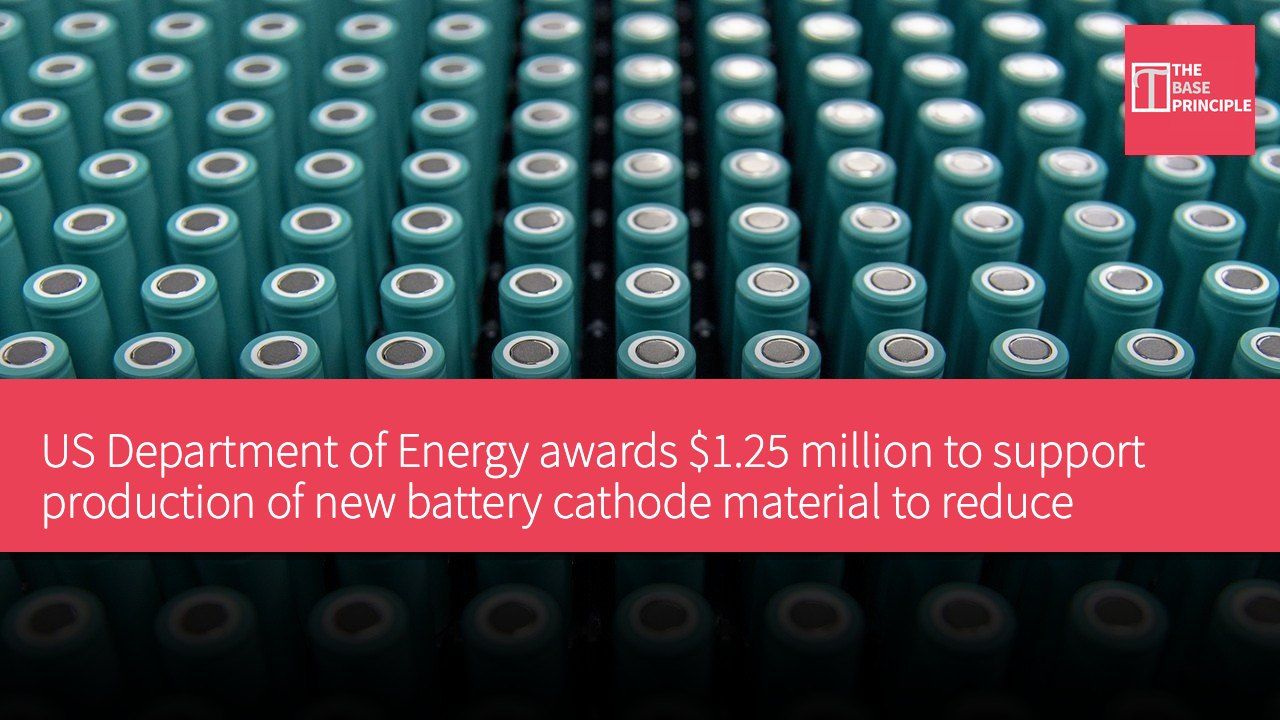
- COnovate receives $1.25 million contract to scale up eCOphite anode material production.
- eCOphite reduces dependence on mined graphite and is produced using renewable feedstocks.
- The new material improves state-of-charge estimation in lithium iron phosphate batteries, enhancing system visibility.
- The project will strengthen the US battery materials supply chain and support domestic production.
A battery materials company based in Wisconsin has received a $1.25 million US Department of Energy contract to scale up production of an anode material designed to reduce reliance on mined graphite and improve the charge-tracking capabilities of lithium-ion battery systems. COnovate will use the 24-month development contract to advance commercial-scale production of its eCOphite anode material. The award was provided through the US Department of Energy's Critical Minerals and Materials Acceleration Program. Unlike conventional graphite anodes, eCOphite is positioned as a graphite substitute that can be added to existing anode materials.
The company said the material can be produced domestically using renewable feedstocks and does not require mining.
Advantages of the eCOphite Anode Material
The technology targets a specific problem in lithium iron phosphate (LFP) batteries. These batteries have a relatively flat voltage curve across their usable range, making it difficult for battery management systems to determine the remaining charge. COnovate said the new graphite substitute, eCOphite, can introduce a stable voltage reference point into the battery. This additional signal can enable existing battery management systems to more accurately estimate state of charge during battery operation. More accurate state-of-charge information helps battery operators monitor systems and manage battery packs over longer operating periods.
The company said this can improve system visibility while reducing downtime, warranty risks, and costs associated with maintenance and battery augmentation. The $1.25 million award focuses on scaling and qualification rather than simply developing the material in the laboratory. COnovate said the work will help qualify eCOphite at commercial scale and demonstrate its compatibility with existing battery manufacturing infrastructure. COnovate president and CEO Craig Rigby said: "This award is an important step toward qualifying eCOphite material at commercial scale and strengthening the domestic battery materials supply chain."
Strengthening the US Battery Supply Chain
The company's approach is designed to make adoption easier, because manufacturers do not have to retool their existing production infrastructure to use the material. Battery control becomes more precise. The technology is based on graphene oxide, which COnovate describes as the foundation of its eCOphite anode material. The company said it holds patents covering product development and commercialization in the lithium-ion battery industry. The domestic-production angle is also central to the US Department of Energy-backed project. Graphite is a critical battery material, and securing alternative sources and production methods is part of efforts to strengthen the US battery supply chain.
Under the contract, COnovate will continue to expand production in the United States while advancing commercial qualification of the material. The project is supported by the US Department of Energy's Office of Critical Minerals and Energy Innovation, under award number DE-EE0011730. For LFP batteries, the company is targeting an issue that is less visible than energy density or charging speed but equally important to operating battery systems: knowing precisely how much charge remains. By adding a measurable voltage reference, eCOphite is intended to give battery management systems another signal to work with.
Impact of the New Battery Material on the Market
COnovate's eCOphite anode material not only reduces dependence on graphite but also improves charge management in lithium iron phosphate batteries. As battery technology evolves, accurate state-of-charge information is essential to battery safety and efficiency. Commercializing this technology will not only help enhance battery performance but also promote US self-sufficiency in battery materials production, thereby reducing reliance on external supply chains—a development critical to the future of electric vehicles and renewable energy systems.