
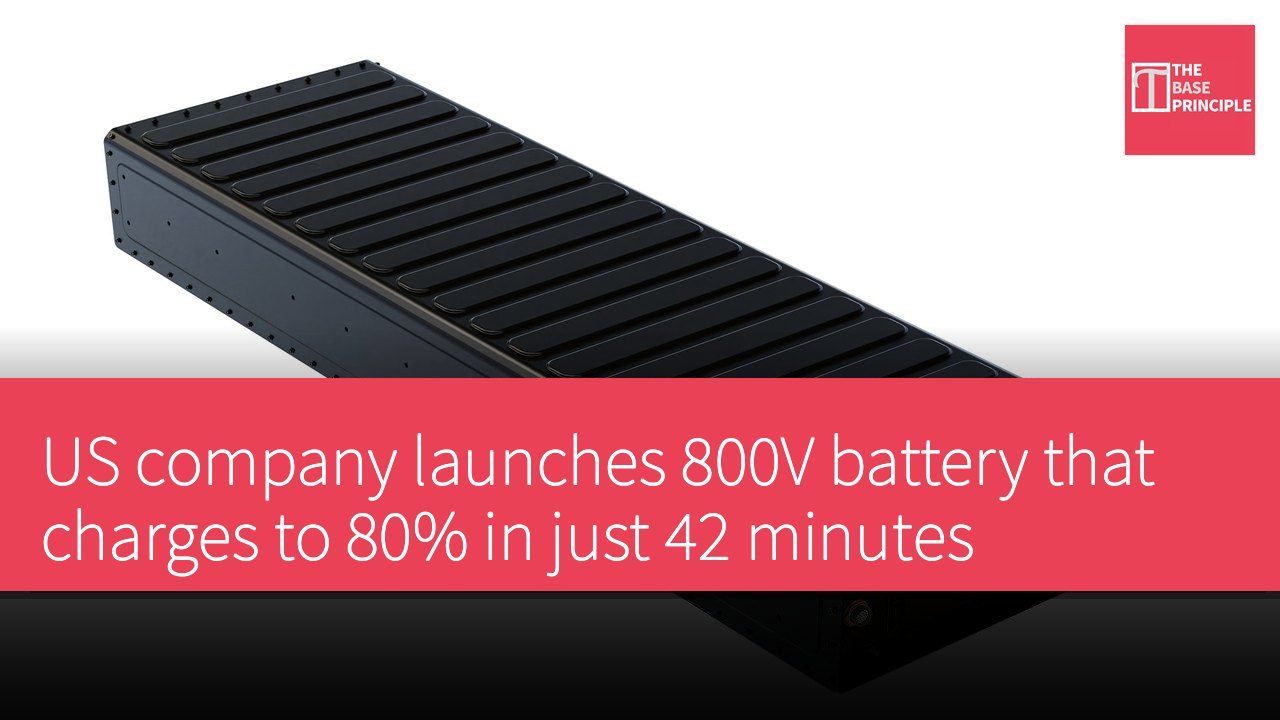
- The Aventor battery can charge to 80% in 42 minutes.
- The battery is designed for electric trucks and heavy equipment.
- Aventor comes in two versions to meet different needs.
- The battery has multiple safety features and a service life of up to 10 years.
A US company recently launched a rugged 800-volt (V) battery with a capacity of 113 kilowatt-hours (kWh) that can charge to 80% in under 42 minutes. Called Aventor, the battery was designed by Michigan-based American Battery Solutions (ABS), which focuses on lithium-ion (Li-ion) batteries for commercial and industrial vehicles. ABS first showcased the battery on October 13 at the North American Battery Show in Detroit.
Aventor Battery Design and Features
The battery is designed for electric trucks, industrial machinery and other heavy-duty equipment, delivering up to 358 kilowatts (kW) of peak power and charging to 80% in 42 minutes. ABS founder and CEO Subhash Dhar discussed the battery's potential. He said, "Aventor represents the culmination of years of work at ABS and an exciting step forward in what we can offer heavy-duty original equipment manufacturer customers."
Both versions of the Aventor battery operate at 800 volts (V). It can store up to 300 watt-hours per liter (Wh/L) and 200 watt-hours per kilogram (Wh/kg). ABS developed the two versions to meet the different needs of commercial and industrial vehicles. The first, called the chassis-integrated pack, is designed to be mounted in gaps in a vehicle frame or other limited spaces, such as roof mounting. The second version, the ultra-rugged cube pack, has a reinforced enclosure and can withstand higher levels of vibration, impact and heavy use.
According to ABS, the latter can also be installed in different locations, giving automakers more flexibility when designing electric vehicles. Both versions rely on the same basic technology, meaning manufacturers can use them in different vehicles and equipment. In addition, the battery pack is equipped with a wireless battery management system that can monitor the voltage and temperature of individual battery modules, and features internal data storage, cybersecurity protection and over-the-air software updates.
Safety and Durability
Jeffrey Donaldson, ABS vice president of engineering, said: "Safety, reliability and intelligence are at the core of the design." Additional safety features include gas detection, electrical isolation monitoring, and technology designed to prevent battery failures from spreading between battery cells. The battery has a service life of up to 10 years, even under heavy use and harsh conditions. It has IP67 and IP69K protection ratings, meaning it is dustproof and can withstand brief immersion in water and high-pressure water jets. At the same time, its fast-charging capability can reduce downtime for vehicles and equipment that operate for long periods.
Dhar noted: "This achievement is a highly capable platform that provides customers with more energy, longer runtime and greater value, and offers an excellent foundation for electrifying their entire product lines."
The company plans to deliver the first customer samples in 2027, with commercial production scheduled to begin in the first quarter of 2028. Initial production capacity is set to reach 6,000 battery packs per year, equivalent to about 0.7 gigawatt-hours (GWh). Dhar concluded in a press release: "We are committed to developing a platform that leads in energy density, with no compromise on the safety, durability or performance these applications require."
Item Specification Battery capacity 113 kWh Charging time 42 minutes to 80% Peak power 358 kW Service life 10 years Protection rating IP67 and IP69K
Market Potential and Impact of the Aventor Battery
The launch of the Aventor battery marks another step forward in electric commercial vehicle technology, especially in the heavy-duty equipment sector. Its fast-charging capability and high power output will appeal to many customers that need high performance, particularly in logistics and industrial machinery. In addition, Aventor's design takes safety and durability into account, which is especially important for heavy-duty equipment facing harsh environments. As market demand for electric vehicles increases, the success of this battery could promote broader electrification and change how traditional heavy-duty vehicles operate.