
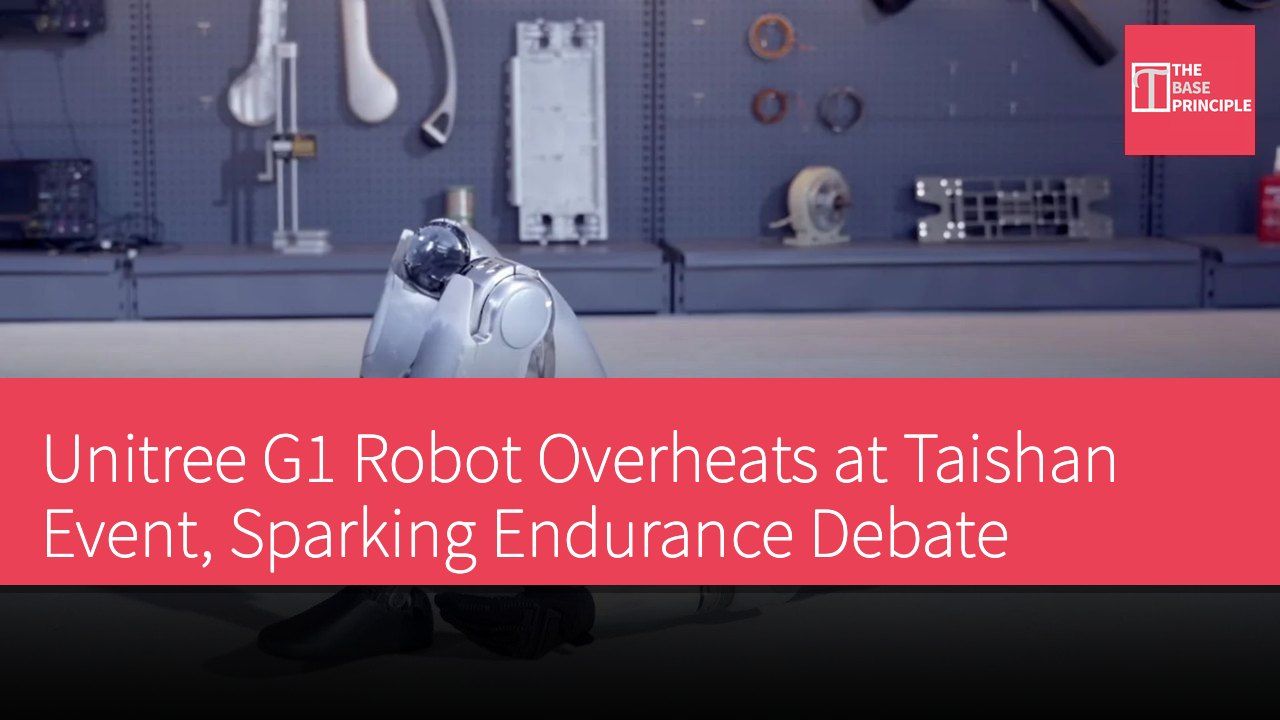
- The Unitree G1 robot was withdrawn from the Taishan event due to overheating, raising discussions about endurance issues.
- The robot faced technical challenges during the climbing process, highlighting the difficulties of prolonged operation.
- Experts emphasize the importance of thermal management for robots operating under harsh conditions.
- The incident underscores the distinction between sustained movement and short-term demonstrations for humanoid robots.
During a robotics competition in China, a Unitree G1 humanoid robot was forced to be carried off Taishan on a stretcher due to overheating. This incident occurred at the inaugural CMG World Robot Taishan Competition, held in Shandong Province, China. Unitree later stated that the robot may have participated in the competition without proper adjustments, sparking online discussions about humanoid robot endurance and their operational capabilities in harsh real-world environments. Recently, the company demonstrated its G1 humanoid robot autonomously sparring with a human using the UnifoLM-X2-1.0 artificial intelligence model, showcasing advancements in real-time robotic control technology.
Challenges at the Taishan Event
Endurance Test The humanoid robot faced endurance challenges during the Taishan competition on November 2, overheating during the climbing process, which highlighted the technical difficulties of operating bipedal robots over prolonged periods on rugged terrain. The G1 development version was also used during the Chinese New Year Gala, but it overheated during the competition, requiring the operator to withdraw it. Event staff subsequently placed the humanoid robot on a stretcher and carried it down the mountain. The competition posed stringent tests on the robot's mobility, balance, and thermal management systems. The course was approximately 3.9 kilometers (2.4 miles) long, from Hongmen to Zhongtian Gate, featuring over 3,100 steps and an elevation change of about 600 meters (1,970 feet).
Unlike demonstrations on flat indoor surfaces, this route required the humanoid robot to navigate uneven terrain and repeatedly climb stairs while maintaining balance.
According to experts, such conditions place considerable stress on the mechanical and electronic systems of humanoid robots. Walking involves continuous coordination between joints, actuators, sensors, and onboard control systems. Climbing thousands of steps further increases the demands, requiring constant adjustments to leg movements, body posture, and balance at varying heights. Thermal management is also a critical consideration during prolonged operation. Motors, actuators, computing hardware, and power electronics generate heat when performing demanding tasks. If the heat generated exceeds the system's cooling capacity, internal temperatures may rise, affecting operational reliability.
As a result, this incident raised questions about how humanoid robots manage heat during prolonged physical activity, rather than during short demonstrations.
Key Aspects of Endurance and Thermal Management
G1 Under Review Unitree suggested that the G1 development version may not have been adjusted for the competition. The company did not provide further technical details regarding the overheating incident and did not identify the specific components that caused the temperature increase. The robot's withdrawal also sparked discussions about the distinction between demonstrating mobility and sustaining movement under harsh conditions. While humanoid robots may successfully walk, run, or perform complex actions, maintaining these capabilities during prolonged operation requires reliable coordination between their mechanical hardware, control software, and thermal management systems. Analysts noted that the Taishan competition exposed these challenges in real-world operations.
Thousands of steps, continuous movement, and significant elevation changes provided a test environment distinct from the controlled conditions typically used for laboratory demonstrations, while also highlighting the need to consider more than just the ability to complete individual actions when evaluating robotic capabilities.
This incident does not necessarily indicate a fundamental limitation of the G1 platform, especially considering that Unitree suggested the development model may not have been properly adjusted for the event. However, it illustrates why endurance, thermal stability, and adaptability are critical performance indicators for humanoid robots.
The Importance of Endurance Testing for Humanoid Robots
The overheating incident involving the Unitree G1 robot at the Taishan event highlights the endurance and thermal management challenges faced by humanoid robots during prolonged operation. Such competitions require robots to move continuously over uneven terrain, placing immense pressure on their mechanical systems. While the robot demonstrated its capabilities during short demonstrations, endurance and thermal stability emerged as key performance indicators in practical operations. This incident prompts the industry to rethink the application potential and technological development direction of humanoid robots in complex environments.