
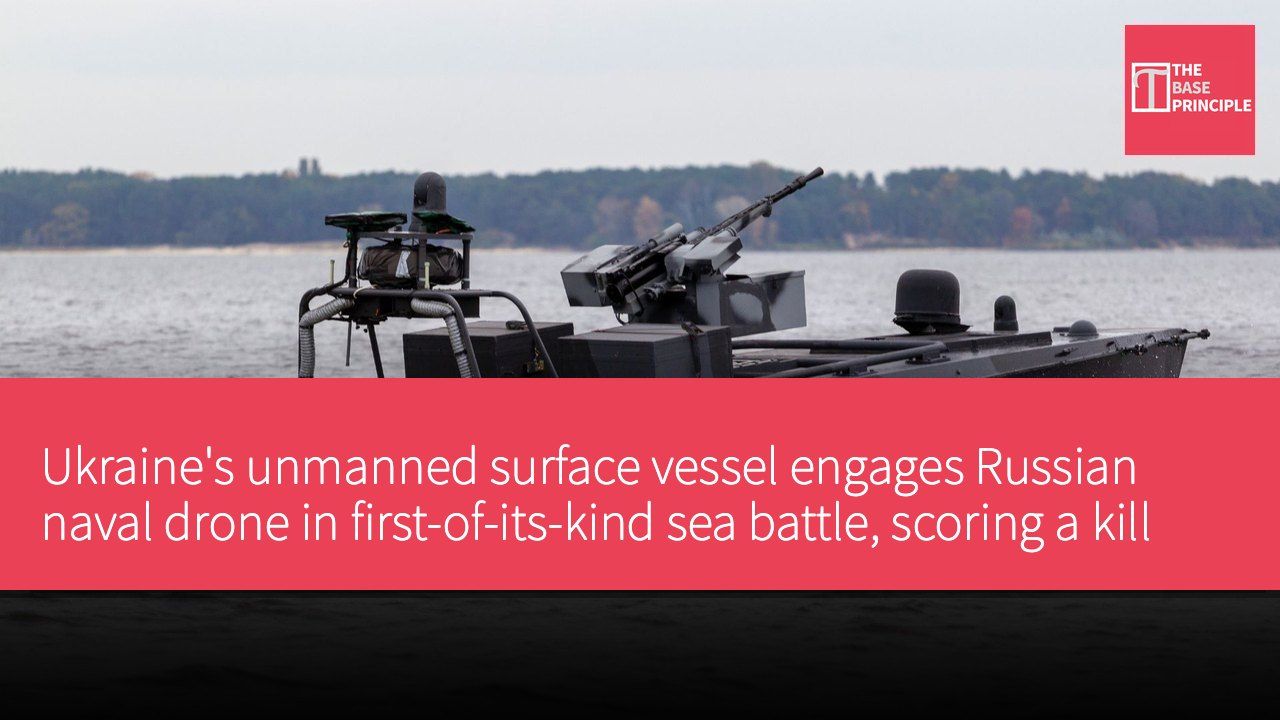
- A Ukrainian unmanned surface vessel successfully destroyed a Russian drone, marking the first naval engagement of its kind.
- The operation was carried out jointly by Ukraine's military intelligence agency HUR and the Navy.
- The Russian vessel, the Orcan, is designed for explosive strikes and offers high speed and maneuverability.
- The tactical significance of naval drones is significant and may drive both sides to improve detection and defense methods.
A Ukrainian unmanned surface vessel (USV) destroyed a Russian naval drone in the Black Sea on September 12, in what Ukraine's Navy has described as the first engagement between uncrewed boats. The operation was a joint effort by Ukraine's military intelligence agency HUR, which had tracked the Russian vessel before the Ukrainian drone attacked. According to the Ukrainian Navy, its Sargan-3000 USV, fitted with a 12.7 mm Protector remote-controlled weapon station, successfully destroyed the Russian drone. The development marks a new phase in the Russia-Ukraine war, with both sides increasingly deploying naval drones to strike ships, ports and maritime infrastructure.
The Ukrainian Navy noted: "This is the first engagement between uncrewed naval vessels."
First engagement between uncrewed vessels
Ukraine released footage of the operation on its official Telegram account, showing its drone engaging the Russian vessel at sea. The destroyed Russian craft has been identified as an improved Orcan, referred to as Zefir or Zephyr by some Russian sources. The small USV is designed for explosive attacks and is similar in size and design to Ukraine's earlier Magura V3 and V5 naval drones. The Orcan is fitted with an internal motor connected to steerable water jets, giving it high speed and maneuverability.
The vessel is fully uncrewed. Russia has increasingly used such USVs to strike Ukrainian ports and naval targets, with multiple attacks near Odesa, while Ukrainian forces have intercepted other suspected maritime drone operations.
Combat capabilities of Ukraine's USV
The Ukrainian Navy's Sargan-3000, also known as SeaWolf, is a multipurpose USV manufactured by Nordex that completed combat testing in April 2026. According to the Navy, the platform is "highly maneuverable" and capable of strike missions. In the September 12 operation, the Sargan was equipped with a Protector remote-controlled weapon station and a 12.7 mm machine gun. This configuration allows the Ukrainian drone to engage Russian vessels at range, avoiding direct ramming. Other variants of the Sargan can be fitted with air-defense equipment or electronic warfare systems, enabling the platform to perform a variety of combat roles.
The exact location of the engagement has not been disclosed, with the northwestern Black Sea considered the most likely area given increased Ukrainian and Russian naval activity there. Russia has been operating naval drones from bases in northwestern Crimea, such as Chornomors'ke and the Donuzlav Lake area. Satellite imagery shows new naval-drone facilities in occupied Crimea. Russian USVs can operate in coordination with long-range aerial drones such as the Geran system, which provide surveillance, communications and long-distance control. Ukraine is also expanding its naval-drone operations in the Black Sea and Sea of Azov.
Navy reports indicate strikes have been launched against multiple Russian vessels and maritime targets, including 105 vessels hit in operations in the Sea of Azov.
Tactical significance of naval drones
Although the destruction of a single USV may have limited impact on overall numbers, given that these systems are designed to be expendable, its tactical significance should not be underestimated. Naval drones are now being used to hunt other naval drones, potentially forcing both sides to develop new methods for detecting, defending against and engaging uncrewed vessels at sea.
Item Specification USV model Sargan-3000 Weapon system 12.7 mm Protector remote-controlled weapon station Combat testing completed April 2026
Strategic significance of uncrewed-vessel engagements
The successful destruction of a Russian drone by a Ukrainian USV highlights the importance of uncrewed vessels in modern naval warfare. As both sides increasingly use drones for strikes, this new form of combat could reshape the character of operations at sea. The maneuverability and efficiency of uncrewed vessels make them a significant component of naval power, and may prompt both sides to innovate tactically and technically to meet the new challenges. With growing deployment of maritime drones, future naval battles are likely to rely even more heavily on the coordinated operations of these uncrewed systems.