
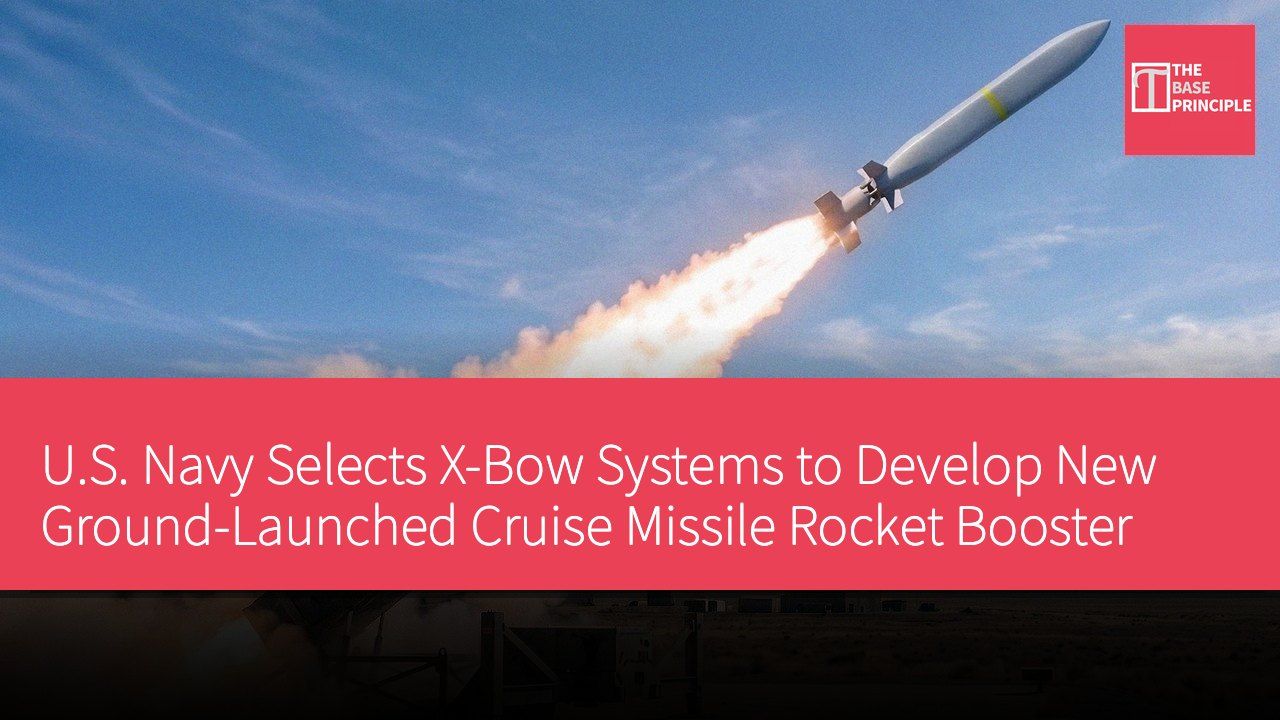
- X-Bow Systems has been selected to develop the U.S. Navy's new rocket booster.
- The CHAOS cruise missile can be launched from the ground without reliance on fighter jets or naval vessels.
- The missile system is designed to target land-based and mobile maritime targets.
- X-Bow leverages additive manufacturing technology to increase production and reduce costs.
U.S. defense manufacturer X-Bow Systems has been selected to develop and produce the rocket booster for the U.S. Navy's new ground-launched cruise missile program. The initiative aims to provide U.S. allies with a more cost-effective method to strike land and maritime targets. X-Bow Systems announced on October 27 that the primary contractor CoAspire has chosen it to supply solid rocket boosters for the Navy's CHAOS missile program. Reports indicate that CoAspire will base the CHAOS missile on its larger RAACM-ER design, claiming an unverified potential range of up to 1,000 nautical miles (approximately 1,150 miles).
The value of X-Bow's subcontract, the number of boosters involved, and the delivery timeline have not yet been disclosed. This selection is part of a broader Navy effort to develop scalable, exportable precision strike weapons for allies, thereby reducing their dependence on expensive legacy missile stockpiles.
Launch Method for the CHAOS Cruise Missile
The ground launch method for the CHAOS cruise missile is designed to enable forces to launch missiles from a launcher without relying on fighter jets or naval vessels. X-Bow will build solid rocket engines to help accelerate the weapon from the launcher and provide the necessary initial thrust. Once the booster completes its mission, the cruise missile's own propulsion system can continue to the target. The weapon is based on CoAspire's Rapid Adaptable Affordable Cruise Missile Extended Range (RAACM-ER). In a July announcement, CoAspire stated that the Navy selected the ground launch variant and is developing it under a $70 million prototype agreement.
The missile system is designed to target land-based and mobile maritime targets. The Navy indicated in an August announcement that initial long-range ground launch capabilities are expected to enter production by 2028. The program may subsequently expand to ground launch platforms, and an air launch configuration could also emerge depending on military needs.
Navy's Precision Strike Weapons Program
The Navy's Precision Strike Weapons Program Office is developing CHAOS under PMX-201, incorporating affordability, scalability, and exportability into its requirements. The initiative aims to enable allies to acquire modern precision strike capabilities without fully relying on expensive existing weapons. The Navy is also leveraging agreements designed to accelerate prototype development, encouraging competition among emerging defense companies. CoAspire is one of two companies selected for the initial CHAOS program, the other being Zone 5 Technologies.
The Navy stated that its approach aims to consider the needs of partner nations from the outset, potentially allowing for local assembly and industrial participation. No announcements have yet been made regarding the system's allied customers or final procurement quantities.
X-Bow has expanded its rocket engine business, and the selection for CHAOS adds to what is expected to be a busy year for X-Bow in 2026. The company stated that it has secured seven new propulsion programs with the Navy, Army, and Missile Defense Agency. X-Bow utilizes additive manufacturing technology to produce solid rocket engines, claiming that its approach helps increase production and reduce manufacturing costs. According to its announcement, the company recently completed a significant production contract involving over 2,100 rocket engines. X-Bow has also been selected to supply booster engines for the Army's low-cost container munitions program through contractor Leidos, another effort focused on developing cost-effective cruise missile capabilities for mass production.
X-Bow Systems' Role in the Defense Market
The selection of X-Bow Systems highlights the U.S. Navy's commitment to enhancing the defense capabilities of its allies, particularly in the area of precision strike weapons. The design of the CHAOS cruise missile not only provides flexible launch options but also reduces reliance on conventional weapons, which is crucial for improving military efficiency. Furthermore, X-Bow's additive manufacturing technology can lower production costs, further promoting defense innovation, which will have far-reaching implications for future military procurement and collaboration.