
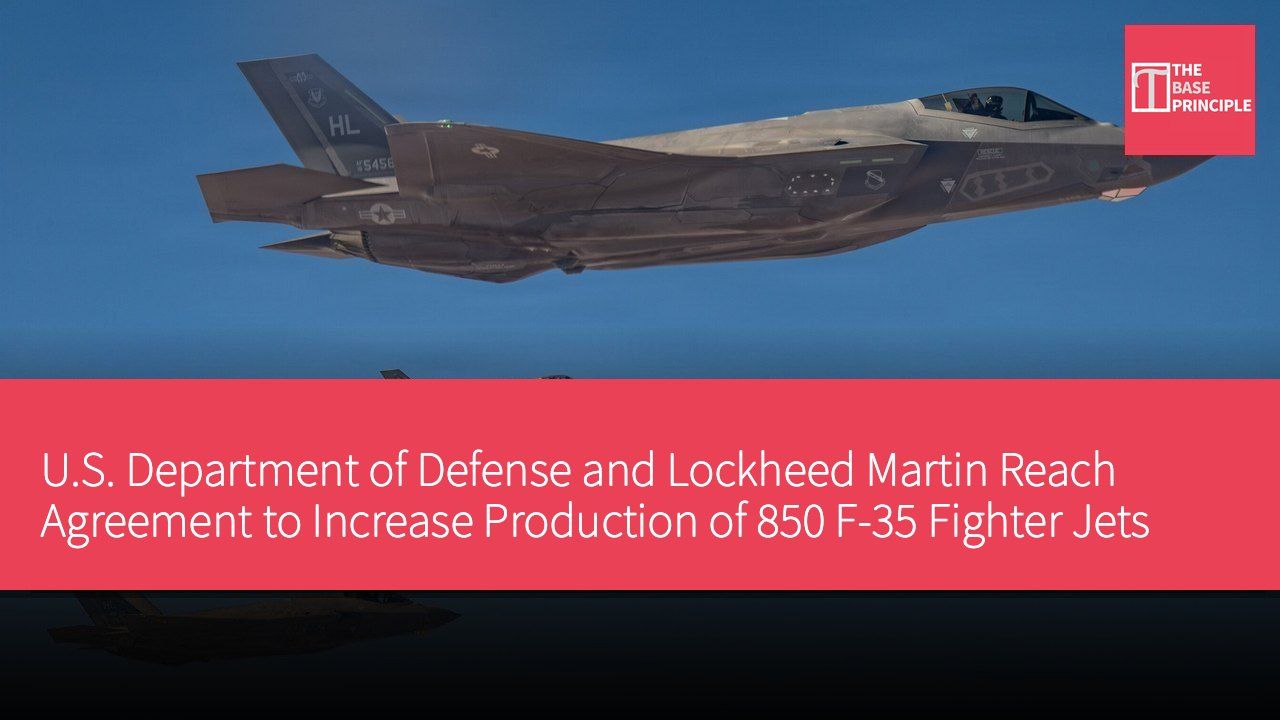
- The U.S. Department of Defense and Lockheed Martin have reached an agreement to increase production of 850 F-35 jets.
- The agreement will support 317,000 U.S. jobs and generate significant economic activity.
- The agreement allows suppliers to make upfront investments to enhance production capacity and efficiency.
- Long-term contracts will reduce production delays and maintenance turnaround times, enhancing supply chain resilience.
The U.S. Department of Defense has reached a framework agreement with Lockheed Martin covering the production and maintenance of the F-35 Lightning II fighter jet, planning to produce at least 850 aircraft for the U.S. military over the next ten years. The agreement also includes initial spare parts, ten years of upgrade kits, and maintenance services, as well as international customer orders for production batches 21 to 30. Lockheed Martin stated that the annual production rate will be maintained at 156 aircraft. The F-35 is a fifth-generation stealth fighter equipped with advanced sensors and communication systems that enable pilots to collect and share battlefield information.
Currently, over 1,375 F-35s are in operation worldwide. Under this ten-year proposal, Lockheed Martin will invest at least $7 billion (approximately HK$54.6 billion) of its own funds to support the F-35 program. However, the deal still requires authorization and funding from Congress.
Background and Purpose of the Agreement
The agreement comes at a time when the Trump administration is pushing for reforms in U.S. defense procurement, focusing on accelerating weapon production, long-term contracts, and increasing private investment in manufacturing capabilities. Last year, President Donald Trump signed an executive order aimed at speeding up military procurement and reducing bureaucratic delays. The Pentagon subsequently pursued multi-year agreements with defense contractors to expand production of key weapons, including the Patriot and THAAD missile defense systems. "We have fundamentally changed the way the U.S. defense industrial base is stabilized for rapid and large-scale production," said Deputy Secretary of Defense Michael P. Duffy.
"This agreement with Lockheed Martin proves that point."
Enhancing Supply Chain and Production Efficiency
Lockheed Martin Chairman, President, and CEO Jim Taiclet stated that the long-term framework will allow the company to make upfront investments to expand production capacity, improve efficiency, and strengthen the supply chain. "With greater certainty brought by the U.S. government's approach to F-35 production and maintenance, we can make the necessary upfront investments to expand capacity, improve efficiency, and build a more resilient supply chain," Taiclet said.
According to Lockheed Martin, the framework is expected to save U.S. taxpayers billions of dollars over the F-35's lifecycle, achieved through bulk purchases, long-term pricing agreements, and supplier discounts. By combining aircraft production with the purchase of spare parts and upgrade kits, the company aims to reduce procurement costs and improve the availability of replacement components. "Our new multi-year framework provides stability for suppliers to plan for the future and invest with confidence, thereby improving the readiness of the F-35 fleet," said OJ Sanchez, President of Lockheed Martin Aeronautics.
Long-term contracts will also allow suppliers to purchase raw materials and critical components in larger quantities, which could reduce production delays and maintenance turnaround times. During Thursday's earnings call, Lockheed Martin CEO Jim Taiclet stated that the agreement will enable suppliers to invest in hiring and software while reducing delays or substandard deliveries to the company's F-35 production facility in Fort Worth, Texas. He noted that manufacturers meeting performance targets could earn higher profits under a fixed-price escalation model. The agreement will also allow for the sharing of components between aircraft production and maintenance, helping to achieve better pricing and supporting investments in testing capabilities.
The company stated that the plan will support 317,000 U.S. jobs and generate approximately $79 billion (about HK$616.2 billion) in annual economic activity over the next decade.
Impact of the Agreement on the U.S. Defense Industry
The agreement between the U.S. Department of Defense and Lockheed Martin marks a significant shift in U.S. weapon production, particularly in the context of accelerating production and improving efficiency. This agreement not only enhances the production capacity of the F-35 but also promotes the U.S. economy and supports a large number of jobs. Through long-term contracts, suppliers can plan and invest more effectively, thereby reducing production costs and improving product quality. Such strategies are crucial for enhancing the U.S.'s position in global military competition.