
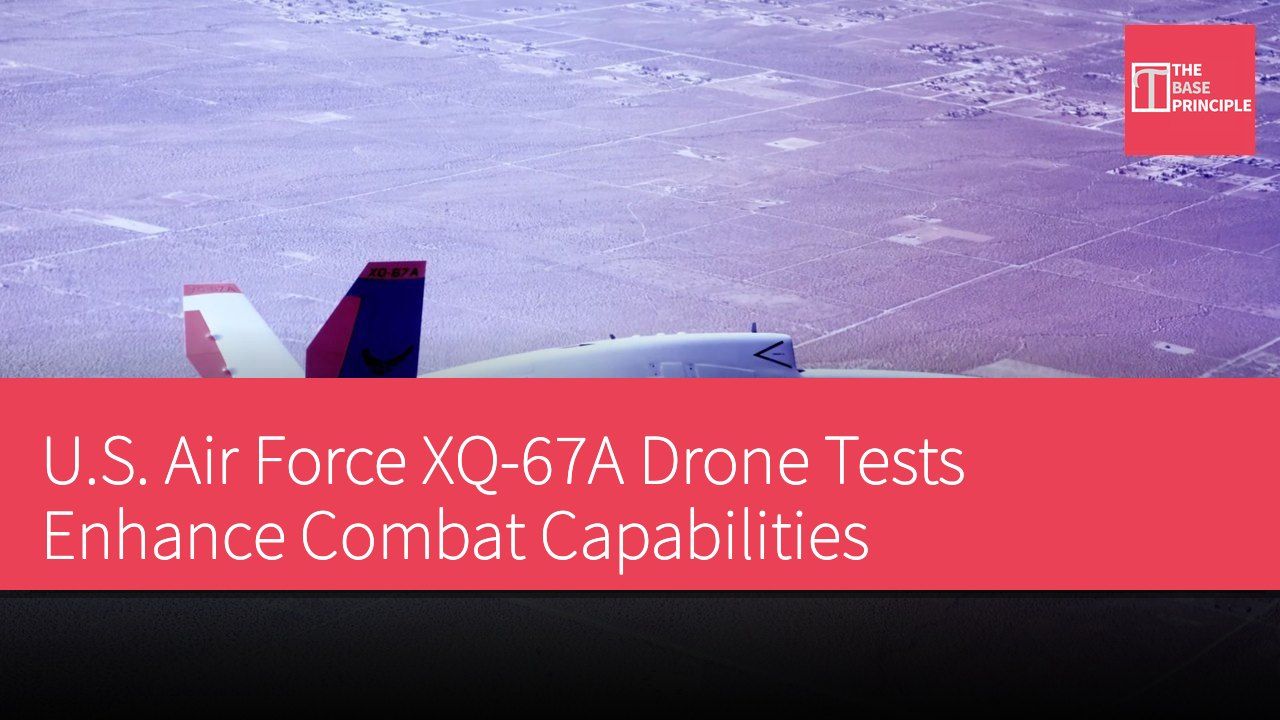
- The XQ-67A drone showcased its integrated mission system and beyond-line-of-sight data link capabilities.
- The drone is designed to support manned fighter aircraft, enhancing operational range and situational awareness.
- The test evaluated how multiple systems work together to enhance autonomous flight capabilities.
- The development of the XQ-67A is part of the Air Force's push for autonomous collaborative platforms.
The U.S. Air Force's XQ-67A drone demonstrated its integrated mission system and beyond-line-of-sight data link capabilities during a test flight. This demonstration aimed to enhance the drone's support for manned fighter aircraft by extending its operational range, improving situational awareness, and reducing pilot risk. The project combines efforts from the Air Force Research Laboratory (AFRL) and the Air Combat Command (ACC) to accelerate the development and delivery of unmanned operational capabilities. Colonel Matthew Kasper, the Deputy Technical Executive Officer of the Department of the Air Force (DAF), stated, "By combining AFRL's rapid prototyping with ACC's operational test units, the Air Force has shortened the time from concept to operational capability."
The XQ-67A Autonomous Collaborative Platform (ACP) completed its flight in the Nevada Test and Training Range, showcasing the integration of advanced mission systems and beyond-line-of-sight communication technologies. The test focused on assisting the drone in operating on a distributed battlefield and supporting manned fighter formations in harsh combat environments. During the flight, the XQ-67A demonstrated the integration of several key mission systems, including advanced sensors, mission computers, and power and thermal management hardware. These components are designed to withstand demanding operational environments, providing the technical support necessary for the drone to conduct autonomous missions.
Testing the Autonomous Collaborative Platform for Drones
Sensors collect information about the environment surrounding the aircraft, while the mission computer processes data and supports mission-related functions. Integrating these systems into a common platform is crucial for developing drones capable of collecting, processing, and transmitting information during operations. Additionally, the flight tested the power and thermal management hardware, which helps manage the power and thermal loads generated by onboard equipment. These functions are particularly important when multiple advanced systems operate together, as they must remain within operational limits to support reliable performance.
This demonstration not only assessed individual components but also focused on integrating these technologies within the XQ-67A. The test provided an opportunity to evaluate how these systems work together as part of an autonomous aircraft architecture. Another key element of the demonstration was the integration of the beyond-line-of-sight (BLOS) data link. These communication systems enable information to be transmitted beyond the direct line of sight between communication platforms, supporting operations over greater distances. The test combined the data link with live, virtual, and constructive (LVC) simulations, integrating real-world activities, simulated environments, and computer-generated elements to assess how systems and operational units work together.
Strengthening Command and Control Systems
According to AFRL, this demonstration showed how unmanned platforms can be managed using resilient, layered command and control in a distributed battlefield. These capabilities are designed to assist military forces in coordinating operations across geographically dispersed areas while maintaining access to combat-relevant information. The flight also evaluated an autonomous architecture consistent with autonomy and agile mission set government reference frameworks. These government reference frameworks provide a common technical framework for the development and integration of autonomous systems and mission software.
The Air Force stated that the XQ-67A's systems are capable of processing and forwarding combat-relevant data in real-world scenarios. This capability is crucial for developing drones that can communicate information and operate as part of a larger force rather than as isolated platforms. The development of the XQ-67A is part of a broader effort by the Air Force to advance autonomous collaborative platforms, which aim to complement manned combat aircraft by extending operational range, improving situational awareness, and increasing the number of available aircraft. By deploying unmanned platforms alongside manned fighters, military commanders can gain additional operational capabilities without requiring a pilot in every aircraft.
This approach also aims to reduce the exposure of personnel to dangerous missions.
This demonstration supports the efforts of the Department of the Air Force to develop command and control systems capable of providing greater operational range and resilience in complex combat environments.
The Importance of Drone Technology in Modern Warfare
As the complexity of the warfare environment increases, the development of drone technology becomes essential. The testing of the XQ-67A drone not only showcases its potential in combat but also highlights the role of autonomous collaborative platforms in enhancing operational efficiency. These drones can augment military commanders' operational capabilities without requiring a pilot in every aircraft, thereby reducing personnel risk. With advancements in technology, drones will become an indispensable resource in future combat.