
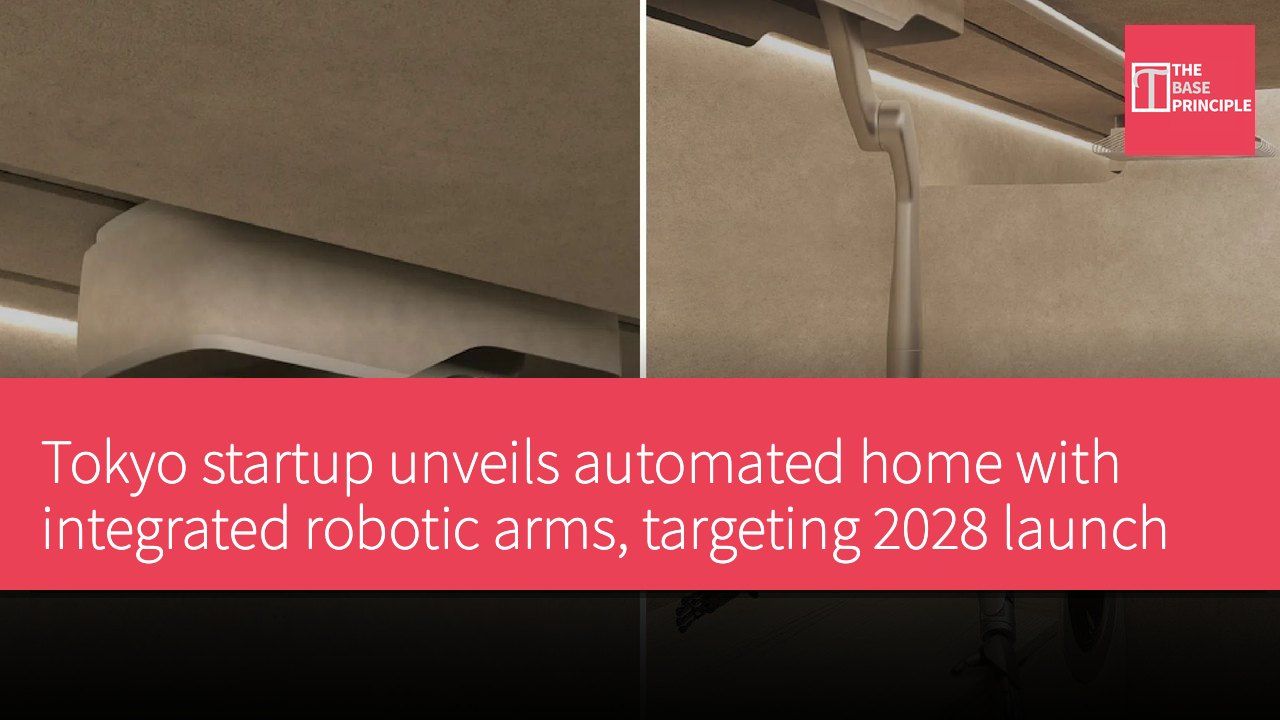
- MW is developing ceiling-mounted robotic arms to automate household chores.
- The company plans to launch its automated homes in Tokyo in 2028.
- The first generation of the MW bot is complete and sales have begun.
- MW vertically manages its entire supply chain, from design to robot construction.
While global tech giants are bringing bipedal humanoid robots into the home, Tokyo startup MW is heading in the opposite direction. The company is developing ceiling-mounted robotic arms designed to automate household chores, offering an alternative to bipedal humanoids. The concept rests on three pillars: custom home construction, integrated hardware called the MW bot, and the MW Intelligence software operating system. MW reportedly intends to roll out its automated homes in Tokyo in 2028. CEO Shuzo Narita envisions producing 10,000 robot-equipped homes annually by 2035.
Market challenges for automated homes
Meeting that goal means capturing roughly 5% of Japan's current new-home market, establishing automated housing as a mainstream standard rather than a niche luxury.
"The first homes and software have been completed, and we have received more than 1,000 applications and started sales," Narita wrote in a blog post. "The first generation (Gen1) of the MW bot, developed alongside the architecture and software, has also been completed." He added: "This robot has been integrated into a trailer home, marking the first step in the fusion of architecture with AI machines."
Enthusiasm for household humanoid robots is high. Yet pristine laboratories rarely reflect the realities of everyday homes. Safety concerns and space constraints are driving new designs. Compact Japanese homes leave little room for bulky bipedal robots to navigate around furniture, pets or children. Bipedal machines also burn significant computing power as they struggle to maintain balance and handle unexpected obstacles. MW firmly believes wall- and ceiling-mounted machines can handle chores more easily, though only time will tell whether integrated architecture outperforms mobile robots.
The newly unveiled ceiling-mounted system relies on two robotic arms fitted with claw-like hands. Running along ceiling tracks, the system tackles everyday tasks such as carrying groceries and folding laundry. In a live demonstration in Tokyo's Toyosu waterfront district, the robot correctly sorted pantry items such as soy sauce from those requiring refrigeration. It successfully removed towels from a dryer and folded them neatly. However, when faced with folding a T-shirt, the machine ran into difficulty.
MW's business model and vision
The startup draws inspiration from the fictional AI butler J.A.R.V.I.S., though its current business model relies on high-end real estate. MW has already sold a three-story residence in Meguro and built additional convertible homes in Yokohama and Fukuoka, priced between ¥200 million and ¥400 million (approximately US$1.30M–US$2.70M). Its primary goal is to sell the first fully functional robot-equipped home before 2028. Unlike other tech firms that develop only software, or hardware startups that purchase third-party housing, MW vertically manages its entire supply chain: acquiring land, designing buildings, overseeing construction, developing AI models and building physical robots.
The company currently holds ¥3 billion (approximately US$20 million) in seed funding and is targeting a ¥10 billion Series A round. The two-year-old company has high hopes that embedded robots can become the ultimate solution for domestic tasks. "We have actually not achieved even 1% of what we want to do, but our initial vision is starting to take shape little by little," Narita wrote in the blog post. Reports indicate the startup plans to begin international expansion in 2029, though a potential initial public offering (IPO) has not yet been decided.
For now, MW's next target markets include larger residential developments, with new projects under consideration in Futtsu and the Nagano resort town of Karuizawa.
Item Specifications Robot model MW bot Gen1 Home type Three-story residence Expected launch year 2028 Price range RMB¥200,000,000 (約 HK$218,000,000) - ¥400,000,000 (約 US$1,300,000 (約 HK$10,140,000) - US$2,700,000 (約 HK$21,060,000))
Future development potential of automated homes
As technology advances, automated homes are gradually becoming a trend for future living. MW's integrated robotic arms offer a novel solution, particularly in space-constrained Japanese homes, effectively tackling household chores. Despite strong market enthusiasm for household humanoid robots, real-world deployment faces challenges. MW's strategy of vertical integration to control the supply chain is expected to improve product quality and reduce costs, helping automated homes become a mainstream choice.