
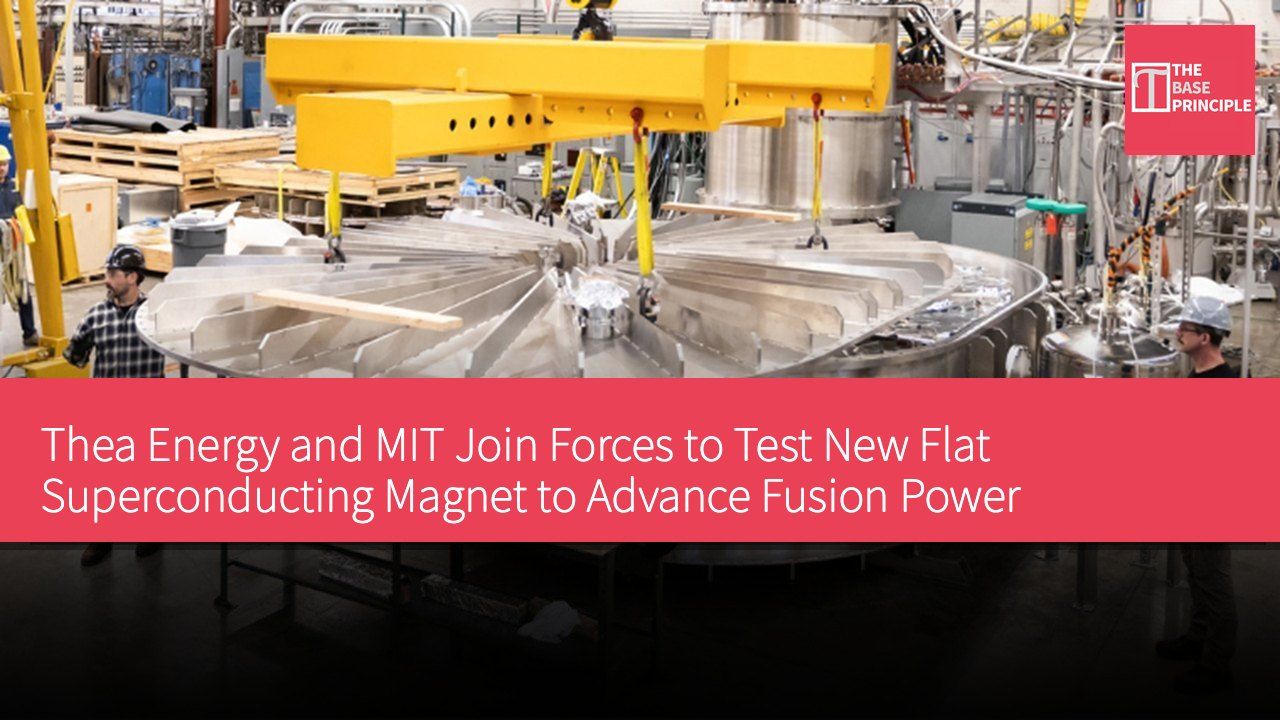
- Thea Energy collaborates with MIT to test a new superconducting magnet to advance fusion technology.
- The Eos design utilizes a flat coil architecture to simplify the production and maintenance of the magnet.
- This collaboration will reduce Thea Energy's risks in achieving key engineering milestones in the fusion process.
- MIT's collaboration focuses on the physical testing of the surrounding magnet, providing performance data.
This work will leverage MIT's low-temperature testing facilities and its expertise in high-temperature superconducting (HTS) magnets. The partners will also examine the efficiency of the coil under plant-relevant conditions and develop predictive models to evaluate its performance. The stellarator uses magnetic fields to confine superheated plasma, which is the charged gas necessary for fusion reactions. Its magnets must maintain precise field configurations while withstanding significant mechanical pressure. Traditional stellarator magnets have complex shapes, and their three-dimensional structures make them difficult and costly to manufacture. Thea Energy is taking a different approach by using a flat coil architecture to simplify the production, construction, and maintenance of the magnet.
Innovative Structure of the Eos Design
The company's Eos design employs 12 surrounding coils and approximately 300 programmable shaping magnets. The surrounding coils generate the necessary magnetic fields to confine the plasma, while the smaller shaping magnets are used to fine-tune its configuration. These modular shaping magnets can be adjusted for strength and replaced individually based on variations during the assembly process, taking into account wear during operation. Thea Energy states that these shaping coils have already been built and validated at full scale. The surrounding coils are the next major components currently undergoing testing.The assessment of the magnet under full magnetic field and full mechanical forces aims to determine whether the design can meet the stringent requirements of commercial fusion systems. The partners will also test the magnet's resilience to help ascertain its reliability and support high plant availability. These factors are critical, as commercial fusion facilities need to operate stably, not just demonstrate their ability to produce fusion reactions.
Reducing Risks in Fusion Technology
Thea Energy states that this collaboration will help reduce its risks in achieving key engineering milestones in the commercial fusion process before 2035. This work builds on the company's collaborations with national laboratories, academic institutions, and industrial partners to develop its stellarator architecture. The company's subsequent plant design, Helios, will adopt the same flat coil approach, combining surrounding magnets and shaping magnets. Thea Energy aims to leverage this shared architecture to reduce manufacturing complexity, making large-scale deployment more feasible.This collaboration is also part of a broader effort to accelerate the development of fusion through modeling and simulation. Thea Energy previously announced partnerships with NVIDIA, Synopsys, Oak Ridge National Laboratory, and Princeton Plasma Physics Laboratory to develop a digital twin for its Helios plant. However, MIT's collaboration focuses on the physical testing of the surrounding magnet, providing performance data for this component under demanding operational conditions. Thea Energy spun out from Princeton University and Princeton Plasma Physics Laboratory in 2022 to commercialize its stellarator technology.
Its latest collaboration with MIT aims to transform the simplified magnet architecture into systems capable of supporting future fusion power plants.
Impact of Simplified Magnet Architecture on Fusion
The collaboration between Thea Energy and the Massachusetts Institute of Technology marks a significant advancement in fusion technology. Through the innovative flat coil architecture, the company hopes to simplify the production process of superconducting magnets, thereby reducing costs and technical risks. This is crucial for achieving commercial fusion power plants, as stable operational capability and production efficiency are key to successful commercialization. Furthermore, this collaboration is not limited to the design of the magnets but also involves a comprehensive assessment of their performance, laying a solid foundation for the future development of fusion technology.