
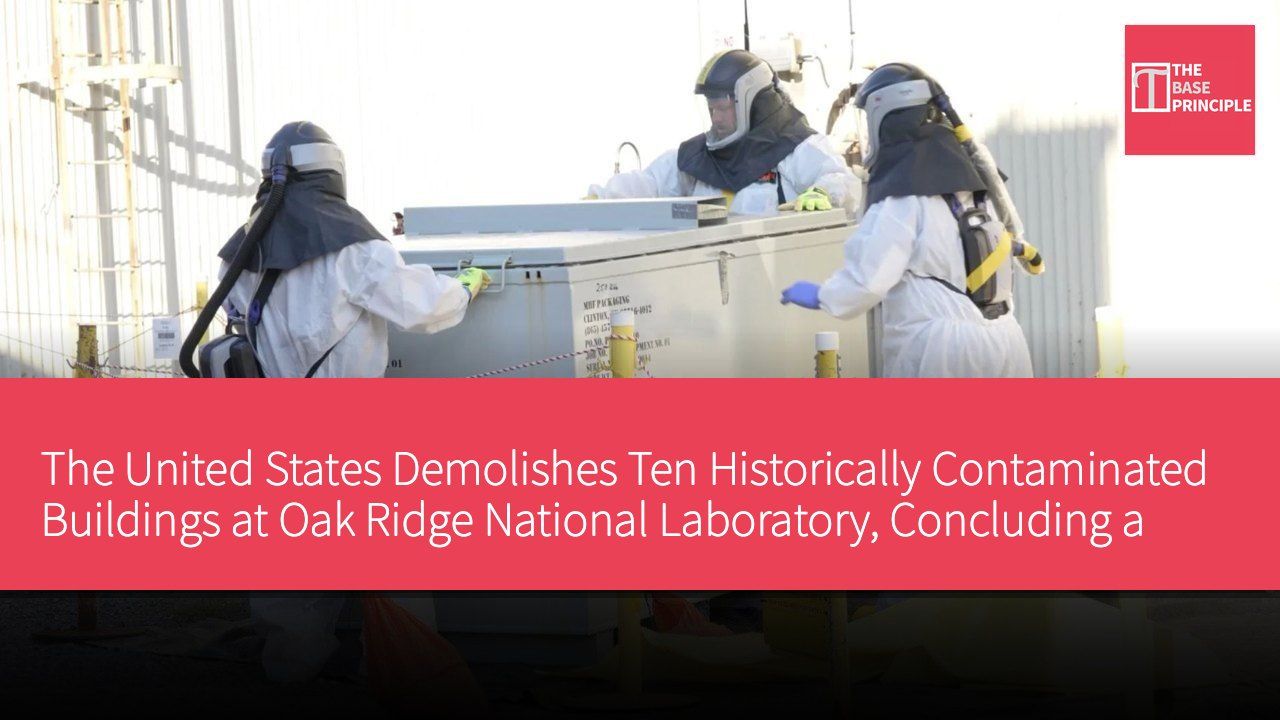
- The demolition of the ten contaminated buildings marks the conclusion of the six-year cleanup effort.
- The demolition work was completed within two months and avoided impacting laboratory operations.
- These buildings previously produced radioactive isotopes and ceased operations in the 1990s.
- The cleanup team successfully removed nearly three million pounds of waste, reducing risks.
Ten historic and severely contaminated buildings located in the core area of Oak Ridge National Laboratory (ORNL) have been demolished, marking the end of a six-year environmental cleanup effort. Collectively known as the Isotope Building, they spanned over 12,000 square feet across the central campus of the laboratory. The demolition of these abandoned structures eliminated long-standing radiation risks while also freeing up valuable land needed for future scientific research. Clint Wolfley, senior vice president of the federal cleanup contractor United Cleanup Oak Ridge (UCOR), stated, "After decades of witnessing, the Isotope Building is gone, and the skyline of ORNL will be forever changed."
Preparation and Execution of the Demolition
The U.S. Department of Energy (DOE) Oak Ridge Environmental Management Office collaborated with UCOR to execute the project. Preparation for this aging complex involved six years of meticulous engineering, yet the actual building demolition was completed in just two months. To ensure that operations at the adjacent laboratory were not affected, the demolition team limited major demolition work to the afternoon, a schedule that required close coordination with laboratory operator UT-Battelle and the DOE Office of Science. The team also handled most of the demolished waste on-site, a practice that saved taxpayers the high costs associated with transporting contaminated waste to distant facilities.
The history of the Isotope Building dates back to the late 1940s through the early 1960s. For decades, scientists within these buildings produced radioactive isotopes used in medicine, industry, scientific research, and national defense. Operations ceased in the early 1990s, leaving facilities that still contained radioactive isotopes, mercury, asbestos, and contaminated machinery. Before demolition equipment could enter, the team had to disconnect all utility connections and remove hazardous insulation materials. This preparation phase is referred to as transitioning the buildings to a "cold and dark state."
Challenges and Achievements During the Cleanup Process
The deactivation team entered these buildings in 2020, gradually addressing internal hazardous materials. Multidisciplinary staff removed combustible materials, six contaminated hot cells, and several dedicated glove boxes. They also moved out four tanks weighing 2,000 pounds each that stored inert gases. In total, the team removed nearly three million pounds of waste from the site. The most challenging engineering problem was located 10 to 15 feet above the laboratory floor. Central ventilation and process exhaust ducts were partially made of a mixture of cement and asbestos, which had absorbed radioactive contamination over decades.
The team used stringent containment barriers and specialized packaging to remove these overhead ducts without releasing harmful dust.
Federal project director Michael Griswold stated that the project required a high level of technical skill and a strong focus on worker safety. He said, "This achievement reduces current risks while opening new opportunities for the laboratory's future." Wolfley praised the cleanup team's creative problem-solving abilities over the six years. He noted that their efforts transformed ORNL's most hazardous footprint into an asset for future discoveries. "After decades of witnessing, the Isotope Building is gone, and the skyline of ORNL will be forever changed, paving the way for its next generation of scientific discoveries," he added.
UCOR concluded.
Impact of the Cleanup Effort on Future Research
The cleanup effort at Oak Ridge National Laboratory not only eliminated long-term radiation risks but also freed up valuable land for future scientific research. With the demolition of these contaminated buildings, the laboratory's operations can further expand, opening new research opportunities. This series of work required a high level of technical skill and fully considered worker safety, demonstrating the importance of environmental cleanup in technological development.