
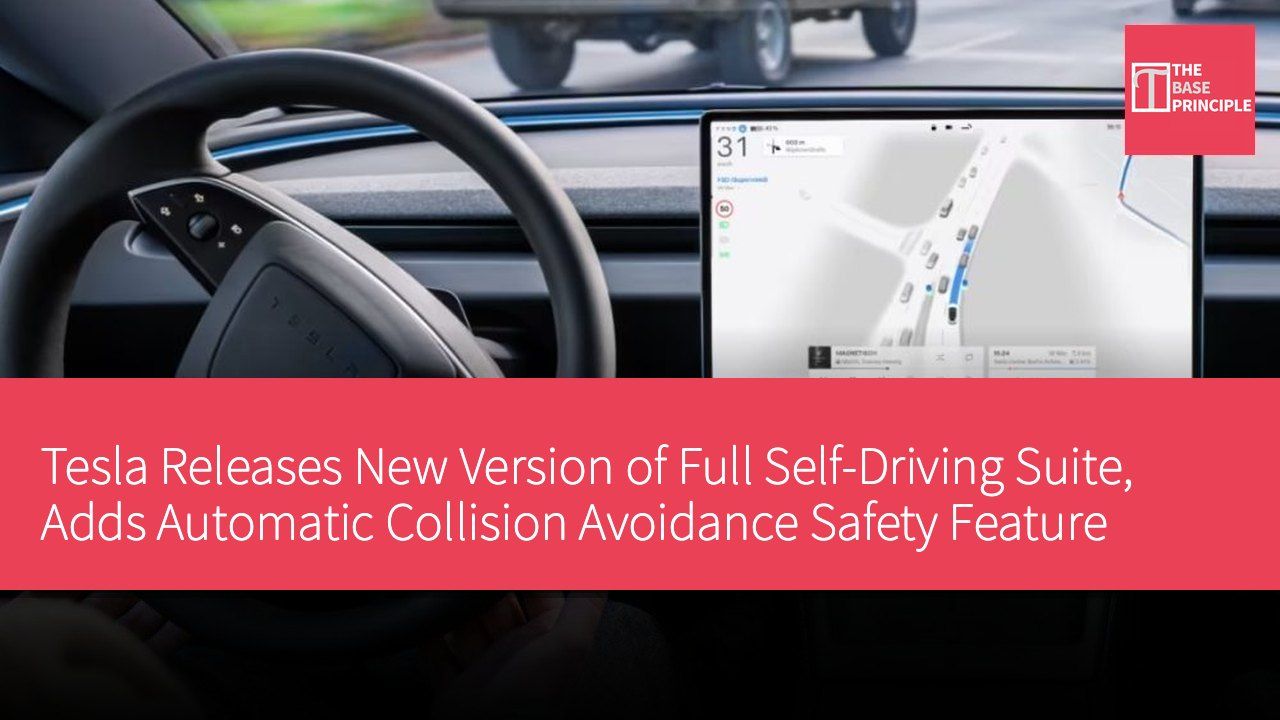
- Tesla has launched a new version of its Full Self-Driving suite, adding Automatic Collision Avoidance.
- Automatic Collision Avoidance can automatically take control when the driver is distracted.
- The feature aims to enhance vehicle safety in response to distracted driving.
- Tesla's new version performs well in driving experience but still faces challenges with parking.
Tesla is rolling out a new version of its Full Self-Driving (FSD) suite to select owners, introducing a significant safety feature. Named Automatic Collision Avoidance, the feature is being pushed out to some vehicles with the 2026.27.6 software update, which began rolling out last night. We have received this update, along with FSD version v14.3.9 and v14.2 Lite, the latter of which has release notes similar to previous versions, appearing to have made some adjustments and improvements in behavior and performance.
Details of Automatic Collision Avoidance
However, most attention is focused on the Automatic Collision Avoidance feature, which was detailed in our article last week. This feature will engage Full Self-Driving to "attempt to protect your vehicle's safety, then continue driving." It can be triggered while you are manually driving in scenarios such as: Scenario One: An imminent collision where braking alone is not sufficient to avoid it; Scenario Two: Your vehicle detects that you are not paying enough attention to the road (for example, reaching for the back seat), or Full Self-Driving (supervision mode) may have been inadvertently turned off.
In short, when the vehicle determines that you are not sufficiently focused or that a collision is imminent, Full Self-Driving will automatically take over. The addition of this feature is very useful, as distracted driving is a major issue in today's society. Additionally, Tesla's FSD v14.3.9 version does not have additional release notes compared to previous versions, but my first impression during the initial drive was that it performed exceptionally well, with some difficulties still present in parking. I just completed a 15-mile (about 24 kilometers) round trip to the gym, and the overall performance was quite consistent with the current FSD, which is really good.
Although the time was not long enough to thoroughly understand its pros and cons, the initial driving experience of these versions was impressive, and they all felt quite similar.
Comparison with Other Brands
Furthermore, Tesla's v14.2 Lite version has also been released, with detailed reviews available via the relevant link. The addition of the Automatic Collision Avoidance feature is similar to the collision avoidance systems used by other brands such as Hyundai, Kia, and Genesis. These systems typically utilize radar and camera sensors to automatically apply emergency braking, while the avoidance steering performed in manual driving mode is primarily pioneered by Tesla's recent addition.
The Importance of Automatic Collision Avoidance
The introduction of the Automatic Collision Avoidance feature reflects Tesla's emphasis on driving safety, especially in the context of the increasing prevalence of distracted driving. This technology not only protects drivers in critical moments but may also influence the safety standards of the entire automotive industry. As other brands adopt similar technologies, Tesla's innovation could prompt more car manufacturers to accelerate the development of safety technologies to meet market demands and consumer expectations for safety.