
- Tesla has made significant adjustments to the Cybertruck's production process.
- The newly added self-reinforced polypropylene shields enhance durability and cost efficiency.
- The side repeater cameras have been redesigned to improve clarity in rainy conditions.
- These improvements come at no extra cost and enhance the reliability of driver-assistance features.
Tesla has made significant adjustments to the production process of the Cybertruck, aiming to make the all-electric pickup truck more cost-effective, reliable, maintainable, and easier to produce. Cybertruck engineers have revealed these evolving changes, one of which is the addition of a self-reinforced polypropylene pneumatic shield installed at the bottom of the vehicle. Previously, Tesla used aluminum, but the self-reinforced polypropylene offers better durability while being more cost-effective and lightweight.
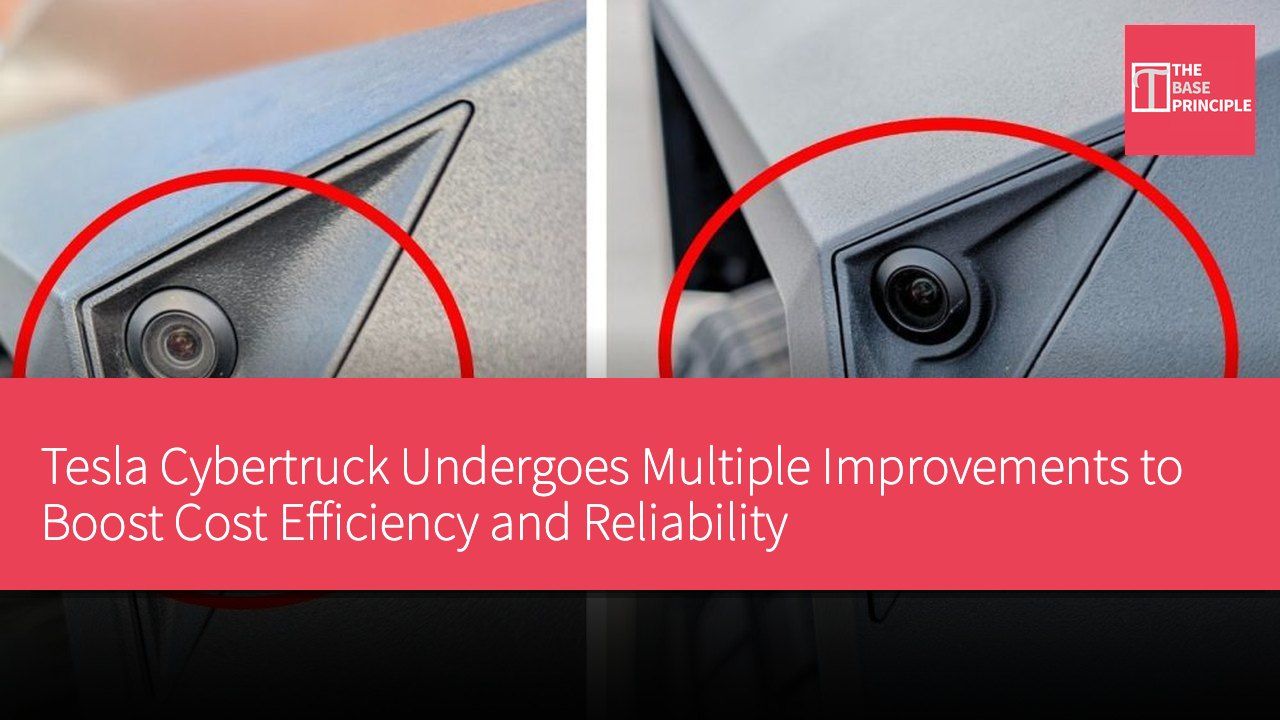
Tesla has also made minor modifications to the Cybertruck's side repeater cameras, not waiting for a new model year to enhance its vehicles. On September 8, Cybertruck Chief Engineer Wes Morrill posted a comparison photo of the old and updated side repeater camera housings, showing that the new version is already in production at the Texas Gigafactory. While the triangular camera housing mounted on the front fender appears almost identical at first glance, a closer inspection reveals a redesigned contour that utilizes the airflow around the vehicle to maintain lens clarity in rainy conditions and road spray.
Design Improvements to the Side Cameras
The updated version of the side repeater cameras, on the left, employs passive geometric shapes to create airflow disturbances that better prevent water from adhering to the lens during driving. This comes at no extra cost and is purely a visual improvement. These cameras are located in exposed positions on the Cybertruck's steel exterior and often collect water droplets in wet weather, which can affect the images needed for lane changes and blind spot monitoring by the Autopilot and Full Self-Driving features. Early production vehicles sometimes required owners to manually wipe the lenses or temporarily accept limitations on driver-assistance functions.
Tesla has added camera washers to some other models and the Cybercab prototype, but these active systems increase cost, complexity, and potential leak points. The new housing solves the problem with passive geometric shapes. Minor surrounding changes create localized airflow disturbances as the vehicle moves, and these vortices physically push water droplets away from the optical surface. Morrill calls this result a "purely visual improvement" and "no extra cost." Once the production molds are updated, each subsequent part will cost the same as the original.
Gradual Performance Enhancements
These advantages quickly accumulate. Clearer cameras in rainy conditions improve the reliability of driver-assistance features precisely when they are most needed. This design does not consume additional energy or introduce new failure modes. New Cybertrucks produced after the tooling change automatically come with the updated parts, and some owners who took delivery as early as June 2026 have confirmed receiving the revised housings. Although questions about retrofitting have arisen in replies, and the cameras are electrically compatible, Tesla has not announced a formal service program.
A few millimeters of housing reshaping won't cause the same stir as a new battery pack, but these changes are incremental, improving the Cybertruck's performance as a vehicle over time. This progress demonstrates how Tesla continues to refine the Cybertruck's capabilities after the start of mass production. Better rainy weather vision, zero extra cost, and no additional hardware ultimately add up to a significant enhancement in everyday use and safety.
How Tesla Continues to Optimize Cybertruck Performance
Tesla's continuous improvements to the Cybertruck demonstrate its competitiveness in the electric vehicle market. By continuously optimizing the design, Tesla not only enhances the vehicle's functionality but also reduces production costs, which is crucial for future market performance. The improvement in rainy weather vision, in particular, shows Tesla's emphasis on driving safety, which has a positive impact on consumer confidence and brand image. These incremental improvements not only enhance product reliability but also lay the foundation for Tesla in the fierce market competition.