
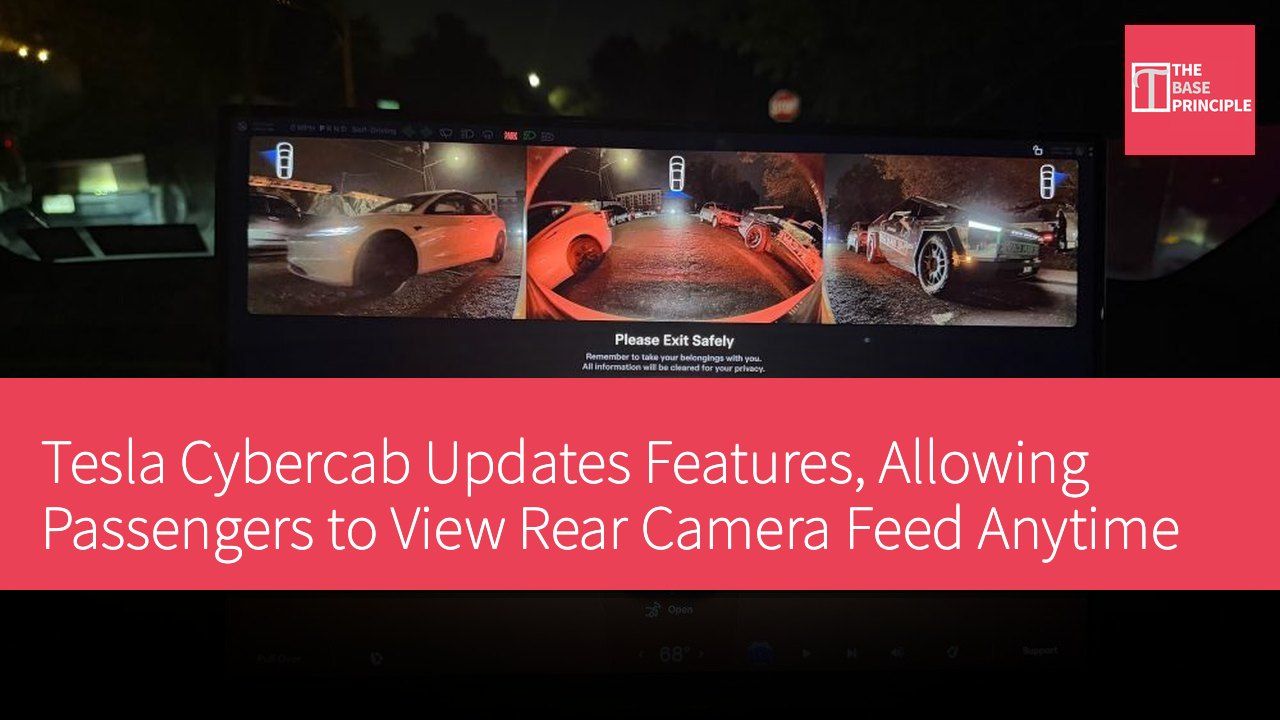
- Tesla Cybercab now allows passengers to view the rear situation and can turn off the display.
- A new silent mode lets passengers dim the entire display at night.
- The introduction of the rear camera feed feature responds to passenger demand, enhancing the sense of safety.
- These updates indicate that Tesla is preparing for the future development of Cybercab.
Tesla has provided Cybercab passengers with a way to view the rear situation while also allowing them to completely turn off the cabin display. Passengers in Austin can now access a live rear camera feed on the central display of the Cybercab during their ride. Austin passenger Ethan McKanna discovered this change on Friday night and shared a message during a ride, stating, "You can now turn on the camera to see what's behind the Cybercab!" His photo showed a rear camera video appearing at the top of the display, with another Cybercab following on the bridge.
Sawyer Merritt shared the image on Saturday, noting that there is also a new silent mode that can dim the entire display for passengers wanting to relax, sleep, or avoid nighttime brightness. The camera view is not limited to just the rear feed. Tesla's user interface software engineer Evan (posting as @CarCoder) responded to McKanna with a tip: "You can also click it to see more cameras and swipe up and down to hide and show." Previously, the Cybercab only displayed its rear and repeater feeds on the "Please exit safely" screen at the end of the ride, allowing passengers to check for bicycles and traffic before opening the door.
New Features Enhance Passenger Experience
The silent mode appeared the day before. Austin passenger Jackson Blatz shared a video on Friday morning showcasing the new Robotaxi interface and its options within the Cybercab. Tesla has not released update notes for these two features. The rapid rollout of the rear camera feed, from request to release, came after Austin Cybercab passenger Dan Burkland asked Tesla to allow passengers to access the rear and repeater camera feeds at any time, "especially for peace of mind."
Evan's response at the time was "in development," as reported by Teslarati. About two weeks later, passengers had access to this feature. This functionality fills a gap created by the design of the Cybercab. Without a steering wheel, pedals, mirrors, and rear windows, passengers cannot naturally view the rear situation. Eight external cameras are already integrated into Tesla's autonomous driving software, so this change only required a software update.
AI Optimizes Camera Views
Additionally, the implementation of this change involves factors related to artificial intelligence. Yun-Ta Tsai, a senior engineer on the Tesla AI team, referenced Merritt's post and wrote, "The (human) camera view adjustments are optimized through Grok and are part of the algorithm implemented directly on fixed-function hardware, so I don't even need to look at the data sheet." Tsai did not disclose which part of the Grok processing algorithm was involved. Grok's role within the vehicle has expanded, with Grok Bot now enabled in every Cybercab and Model Y Robotaxi fleet since Tesla introduced the agent into its vehicles in September.
These two features have ushered in significant changes for Austin passengers within a week, coinciding with the launch of redesigned iPhone and Apple Watch live events and real-time trip sharing. These features also represent Tesla's preparations for the Cybercab's integration into its own fleet and beyond. During the third-quarter earnings call, Lars Moravy stated that the company plans to deliver Cybercabs to customers by the end of 2026. Tesla has not disclosed whether the rear camera feed and silent mode will also be applied to its Model Y Robotaxis.
Importance of Tesla Cybercab Feature Updates
Tesla's Cybercab updates demonstrate the company's sensitivity to passenger needs, particularly regarding safety and comfort. The introduction of the rear camera feed and silent mode not only enhances the passenger experience but also fills gaps in the design of autonomous vehicles. As Tesla continues to integrate artificial intelligence technology, the realization of these features showcases its innovative capabilities in the field of autonomous driving. These changes benefit not only passengers in Austin but may also lay the groundwork for future Cybercab expansions, reflecting Tesla's forward-looking planning for future mobility solutions.