
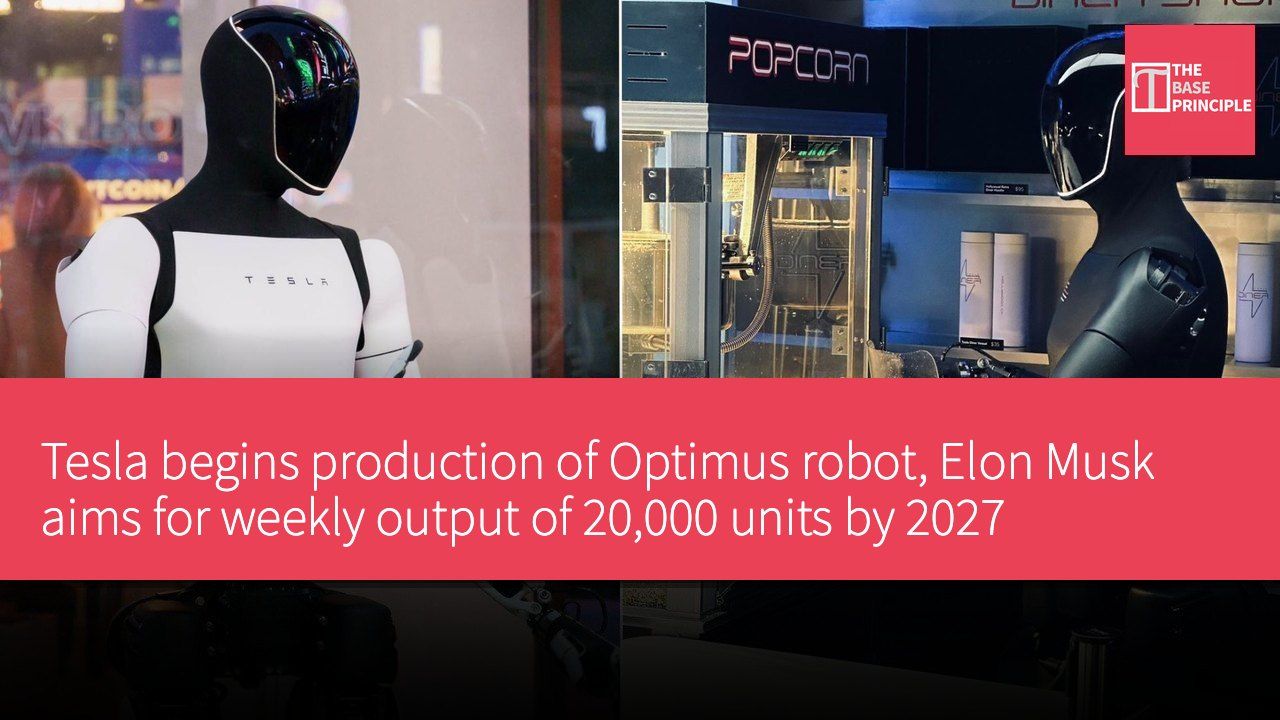
- Tesla has begun production of the Optimus robot in California, marking a significant step toward commercial deployment.
- Elon Musk aims to produce 20,000 units weekly by 2027, but further improvements in manufacturing efficiency are needed.
- Reliability and software development are major challenges for the success of Optimus.
- Tesla is expanding its computing infrastructure to support robot development and autonomous driving.
Tesla has started manufacturing its Optimus humanoid robot on the production line in Fremont, California, marking a significant step toward commercial deployment. CEO Elon Musk's current goal is to ramp up weekly production to 20,000 units by the end of 2027. The factory, which previously focused on electric vehicle production, has been repurposed to support its robot initiative. This initial production marks the first time Tesla has manufactured Optimus units to production standards.
However, achieving large-scale production will require further engineering work and improvements in manufacturing efficiency. Tesla revealed this milestone in its Q3 2026 shareholder update. Musk cautioned investors that production growth will be slow, as Optimus represents a completely new product category for the company.
Challenges in Production Expansion
Tesla has established a manufacturing process deemed suitable for commercial Optimus products. As production expands, the company still hopes to improve its production methods and robot hardware. In Tesla's earnings call, Musk described the current phase as early production. He warned that scaling up output will involve setbacks, as engineers must tackle the challenges of building humanoid robots at an industrial scale.
Reliability remains a major hurdle. Tesla expects Optimus to operate safely over extended periods without frequent repairs or component failures. Musk acknowledged that engineers still need to improve the robot's design to meet these requirements. Software is also a significant challenge. Tesla must develop functionalities that allow Optimus to reliably handle unfamiliar tasks. Musk stated that a substantial amount of work remains before the robot can independently perform a wide range of activities.
Battery Supply and Production Plans
The planned weekly production target of 20,000 units will be an ambitious manufacturing goal. Achieving this output will require Tesla to establish a supply chain and production system capable of supporting continuous output. Tesla is also expanding its computing infrastructure to support the development of autonomous driving and humanoid robots. The company plans to reach 400 megawatts of training computing power by the end of 2026. This infrastructure will support software development for its vehicles and Optimus robots.
Tesla is also continuing to build its Austin manufacturing facility, with equipment commissioning expected to begin in 2027. The computing expansion reflects the significant processing power required to develop autonomous robots. Optimus needs to interpret its surroundings, plan actions, and execute tasks in changing environments. Tesla has yet to determine when Optimus will be commercially launched. Its production progress marks an important manufacturing milestone, but the robot's actual capabilities are still under continuous improvement.
Tesla's manufacturing plans are not limited to robots. The automaker has identified battery availability as a persistent constraint on increasing global vehicle production. To address supply limitations, Tesla is expanding its battery-related operations at multiple locations. Projects include battery pack capacity in Berlin, cathode material production and lithium refining in Texas, and lithium iron phosphate battery cell manufacturing in Nevada. Tesla has shipped its first Megapack energy storage systems using its own LFP batteries, a milestone that gives the company greater control over the key battery technology used in its energy storage business.
Production of Tesla's 4680 battery cells is also ramping up, which will support growth in Cybertruck and Tesla Semi production and increase Model Y output. At this time, the robot initiative comes as Tesla faces pressure in its core automotive business. Third-quarter revenue reached $28.04 billion, nearly flat compared to $28.09 billion a year earlier. With investments in robotics, computing infrastructure, and autonomous driving, profits fell by 43%.
Tesla's ability to transform Optimus into a reliable commercial product depends not only on factory output but also on the simultaneous advancement of manufacturing scale, battery availability, and software development to achieve Musk's ambitious production goals.
Item Specifications Processor/SoC Unknown Battery Capacity Unknown Computing Power 400 megawatts
Key Challenges in Commercializing the Optimus Robot
Tesla's Optimus robot initiative marks the company's exploration into a new product category, but the challenges it faces are significant. Production efficiency and reliability are critical factors for achieving large-scale production, especially in robot design and software development. Additionally, the stability of battery supply is crucial for supporting the production of both robots and electric vehicles. As Tesla further expands its computing infrastructure, its ability to successfully overcome these challenges will directly impact its competitiveness in the market and future growth potential.