
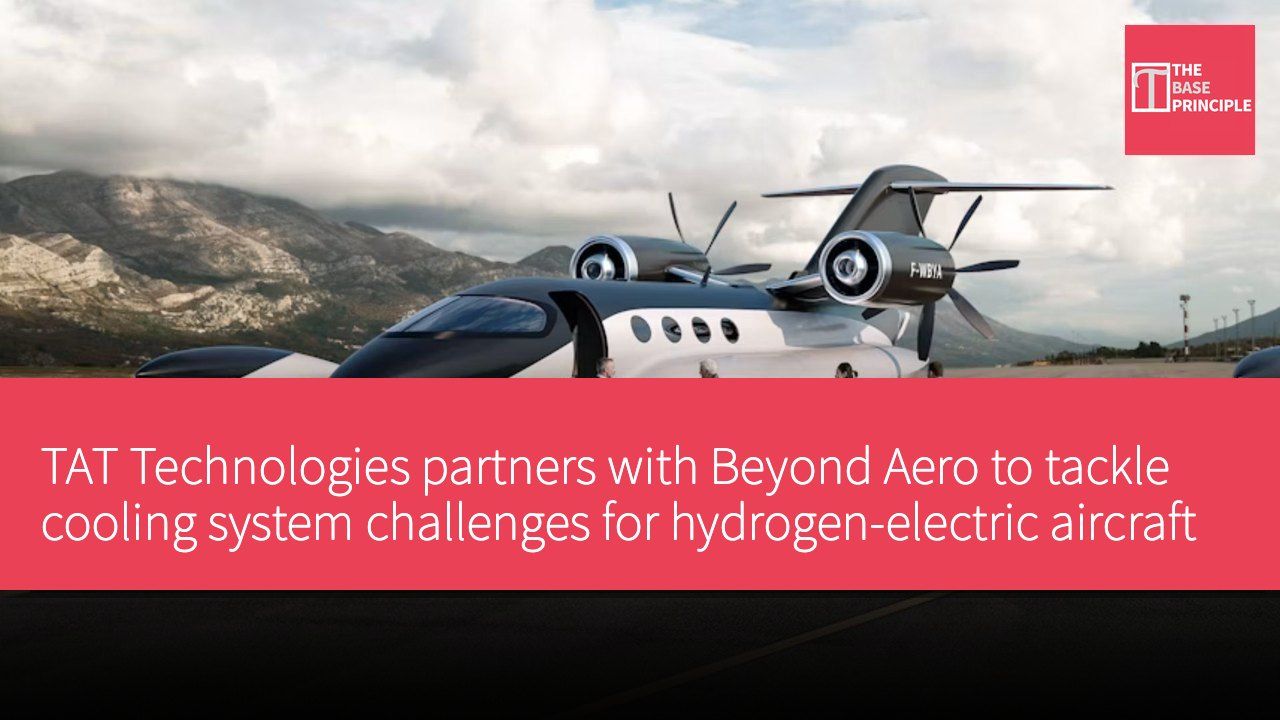
- TAT Technologies is partnering with Beyond Aero to develop a cooling system for a hydrogen-electric commercial aircraft.
- Hydrogen-electric propulsion systems impose demanding thermal conditions that require effective heat management.
- Beyond Aero is focused on gaseous hydrogen storage and fuel cell-powered development.
- The collaboration strengthens the industrial base and thermal management expertise supporting hydrogen-electric programs.
Cooling may prove as important to hydrogen-electric flight as the propulsion system itself. TAT Technologies is working with French aviation startup Beyond Aero to address that challenge in its planned hydrogen-electric commercial aircraft. The two companies are jointly developing the thermal management architecture for Beyond Aero's ONE aircraft. TAT's Universal Cooling System (UCS) is being integrated into the aircraft design, with engineers working toward a compact propulsion system capable of handling high heat loads. The ONE is planned to carry six passengers with a range of about 800 nautical miles, roughly 920 miles, five times the target distance of comparable battery-electric aircraft.
Thermal Management Challenges in Hydrogen-Electric Propulsion
Hydrogen-electric propulsion systems impose demanding thermal conditions. Engineers must manage heat effectively without adding excessive weight or consuming valuable space inside the aircraft. As a result, thermal management becomes an integral part of the aircraft architecture rather than a secondary system added later. TAT's UCS, developed as an integrated cooling platform for both electric and hydrogen-electric aircraft, can adapt to varying operating conditions while meeting the compact size and weight constraints of emerging aircraft designs. Igal Zamir, CEO of TAT Technologies, said that hydrogen propulsion offers a promising path to low-emission aviation, noting that flexibility, efficiency and reliability are key requirements for new aircraft platforms.
Beyond Aero is developing the ONE around gaseous hydrogen storage and fuel cell power. The company has been operating since 2020 and now has more than 80 aeronautical engineers based in Toulouse, Paris and Los Angeles. The project's 800-mile range sets it apart in the electric aviation segment. Battery-powered aircraft face significant energy density limitations, particularly as designers try to extend range without substantially increasing battery mass. Hydrogen offers a different path. Fuel cells converting hydrogen into electricity produce heat that aircraft must continuously shed, making the cooling architecture especially important as Beyond Aero moves toward a full aircraft configuration.
Yannick Schwartzenbart, head of industrialization for the project at Beyond Aero, said TAT's aviation experience will help the startup develop a reliable aircraft architecture. He added that the partnership strengthens the industrial base supporting hydrogen-electric programs and gives Beyond Aero access to thermal management expertise developed for demanding aerospace applications.
Implications of the Partnership
The partnership illustrates how advances in propulsion technology are reshaping aircraft systems that might once have seemed peripheral. Hydrogen tanks, fuel cells, electrical equipment and cooling hardware all have to fit within a compact airframe. Engineers therefore need to address heat rejection early in the design process. A cooling system that performs well but adds too much mass or occupies too much space could undermine the aircraft's overall efficiency. Beyond Aero aims to use the ONE to bring hydrogen-electric propulsion into commercial aviation. The aircraft has been developed specifically around the propulsion architecture rather than adapted from an existing conventional design.
TAT's involvement makes thermal management part of this broader engineering effort. If the ONE reaches commercial operation, its cooling system will be one of the less conspicuous components affecting how efficiently the aircraft uses hydrogen.
Specification Value Range 800 nautical miles (approximately 920 miles) Passenger capacity 6
Thermal Management and Design Challenges in Hydrogen-Electric Aviation
The development of hydrogen-electric aviation faces multiple challenges, particularly in thermal management. An effective cooling system affects not only aircraft performance but also the feasibility of the overall design. As hydrogen-electric propulsion technology advances, engineers must address heat rejection early in the design phase to avoid compromising aircraft efficiency. The partnership between TAT and Beyond Aero is therefore not merely a technical integration but a key step in advancing the future of hydrogen-electric aviation. This collaborative model may become an important trend in the aviation industry, fostering innovation in new aircraft architectures.