
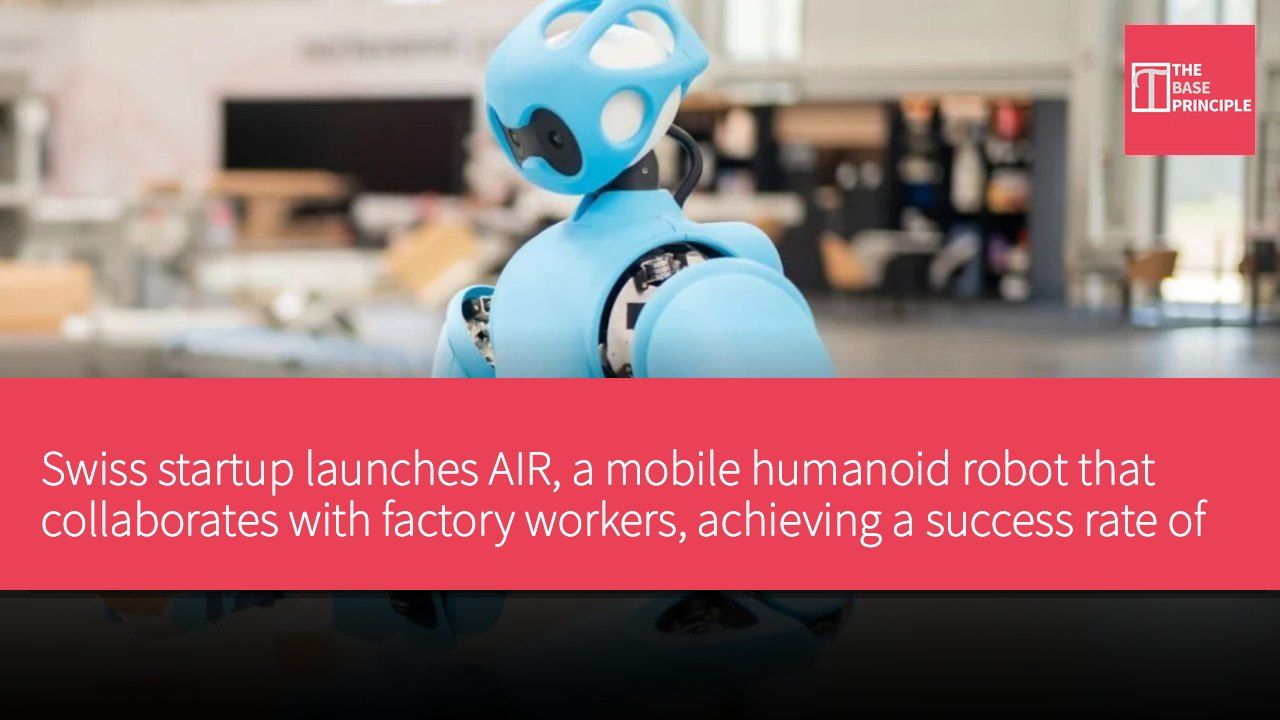
- AIR is a dual-arm mobile robot designed to collaborate with factory workers.
- The robot achieves an average task success rate of 95%.
- AIR features a tendon-driven design that reduces the risk of injury during accidental contact.
- The robot can transition to autonomous operation in about a month.
Swiss startup Embodied AI has recently unveiled AIR, a dual-arm mobile robot designed to work alongside factory employees without the need for safety barriers. The company states that AIR initially operates under remote supervision and learns to perform designated tasks independently within about a month. Embodied AI reports that in paid manufacturing pilot programs with consumer electronics and automotive companies, the robot achieves an average task success rate of 95%. Francesco Stella, co-founder and CEO of Embodied AI, stated, "Safety and reliability are core requirements for physical AI to enter the real world, and these principles guided the design of AIR."
Design and Features of AIR
AIR is a humanoid dual-arm mobile robot designed to perform manufacturing tasks alongside factory workers without traditional safety barriers. The robot was developed by a team of 25 people from the École Polytechnique Fédérale de Lausanne (EPFL), combining a body, two lightweight arms, and a wheeled base. Unlike traditional industrial robots that rely on rigid structures and external safety barriers, AIR features an ergonomic mechanical design aimed at reducing the risk of injury during accidental contact. The robot's architecture focuses on placing heavy components inside the body while using a tendon-driven mechanism to operate the arms.
Cables transmit motion from the motors to the arms, reducing the mass of moving parts, which keeps the arms lightweight and allows them to yield when encountering obstacles or making contact with people.
This design aims to address a significant limitation of traditional factory automation. Industrial robotic arms are often heavy and rigid, making them difficult to deploy directly in shared workspaces with humans. As a result, many installations require physical barriers or light curtains to separate machines from employees. In contrast, AIR relies on mechanical compliance and mass distribution, placing heavier components away from the robot's moving limbs. The only specific mechanical data disclosed so far pertains to the arms. According to investor descriptions, the tendon-driven unit weighs approximately 2 kilograms (4.4 pounds) and can lift 5 kilograms (11 pounds).
The company has not yet disclosed the overall dimensions, weight, reach, battery capacity, or maximum load of AIR.
Learning and Autonomous Operation Process
Another core feature is its method of learning manufacturing tasks. AIR initially operates through remote control, with a human operator controlling the robot during its first shift. These operations generate training data, which the company's AI system uses to learn the designated tasks. Embodied AI states that the robot can transition to autonomous operation in about a month, taking over tasks that initially required human supervision.
The company is not starting from a completely untested software platform. AIR uses the same AI stack as dual-arm robot units that are already operational on customer production lines. The company has utilized this system in paid manufacturing pilot programs with consumer electronics manufacturers and automotive and industrial technology suppliers, reporting an average task success rate of 95% for these deployments. However, the company has not disclosed how many tasks it evaluated, how long the trials lasted, or how it calculated the success rate. The company also stated that a single AIR unit can handle workloads equivalent to up to three workers per shift, depending on the application.
The robot's initial deployment model combines human supervision with gradual automation, rather than requiring full autonomy before entering factories. This allows manufacturers to use the robot for productive work while the AI system collects operational data. This approach also provides the company with the opportunity to refine the robot's capabilities for specific tasks using information gathered in real manufacturing environments, rather than relying solely on laboratory demonstrations. Although described as a humanoid robot, AIR does not possess legs or a bipedal walking system. Its wheeled platform provides mobility within factory workspaces, while its upper body and two arms enable it to interact with equipment and handle objects.
This configuration makes it closer to a class of mobile manipulation robots designed for industrial applications rather than a full-sized bipedal humanoid robot.
Future Plans and Market Trends
The company has not disclosed pricing or delivery timelines but indicated that it will begin accepting orders after unveiling at the Humanoid Europe exhibition in Munich in 2026.
Item Specifications Arm Weight Approximately 2 kilograms (4.4 pounds) Maximum Lifting Capacity 5 kilograms (11 pounds)
How AIR is Changing the Future of Factory Automation
The launch of AIR marks a significant advancement in factory automation, particularly in terms of safety and human-robot collaboration. Traditional industrial robots often require physical barriers to protect workers due to their bulk and rigidity, while AIR's design aims to reduce these constraints, allowing it to operate in shared workspaces with humans. Through tendon-driven technology, AIR not only enhances operational flexibility but also lowers the risk of accidental contact. Furthermore, the robot's ability to learn and adapt in real production environments is crucial for improving productivity and reducing labor costs.