
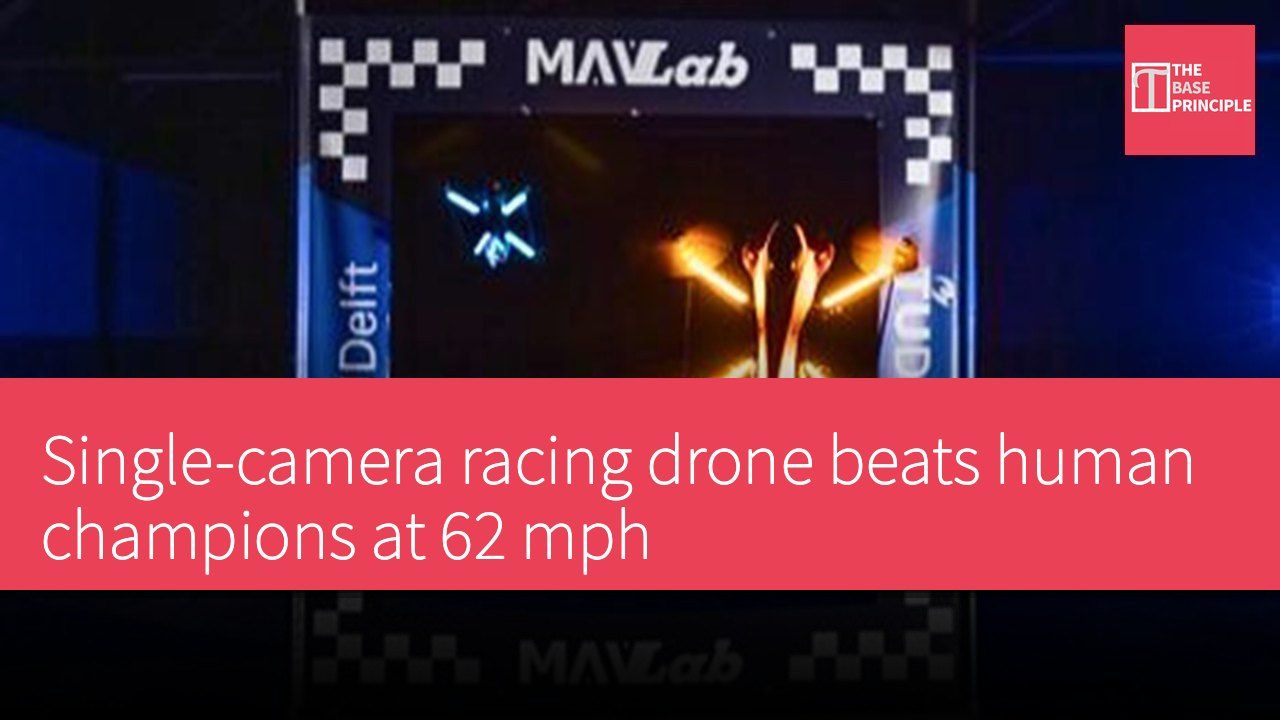
- MonoRace drone beats three world champions at roughly 62 mph.
- The system uses a single camera and IMU for navigation, no GPS required.
- MonoRace generates motor commands directly via reinforcement learning, reacting extremely fast.
- Research shows efficient intelligence can be extracted under limited resources, advancing AI.
A racing drone that sees the world through a single lens defeated three former world champions and all other autonomous teams in an international competition, reaching speeds of approximately 62 mph (100 km/h), according to researchers at Delft University of Technology. The system, named MonoRace, was developed at the MAVLab in the Faculty of Aerospace Engineering at Delft University of Technology. Early autonomous racing systems relied on multiple sensors, whereas MonoRace uses a single forward-facing camera and an inertial measurement unit (IMU) for perception, navigation and control.
At racing speeds, the drone has almost no time to interpret blurry, distorted imagery. A neural network identifies the track gates in each frame, while the IMU and a drone dynamics model estimate its position and motion. The system does not involve GPS or external motion tracking. The software must also cope with real-flight failures such as camera glitches and sensor saturation. "We developed a robust method that combines what the camera sees with the drone's own motion information, allowing it to navigate without GPS," said lead author Stavrow Bahnam.
MonoRace system's unique design
MonoRace does not use a traditional control stack; instead, a small neural network generates motor commands directly. It runs on a tiny onboard chip, with the flight controller issuing commands at 500 Hz. The researchers trained it through reinforcement learning, enabling it to control the drone while respecting physical constraints. Skipping the step of first planning a flight path lets the controller react extremely fast and exploit the drone's full performance while staying small enough to run onboard, said author Robin Ferede.
The team tested MonoRace at the 2025 Abu Dhabi Autonomous Drone Racing event. The organizers designed and operated the drones and track environment, so the researchers had no control over hardware or course. Even so, the Delft drone reached 100 km/h and beat every other autonomous team as well as three former world-champion human pilots. The goal is not to give robots stronger sensors and computers, but to see how much intelligence can be extracted from limited resources, said Christophe De Wagter.
Racing pushes AI limits
Racing forces AI to be fast, robust, and able to adapt without external reference measurements.
Racing is a way to push robot AI to its limits, said Delft University of Technology professor Guido de Croon. Here the team optimized for speed, but he said the same approach could prioritize efficiency or safety — for example, providing smooth, energy-optimal control for machines ranging from small vacuum robots to large quay-side cranes. The researchers believe these principles can help many autonomous systems, including vehicles, mobile robots, and future aerial and humanoid machines, make fast, reliable decisions with limited onboard compute.
The research was first published in the journal Science Robotics.
MonoRace's impact on autonomous systems
MonoRace's success not only demonstrates drone performance under extreme conditions, but also highlights how innovative technology can enhance the intelligence of autonomous systems when resources are limited. This approach does not rely on traditional multi-sensor configurations; instead, it leverages a single camera and internal motion information, showing the potential of future autonomous systems across various applications — whether in transportation or industrial automation — to benefit from this efficient control strategy.