
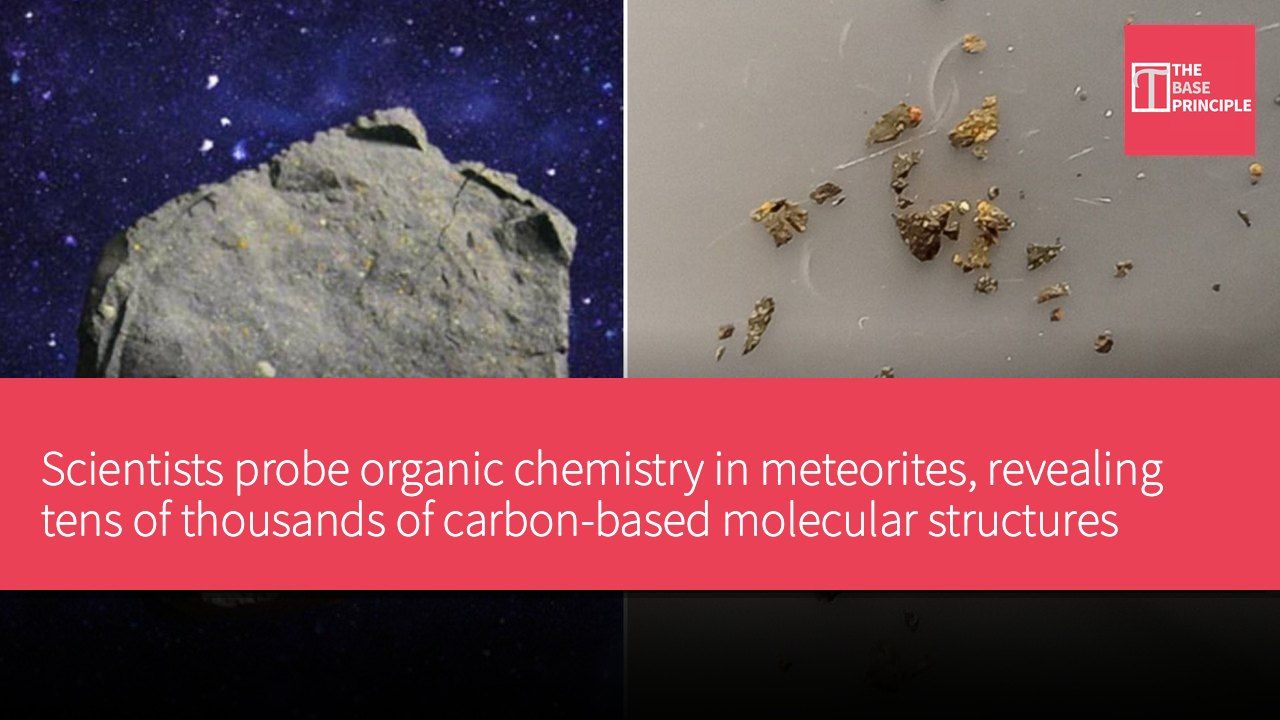
- Scientists studied the organic chemistry inside meteorites, revealing tens of thousands of carbon-based molecules.
- The Murchison meteorite is a carbonaceous chondrite rich in organic material.
- The study shows that the molecular fingerprints of the Murchison and Aguas Zarcas meteorites differ significantly.
- The new techniques reveal not only molecular compositions but also images of individual molecular structures.
Scientists have carried out an unusually detailed study of the organic chemistry preserved inside two meteorites, uncovering tens of thousands of carbon-based molecules and producing the first structural images of individual molecules. The research brought together scientists from the National High Magnetic Field Laboratory (MagLab), Florida State University and Brookhaven National Laboratory. The team used MagLab's ultra-high-resolution mass spectrometer and Brookhaven's atomic-scale microscope to examine fragments of the Murchison meteorite, which fell in Australia in 1969, and the Aguas Zarcas meteorite, which fell in Costa Rica in 2019.
The findings were published in The Planetary Science Journal.
Meteorites as chemical time capsules
Meteorites can act as chemical time capsules, preserving material from the formation of the solar system. The Murchison meteorite is particularly valuable because it is a carbonaceous chondrite rich in organic compounds and has been extensively studied since it fell. The new analysis used MagLab's 21 Tesla Fourier transform ion cyclotron resonance (FT-ICR) mass spectrometer, which can distinguish a vast number of compounds in extremely complex mixtures. Before analysis, the researchers dissolved tiny fragments of the meteorites in an organic solvent. The technique revealed tens of thousands of carbon-based molecular compositions in each meteorite.
That figure does not mean scientists identified tens of thousands of completely unique molecular structures. Mass spectrometry mainly reveals the molecular formulas present, and different structures can share the same molecular formula.
Brookhaven scientist Percy Zahl used a high-resolution non-contact atomic force microscope to examine individual molecules in the meteorite material. The technique uses an extremely sharp probe that hovers above the surface. The microscope does not physically touch the molecules but instead measures the interactions between the probe and the material to image their structure. Knowing a molecule's elemental composition does not necessarily reveal how its atoms are connected. Different arrangements can produce molecules that share the same chemical formula but differ in structure. The researchers noted that successfully imaging individual molecules within such complex mixtures can require painstaking work lasting from days to months.
The team noted that this is only the third reported use of such a microscope on meteorite material.
Chemical signatures of different meteorites
This combination effectively gave scientists two complementary perspectives: mass spectrometry provided a broad chemical inventory, while the microscope could reveal the structure of selected molecules. The comparison of Murchison and Aguas Zarcas produced another important result. Although both meteorites belong to the same class of carbon-rich meteorites and look similar, their molecular fingerprints differ significantly. Only a relatively small portion of their complex molecular inventories overlap. This indicates that the parent asteroids of these materials experienced different chemical environments during their formation and subsequent evolution. The result adds to evidence that the early solar system was not chemically uniform.
Asteroids can experience different combinations of heating, alteration, water-driven reactions and other processes, leaving distinctive chemical signatures that are eventually delivered to Earth. Murchison itself is especially ancient. The researchers describe it as being at least 5.5 billion years old, making it older than Earth and providing a window onto the material that existed before our planet formed.
The findings do not show that life, or even direct precursors of life, came from these meteorites. Instead, they demonstrate the chemical richness of extraterrestrial material. Organic compounds are widespread in meteorites, and some preserve material that existed before or during the earliest stages of solar system formation. The Murchison meteorite had previously yielded evidence of presolar grains—tiny materials produced before the Sun formed and preserved within the meteorite. The Field Museum in Chicago, which holds much of the Murchison meteorite, has described it as one of the most extensively studied carbonaceous chondrites.
The new work pushes this investigation toward greater precision: rather than merely asking which elements and molecules survive, it begins to determine what individual extraterrestrial molecules actually look like. This combination of chemical mapping and molecular imaging could give researchers a more detailed picture of the early solar system's organic inventory and help scientists better understand the chemical starting conditions from which planets, and eventually life, emerged.
What meteorite research reveals about the early solar system
The study of meteorites offers deep insights into the chemical environment of the early solar system. The distinctive character of the Murchison meteorite shows that meteorites not only preserve material from the formation era but also reflect the chemical evolution of different asteroids. These findings underscore the chemical diversity of the early solar system and provide important clues to the conditions surrounding the origin of life. The organic compounds in meteorites may be precursors to life, further fueling the search for extraterrestrial life.