
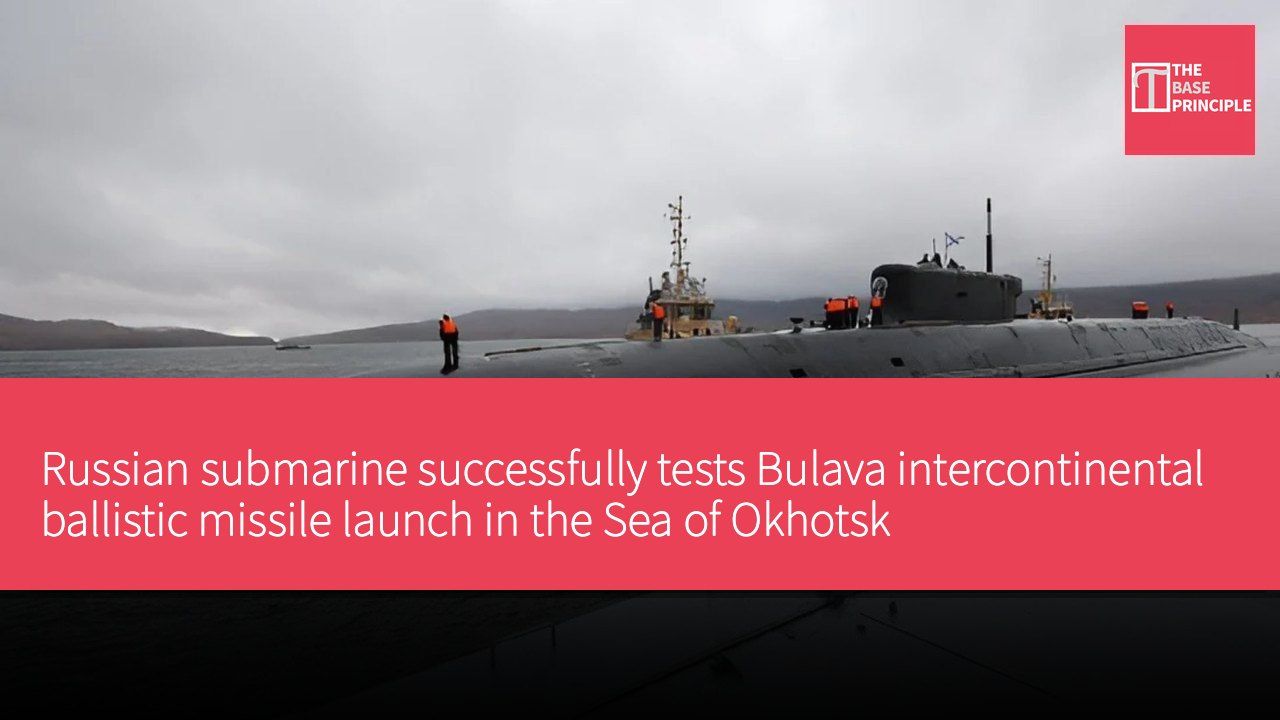
- Russian submarine successfully tests Bulava intercontinental ballistic missile launch.
- The submarine launched the missile from underwater, demonstrating its flexibility and stealth.
- The Bulava missile is a key sea-based nuclear weapon for the Russian Navy.
- This test underscores the importance of submarines in Russia's combat training.
Russia has conducted a test launch of a Bulava intercontinental ballistic missile from a submerged nuclear submarine in the Sea of Okhotsk. According to the Russian Ministry of Defense, the missile was aimed at a designated test range located in the Arkhangelsk region of Russia. The launch took place on October 28 and was part of a scheduled combat training exercise. The submarine "Dmitry Donskoy," part of the Russian Pacific Fleet, is equipped with weapons designed for the country's sea-based nuclear deterrent.
This test involved the underwater launch of a strategic missile, with the submarine operating in Russia's Far East and targeting a site thousands of miles away in northwestern Russia. The Russian Ministry of Defense stated that the crew launched the Bulava missile towards the Kura test range in the Arkhangelsk region. The Ministry did not disclose the flight time of the missile or detailed results of the test.
Technical Requirements for Submarine Missile Launches
Launching a ballistic missile from underwater requires precise coordination between the submarine and its weapon systems. The crew must follow launch protocols while the submarine remains submerged, allowing it to fire without surfacing. This capability is central to the role of ballistic missile submarines. Compared to fixed land-based launch sites, submarines' operational capabilities at sea provide greater flexibility.
The Bulava missile is the primary weapon of Russia's Borei-class strategic submarines. These missiles provide the Russian Navy with a sea-based nuclear weapon delivery option as part of the country's broader deterrent strategy. The Dmitry Donskoy submarine, also known as K-553, belongs to the 955A Borei-A class. Russia developed these nuclear submarines to carry strategic missiles while improving the design of earlier submarines.
Submarine Design and Performance Characteristics
The Dmitry Donskoy submarine is approximately 558 feet long, with a surface displacement of about 14,720 tons, which increases to around 24,000 tons when submerged. The submarine is powered by a nuclear reactor, allowing it to travel at about 15 knots on the surface and reach speeds of up to 29 knots while submerged. It carries 16 Bulava intercontinental ballistic missiles. The vessel integrates updated equipment and technological systems, designed to reduce detectable physical signatures and enhance protection during operations.
This submarine was designed by the Rubin Central Design Bureau for Marine Engineering in St. Petersburg. Construction began on December 26, 2014, and it was officially commissioned into the Russian Navy in 2022. The submarine was initially part of the Russian Northern Fleet and was transferred to the Pacific Fleet in October 2023, arriving at its permanent base on the Kamchatka Peninsula. This move incorporates the vessel into Russia's Pacific submarine force, which operates in the country's eastern maritime corridors.
Role of Submarines in Strategy
The Sea of Okhotsk provides a crucial operational area for Russia's naval forces stationed in the region. According to Russian reports, Borei-class and Borei-A submarines carry 16 Bulava intercontinental ballistic missiles. Nuclear power enables them to remain on station at sea for extended periods without needing to refuel, unlike conventional submarines. The combination of underwater launch capability and long-range missiles makes these vessels a significant component of Russia's strategic arsenal. Submarines can operate far from fixed launch facilities, complicating efforts to track their movements.
This test confirms the continued involvement of the Dmitry Donskoy submarine in Russia's combat training program. However, the Ministry of Defense has released limited details regarding the missile's performance or the specific objectives of the exercise. The launch did not indicate any changes in the capabilities of the Bulava missile. Its significance lies in demonstrating the submarine's ongoing role in training as one of Russia's primary sea-based nuclear weapons.
Strategic Significance of Submarine Tests
The test of the Bulava intercontinental ballistic missile underscores the critical role of Russian submarines in sea-based nuclear deterrence. The submarine's underwater launch capability not only enhances its operational flexibility but also allows it to execute missions from concealed positions, thereby improving survivability. As the submarine is transferred to the Pacific Fleet, this test highlights Russia's military presence and strategic deployment in the region, emphasizing the importance of naval power in the current geopolitical environment.