
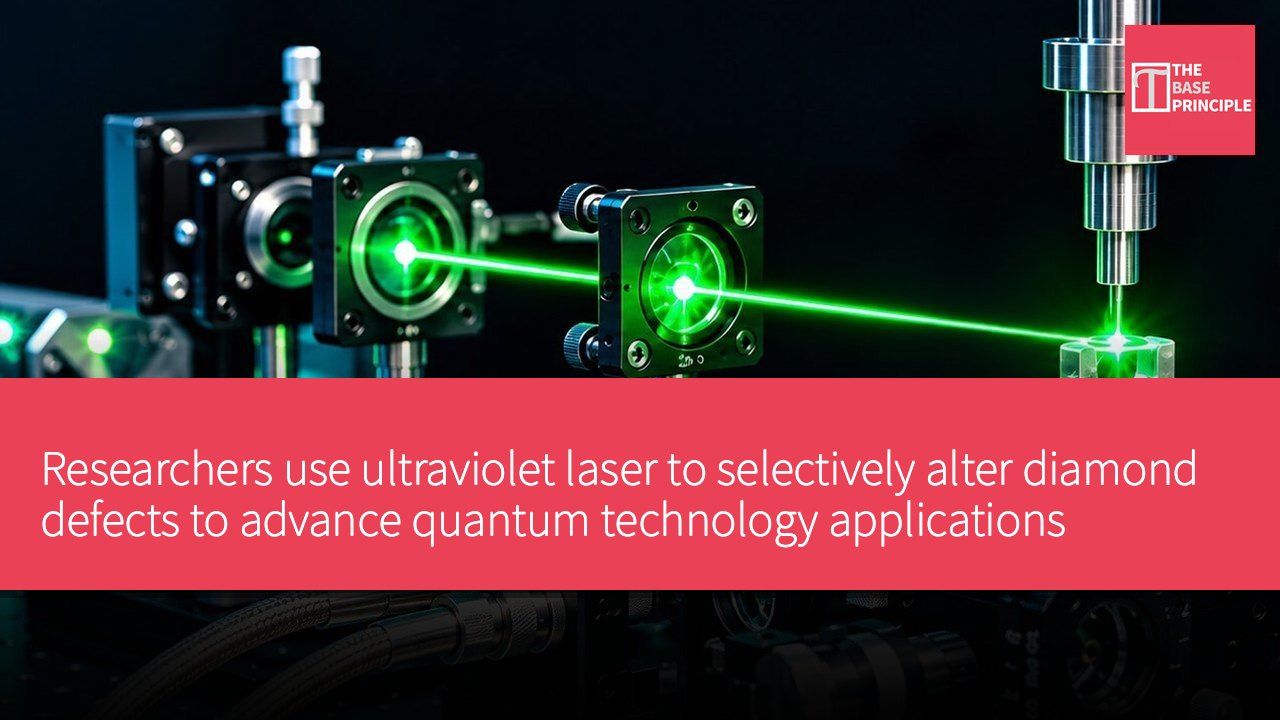
- Researchers use nanosecond ultraviolet laser pulses to modify diamond's optical properties.
- Nanosecond laser pulses enable selective engineering of diamond defects.
- New photoluminescence signals detected after irradiation, indicating defect changes.
- The study has not demonstrated a working quantum device or repeatable creation of specific defects.
Inside a diamond, a misplaced atom or a vacancy in the lattice may be the key to improving quantum technology. However, altering such defects without disturbing others while keeping the material practical has been a major challenge. Now, in a new study, researchers used nanosecond ultraviolet laser pulses to modify the diamond's optical properties while largely preserving its existing nitrogen-vacancy (NV) centers. The finding offers a more selective approach to engineering diamond defects. "Our study demonstrates that nanosecond laser pulses can achieve selective engineering of diamond point defects, with potential for deterministic control of diamond color centers in quantum applications," the researchers said.
Diamond consists of carbon atoms arranged in a lattice. When atoms are displaced, missing, or replaced by other elements, defects arise that give the material new optical and electronic properties. One example is the nitrogen-vacancy center, which forms when a nitrogen atom replaces a carbon atom adjacent to a vacancy in the lattice. NV centers can serve as quantum bits, or qubits, and as highly sensitive sensors for magnetic and electric fields. However, modifying one type of defect can also affect nearby defects, making it difficult to tailor diamond for specific applications.
Research Methods and Experimental Design
To investigate whether light could provide greater control, the researchers irradiated a single-crystal diamond grown by chemical vapor deposition (CVD).
They used 266-nanometer ultraviolet laser pulses, each lasting six nanoseconds, to irradiate localized regions of the crystal. The laser's fluence — energy delivered per unit area — ranged from 2.2 to 8.6 joules per square centimeter. Before irradiation, the team characterized the diamond using confocal photoluminescence spectroscopy, ultraviolet-visible absorption spectroscopy, and Fourier-transform infrared spectroscopy. These techniques helped determine the crystal's initial optical defects, transparency, and impurity content. The starting material contained almost no substitutional nitrogen, meaning nitrogen atoms replacing carbon atoms in the lattice.
Establishing this baseline was crucial: without it, researchers could not confidently distinguish defects associated with the laser treatment from those already present in the diamond.
Observation of Photoluminescence Signals
After irradiation, the researchers detected a photoluminescence signal at 563 nanometers in the exposed regions that was not present before. A second emission signal appeared near 579 nanometers. Previous studies have linked these emissions to carbon interstitial defects, where carbon atoms occupy sites outside their normal lattice positions. However, the more important observation was what did not change. The NV centers already present in the diamond retained nearly identical optical signals after laser treatment compared with untreated regions. "We show that these nanosecond laser pulses can selectively engineer the 563-nanometer center — the interstitial-related defect — without affecting the background nitrogen-vacancy (NV) centers," the study authors said.
This indicates that the laser can modify a subset of the defect ensemble under the tested conditions without significantly disturbing another subset.
This distinction is crucial because the 563-nanometer and 579-nanometer centers have not been established as newly demonstrated qubits. Instead, the experiment points to a possible way to engineer specific defects while preserving the existing centers associated with diamond quantum sensors. The researchers also found that the 563-nanometer emission signal does not increase indefinitely with continued irradiation. Its signal may decrease after reaching a maximum, suggesting that irradiation can both create and transform defect configurations. The emission intensity showed a near-linear relationship with laser fluence, with a measured power-law exponent of 1.10 ± 0.16.
This is consistent with a single-photon excitation process rather than one requiring multiple photons to act together.
Unresolved Atomic-Scale Mechanisms
The specific atomic-scale mechanisms occurring inside the diamond remain unresolved. The researchers propose that ultraviolet photons may excite defect-related electronic states, and subsequent energy transfer could trigger rearrangement of nearby carbon atoms. Processes involving trapped charge carriers or excitons may also play a role, but the experiment did not establish a complete pathway or identify the precise atomic structures responsible for the two emissions. The claimed control over diamond's optical properties could ultimately benefit quantum sensing and other devices that rely on carefully chosen defects. However, the study has not demonstrated a working quantum device or proven that specific defects can be created on demand in a fully repeatable manner.
The next step is to determine exactly how the defects transform and how to consistently control those changes by tuning the laser conditions. If researchers can link irradiation parameters to predictable atomic changes, it may eventually be possible to design diamonds with tailored defect ensembles rather than treating their defects as an inseparable mixture. The study was published in the journal Diamond and Related Materials.
Item Specification 鐳射波長 266 納米 脈衝持續時間 6 納秒 能量密度範圍 2.2 至 8.6 焦耳每平方釐米
Potential Impact of Ultraviolet Laser on Quantum Technology
The study shows that using ultraviolet lasers can selectively alter specific defects in diamond without disturbing other important defects, which is crucial for the development of quantum technology. Diamond's nitrogen-vacancy centers (NV centers) play an important role in quantum computing and sensors, so precise control of these defects will help improve the performance of quantum devices. Although a working quantum device has not yet been realized, this research provides new ideas and possibilities for future quantum applications, especially in designing diamonds with specific defects.