
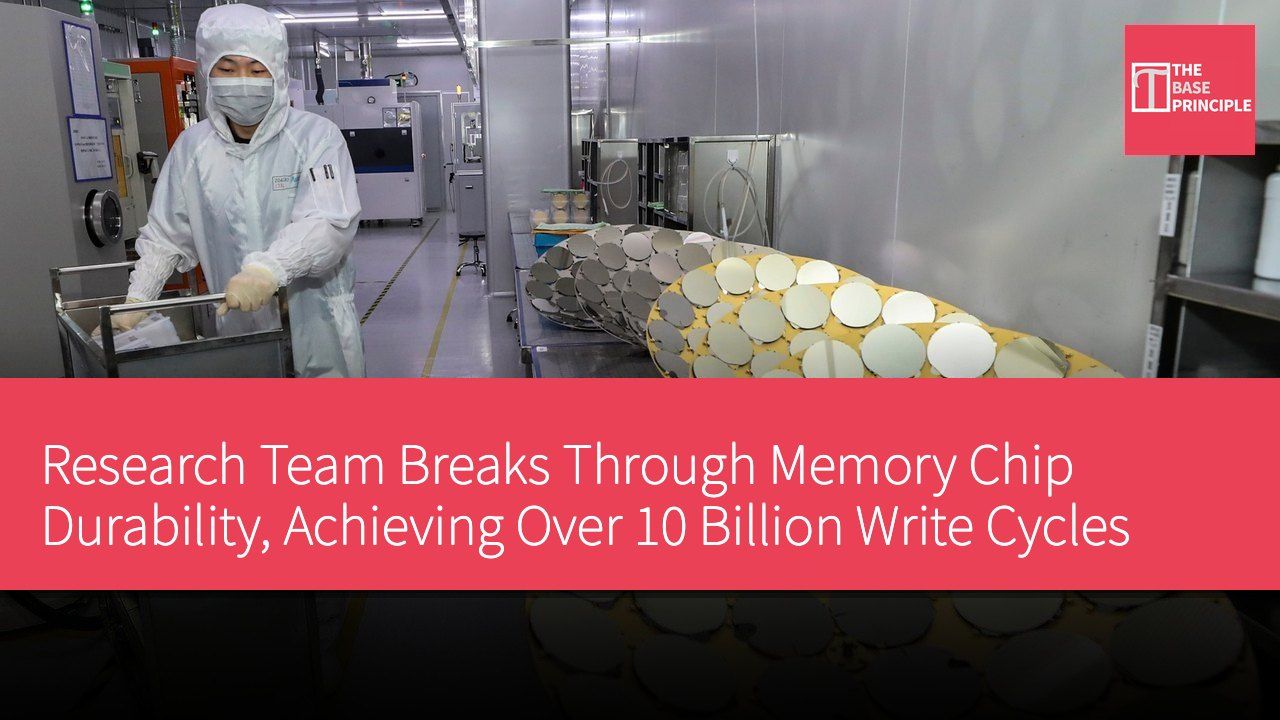
- The research team significantly improved memory chip durability, achieving over 10 billion write cycles.
- New generation memory materials like aluminum scandium nitride are gaining attention for their low energy consumption potential.
- Nitrogen vacancies are the main reason affecting material durability and need to be restricted in movement.
- This research points to the possibility of more dense and lower power consumption memory chips in the future.
A group of researchers has found a way to significantly improve the durability of a new class of memory chips. This advancement could remove a major barrier to the technology's application in high-performance computing, at a time when the boom in artificial intelligence is driving demand for faster and more reliable semiconductors. The team demonstrated over 10 billion write cycles in the material, which is about 100 times the durability achieved by the same technology previously. The research, led by scientists from Xidian University and conducted in collaboration with City University of Hong Kong and Fudan University, was published in the journal Science on Thursday.
The Potential and Challenges of New Materials
With the rise of new generation memory materials, rhombohedral ferroelectric materials like aluminum scandium nitride (AlScN) are increasingly attracting attention. Their appeal lies in their fast switching speed and potential for low energy consumption. The material is also compatible with existing semiconductor manufacturing processes, a practical advantage that could simplify its entry into future memory devices. However, this promise encounters a persistent obstacle. Existing AlScN devices typically fail after about 100 million write cycles, far below the billions of cycles needed for commercial use.
Researchers have traced the main reason for the rapid failure to nitrogen vacancies, which are places in the material structure where nitrogen atoms are missing. Wang Ruiqing, a doctoral student at Xidian University, provided a simple analogy to describe the problem. She said that the ferroelectric material can be imagined as a neatly planted cornfield, and the nitrogen vacancies represent places where seedlings are missing.
The actual problem is not just how many vacancies exist, but how these vacancies behave as the material begins to undergo repeated switching. Nitrogen vacancies may move and cluster together over time, eventually forming channels for current to pass through the material, leading to failure. Wang Ruiqing said that early researchers could observe device failure and even record some symptomatic results. However, no one had explained what was actually happening at the atomic scale, how the vacancies moved, and how this movement ultimately led to failure.
Innovations to Solve the Nitrogen Vacancy Problem
The team solved this problem by designing a layered structure that specifically restricts the movement range of nitrogen vacancies. By limiting their motion and preventing them from clustering together, the researchers significantly slowed the material's degradation, allowing it to withstand over 10 billion write cycles in tests.
Nevertheless, these findings are currently still at the laboratory stage. They point to a feasible path for using such materials to build denser and lower power consumption memory chips. As the global demand for faster and more reliable semiconductors continues to rise, this advancement comes at an opportune time, as the broader boom in artificial intelligence is also driving up this demand. This demand makes the effort to make rhombohedral ferroelectric materials durable enough for practical everyday computing hardware increasingly urgent.
The Potential Impact of New Memory Chip Technology
With the rapid development of artificial intelligence, the demand for high-performance semiconductors is increasing. The breakthrough by the research team not only improves the durability of memory chips but also provides new possibilities for future computing hardware. The application of new materials like aluminum scandium nitride, if the durability issue can be overcome, may change the design and performance of memory devices, promoting the emergence of higher performance computing platforms. This advancement not only helps improve the feasibility of technological applications but also drives innovation and development in the entire semiconductor industry.