
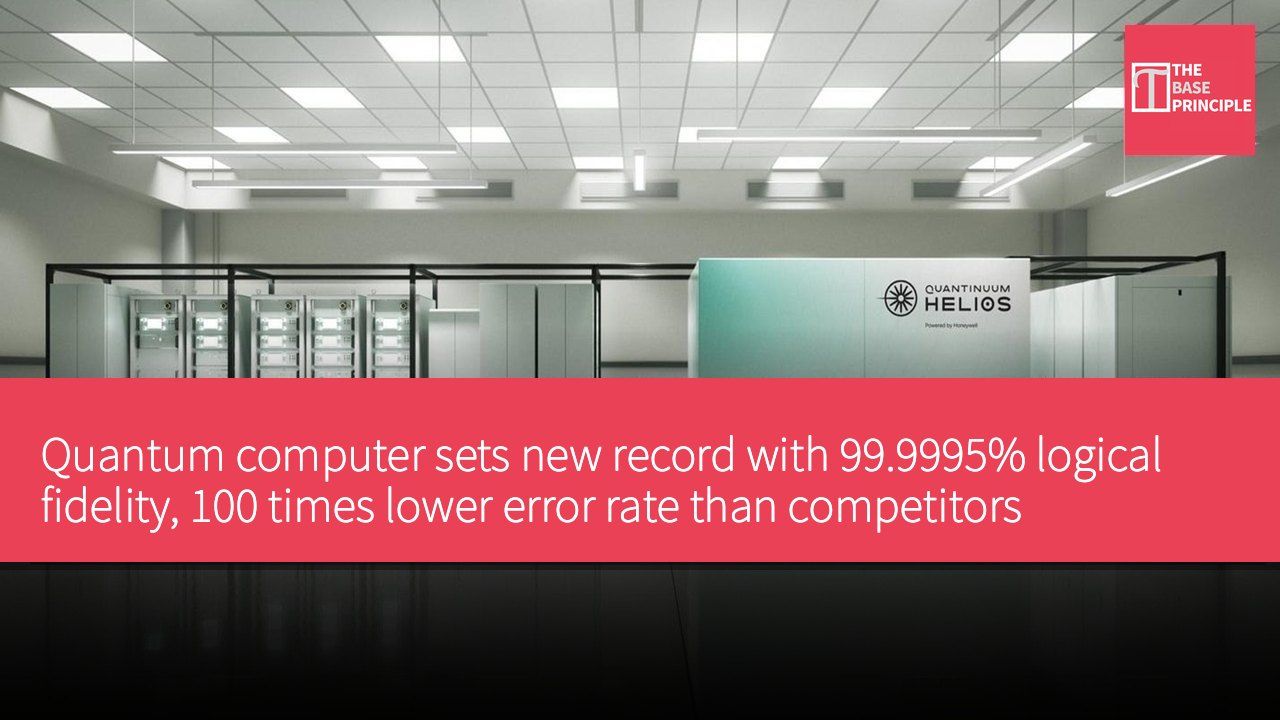
- Quantinuum's quantum computer achieved 99.9995% logical fidelity, with an error rate significantly lower than competitors.
- The computer's error rate is ten times lower than the previous record, approaching practical use.
- The use of color code technology for quantum error correction sets a new benchmark.
- The team's research indicates that the number of physical qubits required for a practical fault-tolerant system may be lower than expected.
Reportedly, the world's most precise quantum computer has achieved a new quantum error correction record, reaching a logical fidelity of 99.9995%, with an error rate 100 times lower than that of Google Quantum AI's published results. The 98-qubit trapped ion commercial quantum computer from Quantinuum, located in Colorado, demonstrated only five errors per million logical operations in its latest tests. According to the company, this result brings quantum computing closer to everyday use. The computer's error rate is currently ten times lower than its previous record set in September 2026.
Furthermore, this figure is 100 times lower than the best results published by Google Quantum AI's competing hardware technology. Quantinuum stated that this achievement brings it closer to developing a general fault-tolerant quantum computer named Apollo, which is expected to be launched in 2029. Dr. Rajeeb Hazra, CEO of Quantinuum, stated, "With this result, we have demonstrated that we possess the error correction architecture and trapped ion technology needed to achieve general fault tolerance."
Technological Advances in Quantum Error Correction
Quantum computers use qubits to process data, but these qubits are extremely sensitive to external interference. Heat, stray electromagnetic signals, vibrations, and cosmic rays can disrupt their fragile quantum states, leading to errors during computation. Therefore, scientists employ quantum error correction to reduce errors. This method combines multiple physical qubits into more reliable logical qubits to better protect information. In the latest experiments, Quantinuum utilized a technique called color codes on its commercial Helios system, achieving 99.9995% logical fidelity, thereby setting a new benchmark for quantum error correction.
The Helios chip generates tiny electromagnetic fields.
Performance Evaluation of the Helios System
At the same time, the team evaluated Helios's performance as the coding distance increased, which determines the strength of protection for quantum information against errors. Each increase in testing reduced the remaining logical errors by a factor of 12. According to the team, further increases in error correction could significantly enhance the reliability of the quantum computer. Tests also indicated that the number of physical qubits required for a practical fault-tolerant system may be fewer than expected. Dr. Robin Blume-Kohout, co-director of the Quantum Performance Laboratory at Sandia National Laboratories, which did not participate in the research, described this result as a significant milestone.
He stated, "This paper demonstrates a real and substantial performance improvement in quantum error correction—one logical qubit's performance is nearly 100 times that of its constituent physical qubits."
This news comes after the company announced its first major breakthrough last month. At that time, the team showcased record logical memory and computation using another error correction method called Helix. Both experiments were conducted on the same Helios hardware, demonstrating that the company could enhance performance by changing the error correction method without replacing the computer. The Helix method requires ten physical qubits for each logical qubit, while the new color code uses up to 37. Although the color code requires additional qubits, it offers significantly lower error rates.
To detect and correct errors during quantum computation, Quantinuum combined artificial intelligence decoding with real-time error correction. The company believes that the latest results strengthen its plans to launch Apollo in 2029. Blume-Kohout stated in a press release, "An expanded version of this system could achieve the reliability needed for practical fault-tolerant computing, requiring fewer than one million physical qubits, which improves the prospects for practical quantum computing." These findings represent significant progress in addressing core technological risks in the field.
New Milestone in Fault-Tolerant Quantum Computing Technology
Quantinuum's latest achievements in quantum computing demonstrate significant advancements in quantum error correction technology. Through color code technology, the company has not only improved logical fidelity but also indicated potential optimizations in the number of physical qubits, which is crucial for future quantum computer designs. These advancements not only enhance its competitiveness in the market but also pave the way for practical fault-tolerant quantum computing, potentially transforming the application landscape of quantum computing.