
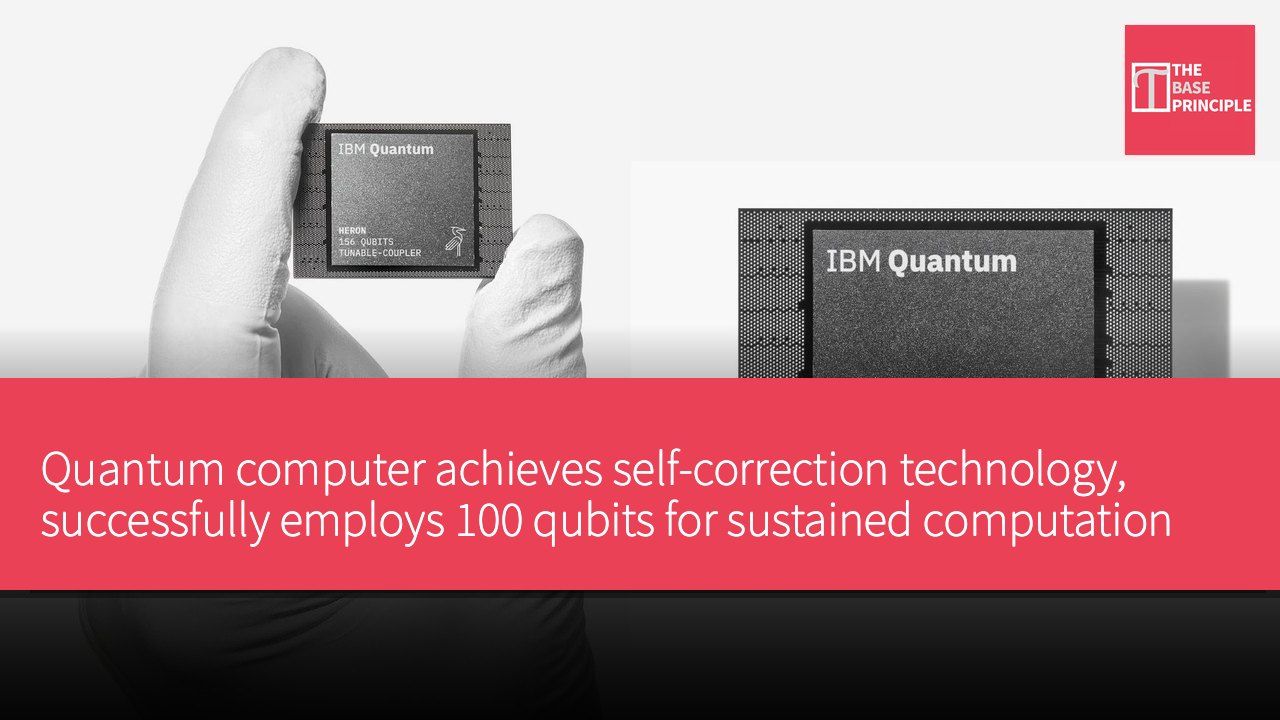
- Researchers demonstrate quantum computer can perform sustained computation while self-correcting.
- Fragile qubit states can degrade due to environmental interactions, requiring quantum error correction systems.
- Adjusting process frequency in experiment can trigger dramatic changes in system behavior.
- This demonstration does not establish a fully fault-tolerant quantum computer, but shows scalability.
Quantum Computing's Unique Challenges
Resetting Qubits to Restore Order Quantum computers process information differently from classical computers. Their qubits can exist in a superposition of multiple states, granting capabilities that classical bits cannot directly replicate. However, these fragile states can degrade due to interactions with the environment and hardware imperfections. During computation, errors accumulate continuously, ultimately rendering results unreliable. Therefore, researchers must develop systems capable of detecting and correcting these errors while computation continues. This approach, known as quantum error correction, forms the foundation of fault-tolerant quantum computing. The team tested using an IBM Quantum Heron processor with 156 qubits. Researchers selected a connected chain of up to 100 qubits for the experiment. They alternated between two competing processes. One process scrambles information between neighboring qubits, spreading disorder within the system; the other continuously measures individual qubits and resets them to a predetermined state. The experiment involved nearly 5,000 two-qubit operations and nearly 5,000 measurement-and-reset cycles, allowing researchers to investigate how repeated interventions counteract the scrambling process. Sharp Change in Chaos Researchers adjusted the frequency of each process to determine which behavior dominated. When the scrambling process occurred more frequently, the system remained in a chaotic state. Conversely, when measurement and reset processes occurred frequently, the system advanced toward an ordered, controllable state. The most pronounced change occurred near a 50-50 balance between the two processes. Small adjustments in relative frequency could trigger dramatic changes across the entire system. Physicists call this phenomenon a phase transition, describing a collective change in system behavior, similar to water freezing.Impact of Random Interventions
Louisiana State University associate professor of physics and study co-author Justin Wilson explained that random interventions can suppress otherwise unpredictable behavior. Researchers also found that this transition persists in quantum systems, though its survivability remains uncertain. The results align with theoretical predictions. As researchers examined larger systems, the transition became more sharply defined, indicating the effect extends beyond small experimental circuits. Toward Fault-Tolerant Computing Real-time feedback will help future quantum processors manage errors during extended computations.Fault-tolerant machines must repeat these operations many times without destroying the information they process. IBM researcher Maika Takata said the experiment coordinated quantum operations, measurements, and resets thousands of times in a large system. She described this capability as an important step toward practical error correction. The team also tested larger systems that cannot be simulated on classical computers. This comparison bolstered confidence in the theoretical interpretation. Researchers from the City College of New York, Iowa State University, Penn State University, and other institutions also contributed to this work.
This demonstration did not establish a fully fault-tolerant quantum computer, but shows that current hardware can repeatedly intervene in a quantum system while operations continue, pushing scalable quantum computing toward a central engineering goal.Important Step for Quantum Computing Toward Fault Tolerance
The development of quantum computers faces unique challenges in information processing, particularly the fragility of qubits. This research demonstrates how continuous measurement and reset can manage errors, laying the foundation for quantum error correction. With the discovery of adjusting process frequencies in the experiment, researchers can control system behavior, which is crucial for the fault-tolerance capabilities of future quantum computing. Although this demonstration has not yet achieved full fault tolerance, it has shown the scalability of quantum computing, providing new hope for the future development of quantum technology.