
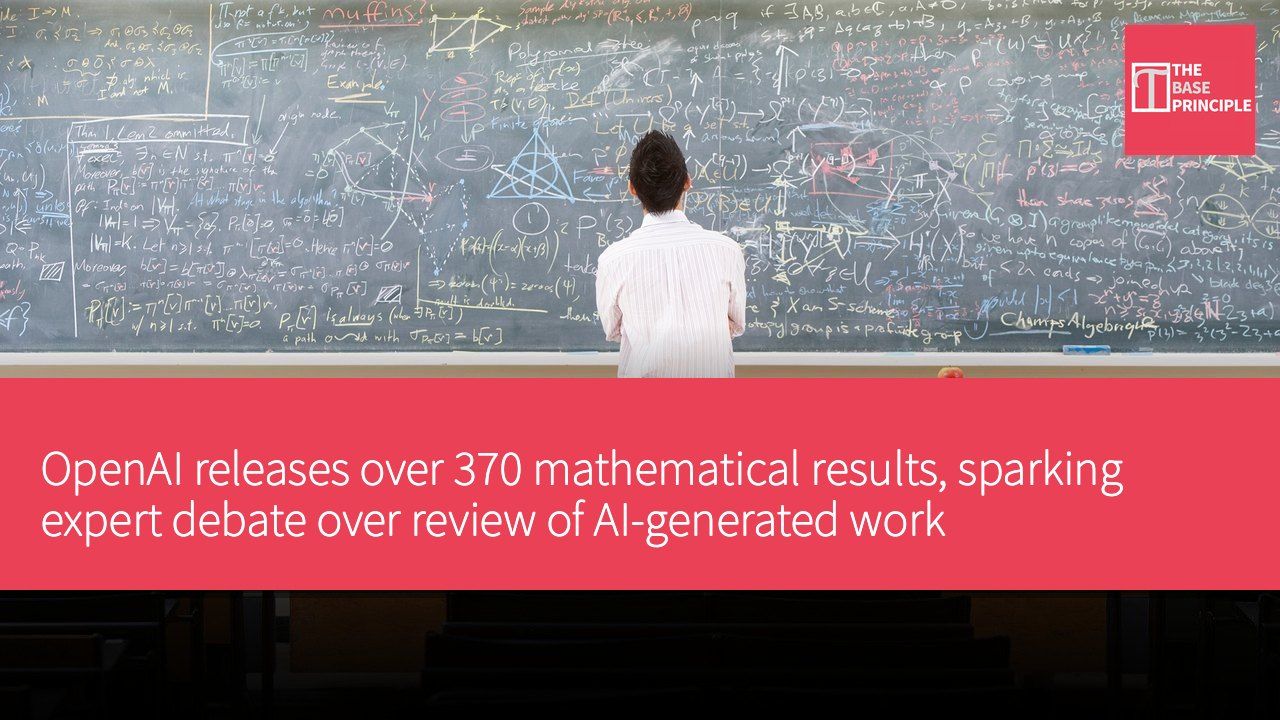
- OpenAI releases over 370 mathematical results, sparking review debate.
- Solution of Navier-Stokes equations raises higher expectations, experts concerned.
- Institute for Advanced Study warns of risks of AI-generated mathematical arguments.
- Mathematicians question ability to understand and verify AI results.
OpenAI has released more than 370 new mathematical results, surprising mathematicians and igniting discussion over how AI-generated work should be reviewed and who has the authority to review it. According to the Guardian, the research unveiled by the company on Tuesday spans algebra, theoretical computer science, and mathematical logic. The Times puts the figure at 377, reporting that OpenAI claims to have solved 377 mathematical equations that have puzzled experts for years. The release aims to showcase what some of OpenAI's most advanced AI models can achieve.
Impact of the Navier-Stokes equations
The solution of the Navier-Stokes equations has raised higher expectations. The release follows OpenAI's solution of the Navier-Stokes equations last month, one of the world's most challenging mathematical problems, which carries a $1 million prize for whoever can crack it, according to the Guardian. The achievement has sparked concern among leaders in the field. They say frontier labs should not test cutting-edge mathematical problems on proprietary AI models that are not accessible to the broader mathematical community.
Experts' concerns over AI-generated mathematics
The Institute for Advanced Study in Princeton, an independent body of mathematical experts, responded by stating it does not endorse this practice. In a statement, the institute warned that AI can now produce mathematical arguments while the individuals prompting it cannot understand, verify, or take responsibility for them. The statement noted that human understanding of mathematics "remains essential." The organization also raised a broader question: in this new era, how can researchers establish a paradigm in which human understanding of mathematics becomes a component of responsible scholarly output?
To address the community's concerns, OpenAI announced it would collaborate with the institute to give "mathematicians a voice in our future development." However, the company did not say it would stop testing its AI models on such advanced problems. Experts in the field worry that OpenAI may fail to subject the results to the necessary review.
Who should get the credit? Tristan Buckmaster, a mathematician at New York University, raised another concern in an interview with the New York Times. He said mathematicians prompting the AI model to solve equations might provide information that helps the model arrive at the answer. "There could be a series of results where they take someone's work and then finish it off," Buckmaster said, according to the Guardian.
Fundamental tension in the mathematical community
The debate has also become more reflective. Kai Shaikh, a mathematics graduate student at the University of Toronto, told the Times that humans have two competing natures: a competitive instinct and a capacity to appreciate beauty. "To me, this looks like the former trying to strangle the latter," Shaikh said. Taken together, the reactions show mathematics grappling with a fundamental tension. OpenAI is publishing research results at a staggering pace, while mathematicians question whether those results can be understood, verified, and credited in the manner of traditional scholarly work.
The Institute for Advanced Study has yet to endorse the practice, while OpenAI has not explicitly said it will stop.
Challenges and responsibilities of AI-generated mathematical results
OpenAI's latest release has triggered questions in the mathematical community about the review of AI-generated work. As AI models make progress in solving complex mathematical problems, experts have questioned the ability to understand and verify their results. The Institute for Advanced Study's statement emphasized the importance of human understanding of mathematics and called for establishing a paradigm of responsible scholarly output. This discussion of AI-generated mathematical results reflects academia's struggle between technological advancement and traditional scholarly standards, and future development will require deeper collaboration and reflection.