
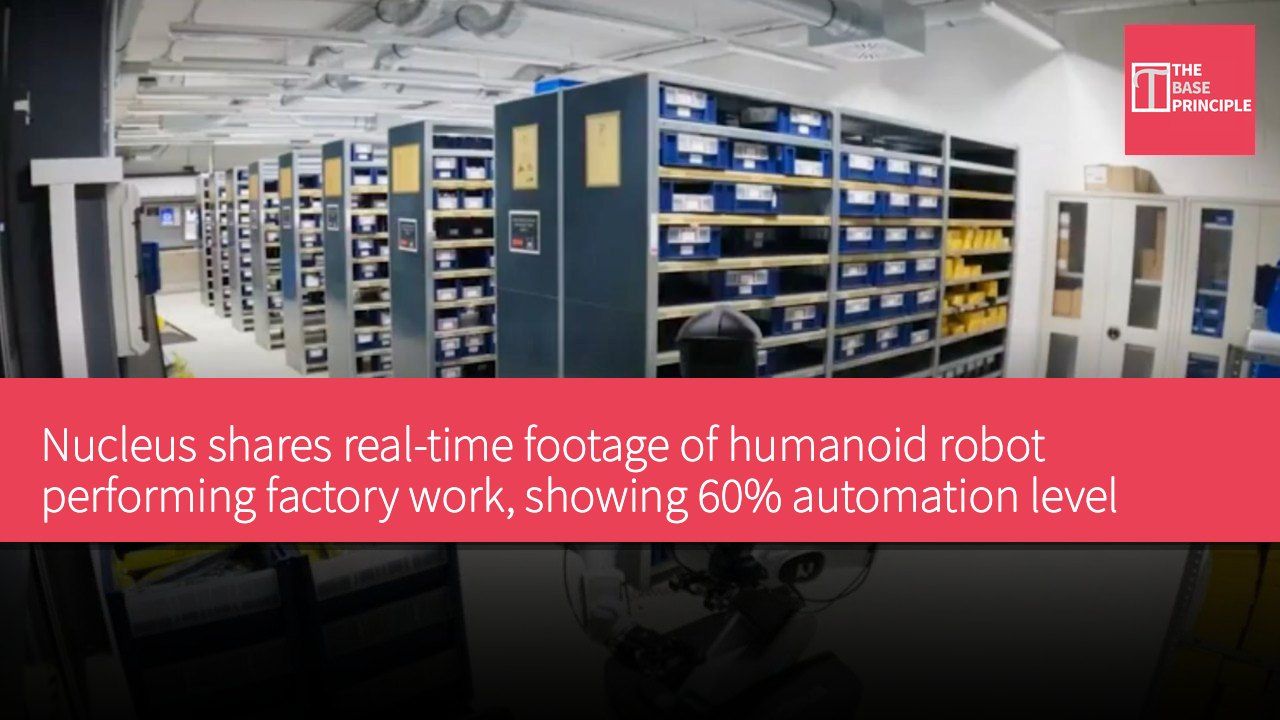
- Nucleus shares unedited footage of humanoid robot performing factory work.
- Robot approximately 60% automated, 40% reliant on human assistance in demo.
- Company emphasizes sustained work over perfect demos, conducts regular work shifts.
- Footage shows real-world challenges and interventions faced by humanoid robots.
Humanoid robots are getting better at impressive demos, but the tougher test is whether they can sustain useful work for hours. Nucleus is now offering a less glamorous demo, sharing nearly two hours of unedited factory work and acknowledging the robot still relies heavily on human assistance. In an Oct. 1 update, Nucleus founder and CEO Melvin Schwarz shared footage of the company's humanoid worker performing routine factory tasks; the recording is unedited, capturing hesitations and human interventions rather than just successful operation clips.
According to the company, this demo was approximately 60% automated and 40% teleoperated. The company did not specify how it calculates these percentages, so they should be treated as a description of this particular demo rather than a general measure of Nucleus autonomy.
Robot Automation and Human Assistance Ratio
Nucleus is pursuing sustained work, not perfect demos. The company is adopting a different yardstick for robot progress — not short sequences under controlled conditions — but proving robots can remain useful across extended industrial workflows. Schwarz said on X that Nucleus now runs regular four- to six-hour shifts in which the robot completes a job from start to finish. That does not mean the robot operates autonomously for four to six hours without intervention; it describes the duration of the shifts the company reports, consistent with Nucleus's broader pattern of blending autonomous operation with human assistance when needed.
The company's website describes Nucleus as providing humanoid labor by the hour to factories, with current applications including part picking, shelf loading, product handling, and cart transport. Its system logs visual observations, depth data, robot motion, contact signals, human corrections, and task outcomes, creating data that can be used to improve its AI models. Human intervention is part of the strategy; Nucleus does not position teleoperation merely as a stopgap until its robots are fully autonomous. Human guidance is one of its methods for deploying robots in factories today.
The company says task prompts, expert instructions, and teleoperated corrections can provide learning signals when the robot needs help.
The Importance of Sustained Work
Its AI architecture is designed to capture those interventions and record what the robot sees and does, turning difficult moments into training data for later improvement. That creates a feedback loop between deployment and autonomy. The robot performs a task, encounters an unfamiliar situation, receives assistance, and logs the resulting trajectory. Those experiences can then be used to improve the system before the robot returns to the factory. This unglamorous work may be the sterner test. The footage also highlights the broader challenges humanoid robots face. A robot nailing a difficult move once does not mean it is ready for industrial work.
Factories need robots that can repeat tasks, recover from errors, and operate amid ordinary variations in lighting, object placement, and workflow.
Nucleus's own description of its approach emphasizes those factors, including whether the robot can recover from disturbances and whether learned skills transfer to different objects, layouts, and workdays. The nearly two-hour recording therefore represents a different kind of robot demo. It is not proof of full autonomy, and the disclosed 60/40 split leaves open the question of how much human attention the system requires. But by keeping interventions visible, Nucleus shows the less glamorous side of deploying robots in real work, and makes sustained, repeatable factory labor the benchmark it wants to improve against.
Item Specification Demo duration Nearly 2 hours Autonomous operation proportion 60% Teleoperation proportion 40% Shift length 4-6 hours
Challenges and Opportunities for Humanoid Robots in Factories
Nucleus's demo highlights the challenges humanoid robots face in factory environments. Although robots can now perform some tasks, they still require human assistance, revealing the limits of their automation. This dependence not only affects the robots' autonomy but also reflects factories' high demands for stability and reliability. Through this approach, Nucleus hopes to demonstrate its robots' adaptability in real work environments and continuously improve robot performance through human guidance, which is crucial for the future development of industrial automation.