
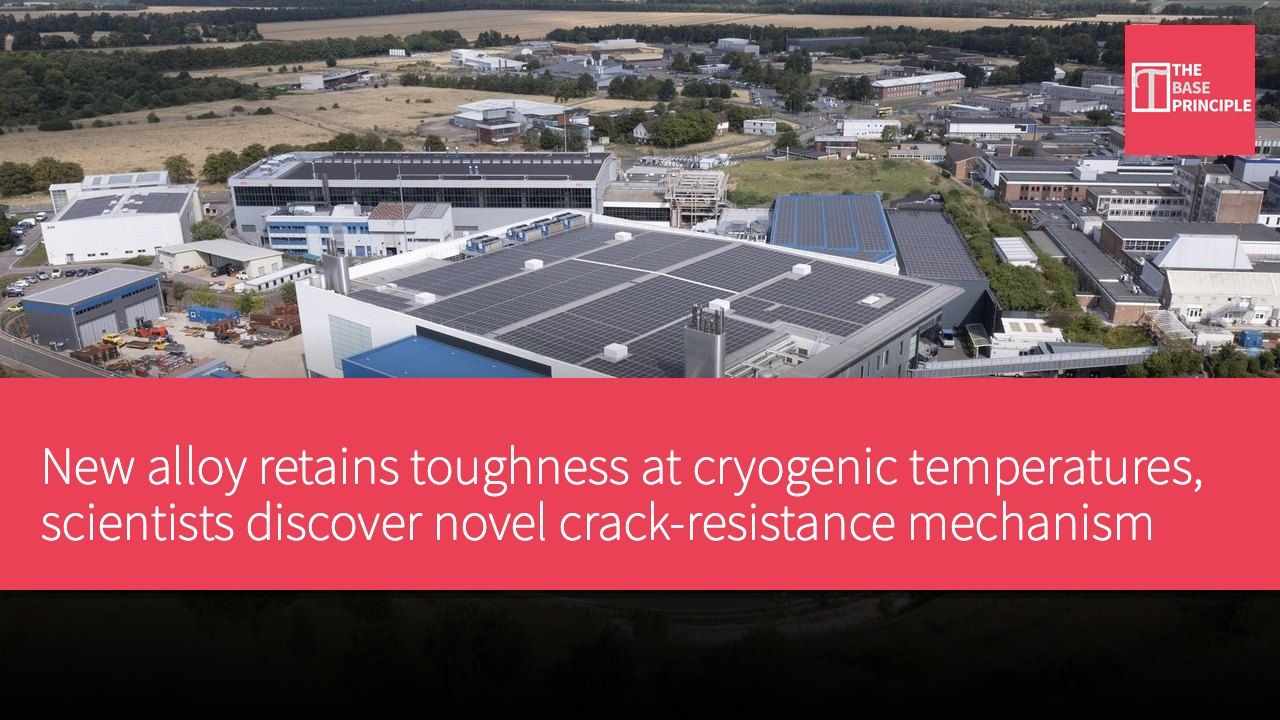
- New alloy retains toughness at cryogenic temperatures, avoiding fracture.
- Body-centered cubic metals typically become brittle at low temperatures.
- Nanoscale twinning assists metal deformation.
- Findings offer insights for designing materials for extreme environments.
A pair of experimental alloys remain tough at 20 kelvin (minus 423 degrees Fahrenheit or minus 253 degrees Celsius), temperatures at which similar metals typically become brittle and fracture. The research, led by an international team from the University of California, Berkeley, Lawrence Berkeley National Laboratory, and the University of Oxford, shows that niobium- and titanium-based alloys avoid failure through an unusual microscopic mechanism, which could guide the design of materials for cryogenic environments.
Why cold makes some metals fractureBrittleness of metals at low temperatures
Most metals grow stronger as they cool, but body-centered cubic metals — such as iron, tungsten, and chromium — become increasingly brittle as temperatures drop because of their atomic structure. At cryogenic temperatures, cracks that would normally be absorbed by the metal bending can instead cause it to break. The bending process in these metals relies heavily on dislocations, line defects in the crystal structure that slide through the material. In deep-cold conditions, dislocation motion becomes more difficult, limiting the metal's ability to deform around a crack and raising the likelihood of fracture.
A different deformation pathwayAlloy deformation mechanism
In these two alloys, a different process dominates. Researchers observed nanoscale twinning, in which small regions of the crystal adopt a mirror-image orientation, accompanied by a local change in crystal structure. When these newly formed regions reach the boundary of a neighboring grain, they create concentrated stress points that trigger new defects. Those defects allow the metal to continue deforming without fracturing. The team likens the effect to a road network rerouting around a frozen, closed road: when the usual deformation pathway becomes impassable, twinning opens new avenues for the required defects to form.
At the lowest test temperature, these alloys showed no measurable brittle transition.
Testing in cryogenic environmentsResearchers used the Engin-X instrument at the ISIS Neutron and Muon Source in Oxfordshire, cooling samples to approximately minus 253 degrees Celsius and testing them with helium gas. The test machine pulled each sample from both ends while probing it with a neutron beam, measuring the force the metal could withstand and how far it stretched before failure. Electron microscopy then revealed structural changes around cracks and within the material, while atom-probe analysis mapped the distribution of individual elements. Computer models helped explain how these mechanisms work together to prevent brittle failure.
Significance of the researchPotential applications of the research
Dong Liu, corresponding author from the University of Oxford's Department of Engineering Science, said the ductile-to-brittle transition has long been considered a fundamental limitation of body-centered cubic metals. He noted that these alloys remain "quite damage-tolerant" at 20 kelvin, providing a new avenue for designing structural metals that operate in extreme cryogenic environments — including components exposed to both extreme heat and cold in a single application. David Cook, lead author during the research at the University of California, Berkeley, and now at the University of Cambridge, said researchers have traditionally focused on how easily existing dislocations move.
He said the ability to create new dislocations at interfaces may be equally important, allowing designers to engineer microstructures that keep metals tough at extreme temperatures.
The researchers said the discovery could inform materials design for energy, transportation, and aerospace. Other participating institutions include the University of Bristol, the ISIS Neutron and Muon Source, the University of California, Irvine, Pacific Northwest National Laboratory, Texas A&M University, and Nanyang Technological University in Singapore. The study was first published in the journal Nature.
Application potential of new alloy in extreme environments
This research reveals the mechanism by which a new alloy retains toughness at cryogenic temperatures, challenging previous understanding of body-centered cubic metals. Traditionally, such metals become brittle at low temperatures, but the new alloy avoids failure through nanoscale twinning, demonstrating its application potential under extreme conditions. This has important implications for materials design in energy, transportation, and aerospace, potentially enabling the development of more durable structural metals and improving the reliability and safety of related technologies.