
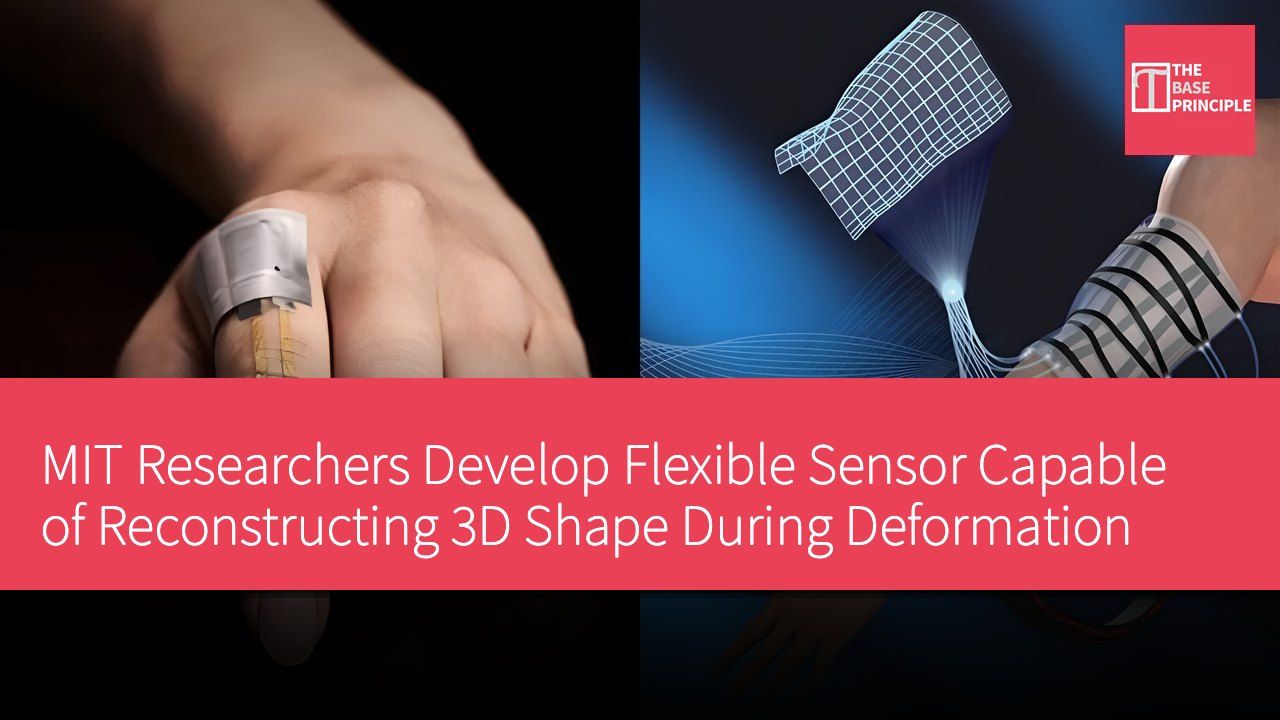
- Flexible sensor developed by MIT researchers can reconstruct 3D shape during deformation.
- The technology aids remote robot control and motion-tracking garments.
- Even with damaged fibers, the sensor can reconstruct overall shape with error under 0.4 centimeters.
- Future plans call for thinner optical fibers to capture finer body-motion details.
Researchers at the Massachusetts Institute of Technology have developed a flexible sensor that can reconstruct its own three-dimensional shape as it bends, folds and twists. The technology could aid remote robot control, enable motion-tracking garments, and measure patient progress during physical rehabilitation. The system embeds flexible optical fibers in silicone, using changes in transmitted light to track surface deformation. Software then converts those measurements into a digital reconstruction that follows the material's movement in near real time. Unlike motion-capture systems that rely on rigid sensors attached to clothing, this design uses flexible elements across its sensing surface and retains the ability to reconstruct the overall shape even when fibers are damaged.
The researchers fabricated the fibers with a flexible rubber core wrapped in a black rubber cladding. They deliberately roughened one side of each core to make its response to bending more pronounced. When a fiber bends, some light strays from its path. The roughened surface makes this effect more sensitive to the direction of the bend, allowing the researchers to estimate each fiber's curvature by measuring the light emerging from the opposite end. While a single fiber can detect curvature along a line, reconstructing an entire surface presents a greater challenge. The MIT team addressed this by embedding multiple fibers in a stretchable silicone sheet.
Fiber Design and Curvature Measurement
Computer simulations helped the researchers compare different fiber arrangements, including checkerboard and zigzag patterns. One specific zigzag configuration proved most effective at capturing complex changes in the sheet's shape.
The researchers built a physical sheet using that arrangement. LEDs sent light through the fibers, and sensors at the opposite ends measured the output. An external circuit board collected and amplified the readings. An algorithm converted the measurements into a three-dimensional representation of the sheet. In a demonstration, the researchers folded the material diagonally, and the digital counterpart morphed along with the geometry. They also placed the sheet on an accurately shaped 3D-printed mold to evaluate accuracy. According to Qifan Yu, a mechanical engineering graduate student at MIT, the reconstructed surface had an error of less than 0.4 centimeters.
Yu said similar systems using rigid sensors typically produce errors of about 1 to 2 centimeters. The team also showed that the sheet could still reconstruct its overall shape even when some fibers were cut or disconnected.
Potential for Physical Therapy
The researchers envision a garment that could let users control video-game characters or teleoperate robots. The technology could also help physical therapists measure patient mobility during rehabilitation. Therapists could wrap the material around a patient's arm or leg to record movement and range of motion. Repeated measurements would help clinicians compare mobility across sessions and assess recovery. Co-author Kaitlyn Becker, an assistant professor of mechanical engineering at MIT, said the technology can help therapists compare patient assessments over time.
Future Improvement Plans
The team now plans to make the fibers thinner. Their current fibers are about 1 millimeter thick, but improved manufacturing methods could reduce that to a few tens of micrometers. Thinner fibers would let researchers embed more sensing elements in a garment, potentially capturing finer details of body movement.
The research was published in the journal Advanced Intelligent Systems.
Application Potential and Challenges of Flexible Sensors
The development of this technology demonstrates the potential of flexible sensors in a variety of applications, particularly in remote control and physical rehabilitation. By enabling sensors to accurately reconstruct three-dimensional shape during deformation, it not only improves motion-capture accuracy but also helps medical professionals monitor patient recovery more effectively. In the future, as optical-fiber technology advances further, these sensors are expected to play an important role in a broader range of applications, especially in settings that demand high-precision motion tracking.