
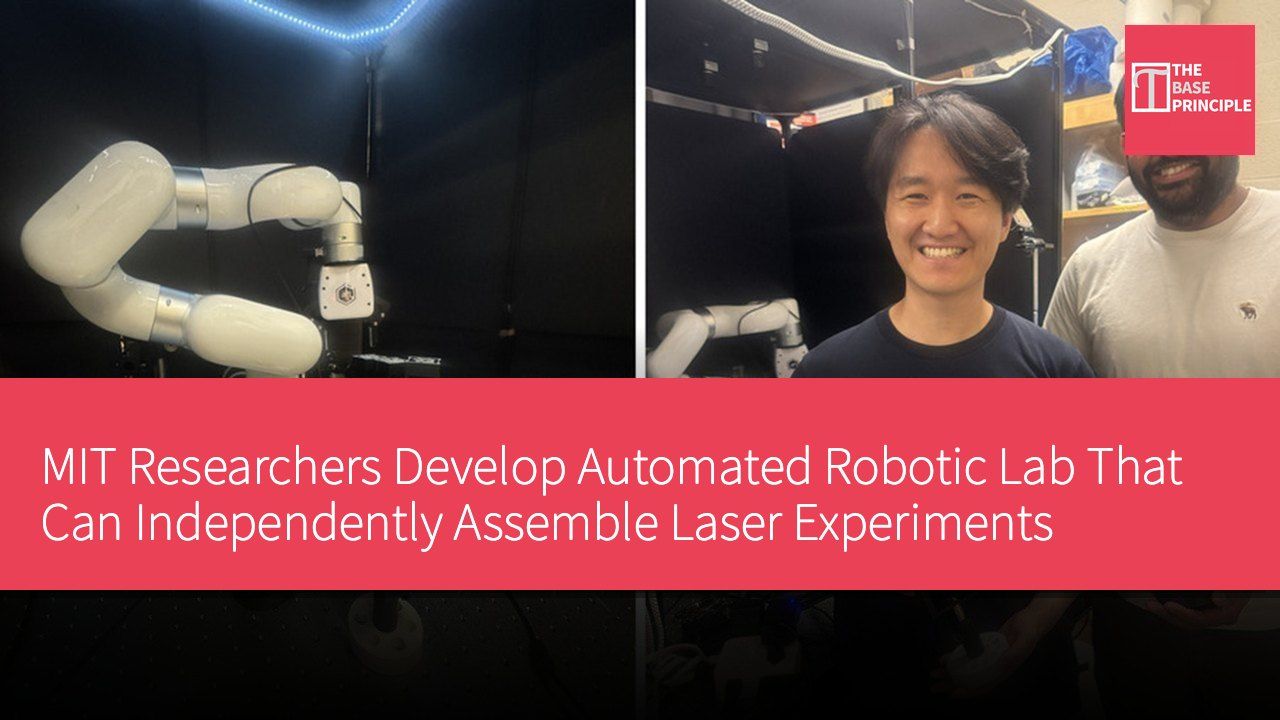
- MIT has developed an automated lab capable of autonomously handling optical experiments.
- The system can assemble and adjust laser cavities without human intervention.
- The fine-tuning tool's precision surpasses that of humans, improving operational consistency.
- The technology could accelerate scientific progress and assist industry with prototype testing.
Researchers at MIT have built an automated laboratory designed to autonomously handle the entire optical experiment process, from initial assembly to fine adjustments and final disassembly. The system uses robotic arms to pick up standard optical components and arrange them into a working configuration, then adjusts each component with micrometer precision to produce a beam with specific characteristics. The system can also safely disassemble completed experiments and reassemble the same components into entirely different setups, all without any human intervention.
Experiment Demonstrating System Capabilities
Researchers demonstrated the system's capabilities by having it autonomously construct and fine-tune a tabletop laser cavity, a structure that forms the core component of most optical experiments. Sachin Vaidya, a postdoctoral researcher in MIT's Electronics Research Laboratory, described the process simply: starting from randomly placed components and ending with a fully functional laser entirely assembled by the robot. The robot successfully performed 50 independent operations in just 30 minutes to assemble a working laser cavity.
When researchers intentionally introduced physical disturbances, such as casually nudging a component, the system was able to react automatically and readjust to maintain the laser's intensity without external assistance. Each optical component is housed in its own 3D-printed enclosure, designed so that the robotic arms can safely grip and move it. Each enclosure carries a QR code identifying its specific contents, including the exact dimensions and performance of the lens or mirror inside. In addition, each component is equipped with a magnetic base to ensure stability on the system's metal tabletop.
A Wi-Fi-enabled fine-tuning tool can clamp onto standard optical mounts and wirelessly adjust their knobs to precisely control component angles. According to Vaidya, the tool's precision matches and even surpasses that of humans. He noted that traditionally, people rely on feel and intuition to adjust these components, whereas machine tools can operate with greater consistency.
A pair of ceiling-mounted cameras provides the system with a bird's-eye view of the entire tabletop setup, which is used to guide the robot in identifying components, planning safe movement paths, and avoiding collisions. Users can direct the robot through a simple virtual interface by dragging icons of components to new locations and confirming the move, and the system will physically relocate the corresponding parts.
Technical Potential and Future Plans
Marin Soljacic, a physics professor at MIT, outlined the technology's potential in simple terms. A machine that can operate continuously without fatigue could free up significant amounts of scientists' time and creativity, potentially accelerating scientific progress. The team is now expanding the physical system and plans to develop a cloud-based interface that would allow researchers to remotely submit experimental protocols from anywhere, letting the robotic lab set up and run experiments autonomously.
Vaidya noted that the technology could help industries prototype products ranging from cameras and displays to solar cells and augmented reality/virtual reality glasses more quickly. The researchers are already using their own robotic lab to test candidate carbon capture materials, applying precisely tuned light to samples to measure how effectively each material absorbs carbon dioxide. The team will present detailed information about the system later this month at the Conference on Intelligent Robots and Systems.
Item Specifications Processor Unknown RAM Unknown
The Impact of Automated Labs on Scientific Research
The development of this technology marks a significant advance in automation within the scientific research field. By having robots autonomously assemble and adjust optical experiments, researchers can save substantial time and focus on innovation and exploration. Automation not only improves experimental accuracy and consistency but also demonstrates flexibility by rapidly adjusting in response to physical disturbances. With plans to develop a cloud-based interface, future research will become more convenient, potentially transforming how researchers work and driving advances in science and technology.