
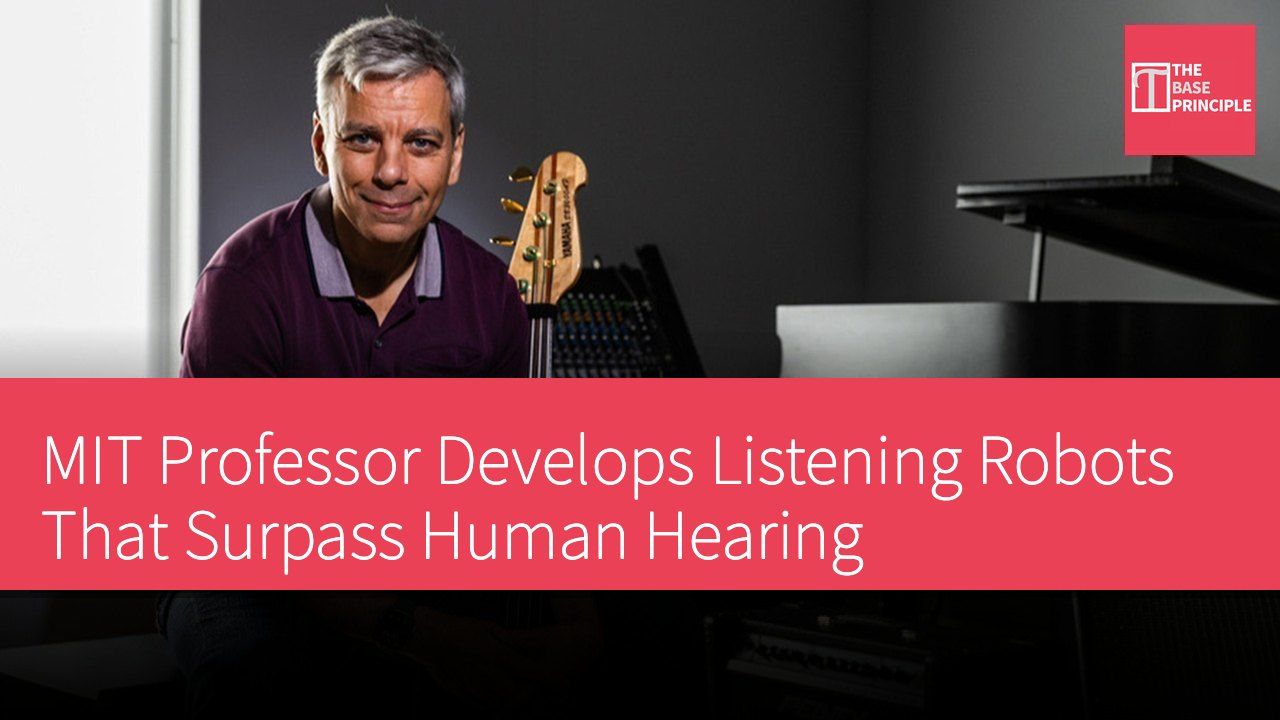
- Smaragdis is focused on developing machine listening technology that surpasses human hearing.
- His team is dedicated to isolating individual sounds from mixed audio to enhance human hearing.
- Smaragdis's technology assisted the production team of "The Beatles: Get Back" in cleaning up recordings.
- He hopes computers can provide constructive feedback to musicians rather than replace them.
Professor Paris Smaragdis of the Massachusetts Institute of Technology (MIT) is working on machine listening technology that surpasses human capabilities. He joined MIT in 2025 with the aim of creating computer systems that can exceed human auditory understanding. Such systems could locate traffic accidents by listening for the sounds of screeching tires and metal collisions, and could also issue warnings when industrial drill bits in geothermal drilling are about to break.
Smaragdis's team focuses on machine learning, working to isolate individual sounds from mixed audio, develop intelligent devices that enhance human hearing, and create better tools for music creation and analysis. Growing up in Greece, he studied bass at Berklee College of Music in Boston and earned his master's and PhD at MIT's Media Lab. Early in his career, he chose an uncommon path. While many students in media labs used signal processing techniques to help machines process sound, he turned to machine learning, as this approach offers advantages that traditional techniques cannot match.
Machine Learning and Auditory Technology
He points out that humans do not fully understand their own auditory processes. "We can't just tell computers how to listen," he states, so they must learn from data.
At Mitsubishi Electric Research Laboratories, Smaragdis built an AI system capable of scanning audio tracks in videos to determine events happening on screen. For example, a roaring crowd can suggest exciting moments in a football match without analyzing the video. This research was later applied to personal recording devices, traffic monitoring systems, and smartphones. At the University of Illinois Urbana-Champaign, his team used neural networks to isolate individual sounds from audio mixes. This technology caught the attention of the production team of the 2021 documentary mini-series "The Beatles: Get Back," who invited Smaragdis to assist in cleaning up archival recordings.
These recordings presented different challenges each time. In one segment, John Lennon plays music while Paul McCartney reads newspaper headlines and jokingly mentions George Harrison. Smaragdis notes that the team sought a technical solution to address all issues rather than tackling each problem individually. His contributions helped the team win the 2022 Emmy Award for Outstanding Sound Editing for Nonfiction or Reality Programming.
Tools for Musicians and Scientists
After 15 years working in Illinois, Smaragdis moved to MIT to tackle the increasingly interdisciplinary challenges in the field. His team is currently pursuing two main goals. The first is to make computers more useful for musicians, including systems that learn how to listen to music in order to provide constructive feedback. "We don't want to replace musicians with computers," he emphasizes. The second is to establish fundamental tools that allow scientists and artists to process, analyze, and manipulate audio. His team is exploring algorithms for complex signal processing, where traditional reference frameworks, including sampling rates and context windows, are not fixed or even well-defined.
He states that this points to computational structures that have yet to be explored, which may handle audio more effectively. They are also investigating how to incorporate large language models into speech recognition and audio enhancement. Smaragdis notes that the ideal ways to use AI for sound and music have yet to be discovered. He emphasizes practical coursework, as few of his students have experience in sound computation, allowing them to intuitively see and hear how equations turn into tangible things.
The Future Potential of Machine Listening Technology
Smaragdis's research not only pushes the boundaries of machine listening technology but also explores new possibilities at the intersection of music and science. His team is dedicated to creating systems that can understand and analyze audio, which has profound implications for both music creation and scientific research. As artificial intelligence advances, the applications of machine listening technology will continue to expand, potentially providing creators and scientists with more powerful tools to enhance their productivity and creativity.