
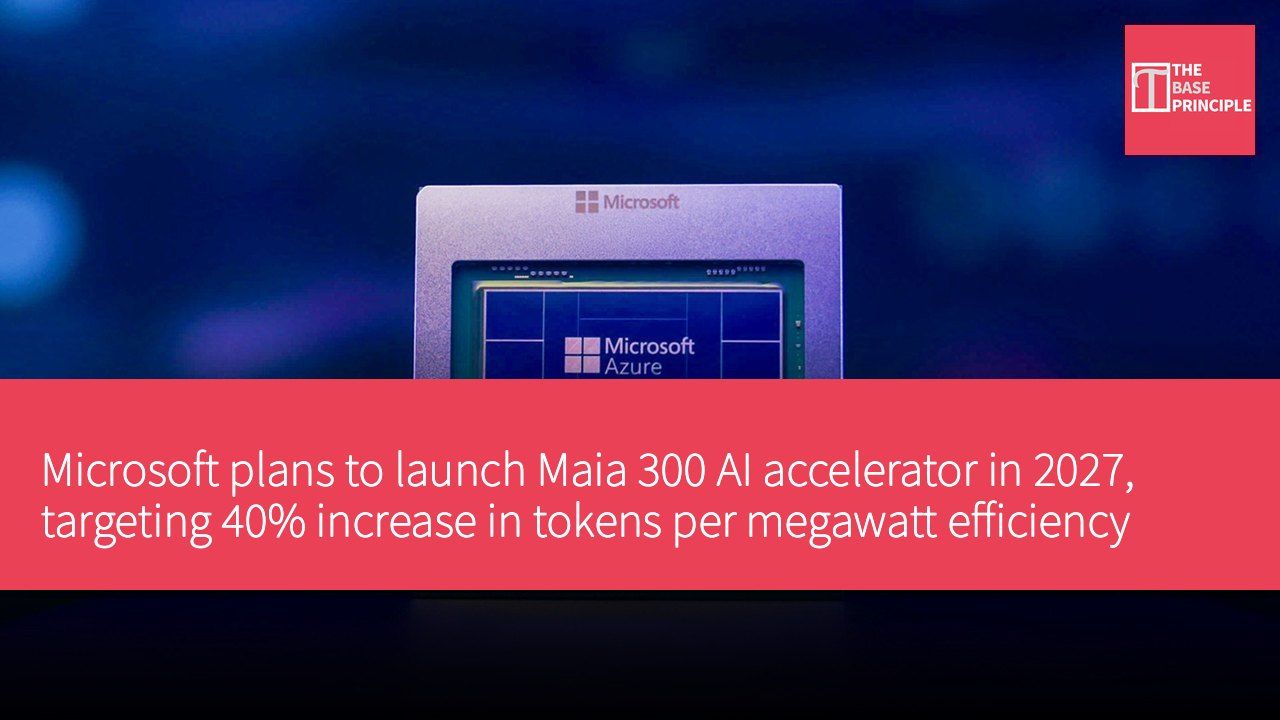
- Maia 300 will launch in 2027, aiming to reduce dependence on NVIDIA.
- The accelerator's design focuses on memory-intensive workloads and multi-step tasks.
- Maia 300 delivers 40% more token output per megawatt than existing GPU systems.
- Microsoft plans to deploy the Maia series as a core strategy for scaling AI compute capacity.
Microsoft plans to launch its next-generation Maia 300 artificial intelligence accelerator in 2027, aiming to break free from NVIDIA dependence and deliver 40% more token output per megawatt than today's leading GPU-based systems. The chip will power Microsoft's rapidly expanding AI infrastructure and is designed with a 96-accelerator rack configuration expected to achieve seven times the token processing capacity of its predecessor. The announcement marks another step by Microsoft in building custom silicon for large-scale AI inference.
Its Maia 200 accelerator is already handling production workloads, including Microsoft's Copilot. Microsoft expects GitHub Copilot and Microsoft Foundry to adopt the hardware before the end of 2026.
Maia 300 Design Features
Maia 300 takes a system-level approach to inference efficiency, with an architecture targeting memory-intensive workloads, long-context inference, and AI agents executing multi-step complex tasks. Driven by memory bandwidth, Maia 300 combines eight HBM4 memory stacks with a peak bandwidth of 18 TB per second. The system operates within a 950-watt thermal design power envelope to meet the growing memory demands of large AI models. Microsoft also employs a multi-chip design separating compute, memory controllers, and input/output functions.
The compute chip uses TSMC's N2P manufacturing process, aimed at improving performance per watt. The accelerator also supports enhanced MXFP4 low-precision computation, a method that reduces memory requirements for model computation and key-value cache storage. These savings help the system accommodate longer context windows and process more requests within the same power budget.
Maia 300 Performance Expectations
Software plays a significant role in the design. Microsoft's software-defined dataflow architecture aims to keep data close to compute resources, reducing unnecessary transfers. AI-assisted kernel optimization also helps improve hardware utilization across different workloads. Maia 300's network connects 96 accelerators, scaling its architecture to the full rack. Each configuration combines 96 accelerators within a 167-kilowatt power envelope. Microsoft lists 27.6 TB of HBM capacity and 1.7 PB per second of aggregate memory bandwidth, targeting larger inference workloads and more simultaneous AI interactions in a single deployment.
The custom network optimizes tensor-parallel links connecting accelerators via high-bandwidth connections. An AI-focused transport layer uses Ethernet infrastructure to support communication between accelerators and racks, designed to scale workloads without treating the network as a separate bottleneck.
Microsoft says Maia 300 should deliver 40% more tokens per megawatt than leading GPU-based systems, with predicted rack-scale throughput also showing significant growth compared to Maia 200, though the company has not detailed independent benchmarks for these comparisons. Microsoft has deployed Maia 200 in the United States, Europe, and Australia, and reports that built-in AI features in Teams, Copilot, and Cowork experiences deliver 1.7 times more tokens per watt than leading GPU infrastructure.
The existing accelerators run OpenAI models, Microsoft's MAI models, and open-source model families. Microsoft uses performance data from these services to guide hardware development and optimize real-world workloads. Maia 300 will support Microsoft's model development efforts, cloud inference, and agent-based coding tools, and the hardware is expected to help scale Dragon Copilot, its clinical AI assistant, with production deployment starting in 2027.
Microsoft's long-term plan calls for multi-gigawatt Maia deployments beginning that year, positioning custom silicon as the primary component of its strategy to scale AI compute capacity.
Item Specification Memory 8 HBM4 memory stacks Peak bandwidth 18 TB per second Thermal design power 950 watts Rack capacity 27.6 TB HBM Aggregate memory bandwidth 1.7 PB per second
Maia 300's Impact on Microsoft AI Ecosystem
The launch of Maia 300 marks a significant advance for Microsoft in the AI hardware space, particularly in reducing dependence on NVIDIA. By focusing on memory-intensive workloads and multi-step task design, Maia 300 has the potential to improve overall compute efficiency and support more complex AI applications. As AI application demand grows, Microsoft's custom silicon will become key to scaling its compute capacity and may change the industry's reliance pattern on AI accelerators.