
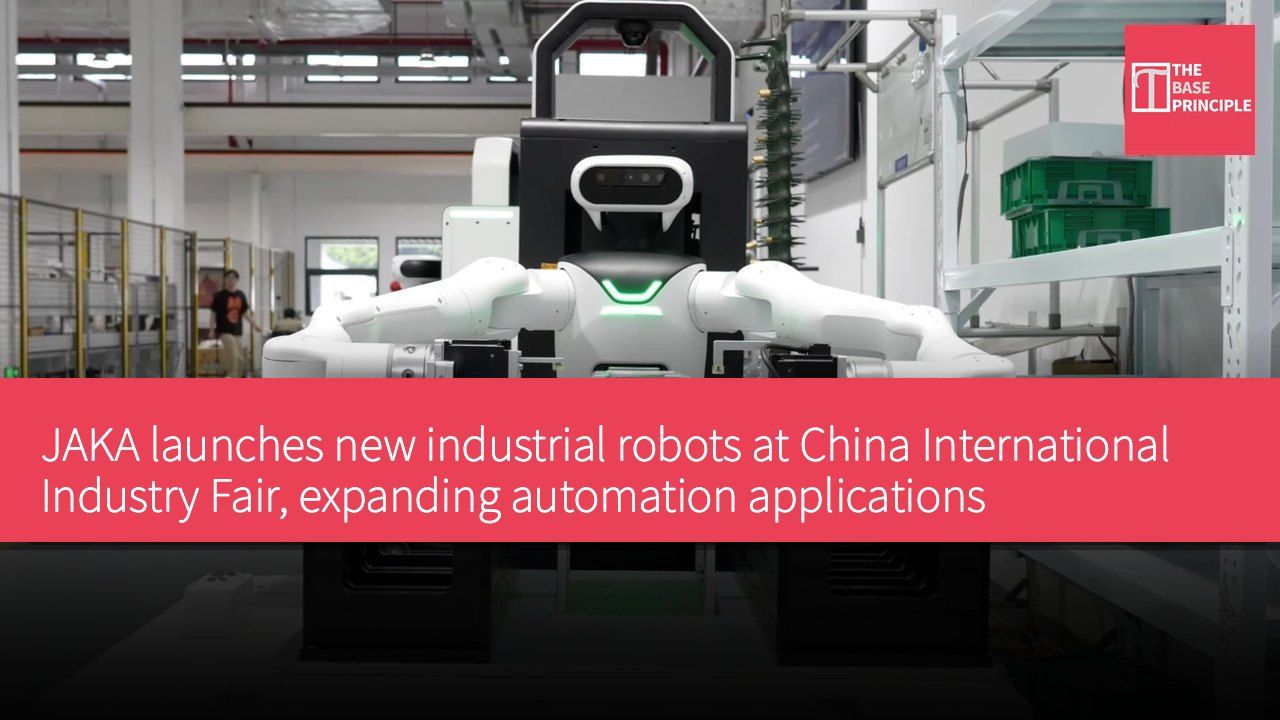
- JAKA launches Kargo50 and Zu50, two new industrial robots, at the China International Industry Fair.
- Kargo50 is designed for material handling, while Zu50 adds a payload-capable model to the collaborative robot arm series.
- The new robots aim to support factory automation and manufacturing operations, improving production process efficiency.
- The JAKA EVO system combines cloud intelligence and edge computing to enhance factory workflow coordination.
Chinese robotics company JAKA unveiled two new industrial robots at the 26th China International Industry Fair (CIIF 2026) in Shanghai. The new products include the Kargo50, a heavy-duty wheeled humanoid robot designed for material handling, and the Zu50, a collaborative robot arm with a payload capacity of 110 lbs (50 kg). These new models expand JAKA's industrial robot product line, targeting applications in factory automation, material transport, and manufacturing operations.
In June, JAKA also launched the Pi, a compact humanoid robot standing 1.22 meters tall and weighing 92 lbs (42 kg). The Kargo50 is designed to transport pallets and materials between workstations, while the Zu50 expands the company's collaborative robot arm series. The Kargo50 pushes JAKA's existing Kargo series of wheeled humanoid robots into heavier industrial applications. The company has not yet disclosed specific payload data or other technical specifications for the new models; their primary tasks include transporting pallets and materials on factory floors, with mobile robots helping to support production processes by transferring components between different workstations.
According to the company, JAKA scaled up based on deployment experience with its smaller Kargo10 wheeled humanoid robot. That robot is currently in large-scale commercial use at automotive parts and high-end electronics factories. With on-site engineering support, its pallet-handling cycle time dropped from 105 seconds to 28 seconds. The company also reported that deployment in new operational scenarios now takes 57 days, reflecting its efforts to simplify integration into factory environments.
New Robot Capabilities and Applications
The second new model, the Zu50, adds a 110-lb (50-kg) payload-capable model to JAKA's collaborative robot arm series. According to the company's product listing, the arm has a maximum reach of 2,100 mm and delivers up to a 50% increase in joint speed. Its design incorporates integrated joint modules with high power-density drives and control systems, aimed at boosting performance in demanding industrial applications.
Beyond the hardware launches, JAKA also demonstrated how mobile robots and robot arms can collaborate to perform coordinated manufacturing tasks. At its CIIF 2026 booth, the company showcased a factory work cell in which two wheeled humanoid robots collaborated on an engine assembly. One robot transported the engine to a designated position, while the other handled bolt tightening, after which both returned to their starting points. The demonstration illustrated a coordinated workflow designed to execute a sequence of industrial tasks, rather than isolated robot actions.
Embodied Intelligence Operating System JAKA EVO
The system relies on JAKA EVO, an embodied intelligence operating system launched in 2025. Its architecture divides processing among cloud-based intelligence, edge computing, and motion control. The cloud model manages perception, task planning, skill selection, and decision-making when anomalies arise. The edge model combines a rules engine with motion planning and force control functions, while a dedicated motion controller operates at 1,000 Hz. This layered architecture aims to link high-level task planning with the precise, responsive control required for physical manipulation. By combining mobile manipulation, collaborative robot arms, and embodied intelligence software, JAKA targets factory workflows that require coordinated action across multiple robots.
Since its founding in 2014, the company has operated in the collaborative robotics and embodied intelligence space, and its latest releases underscore its push toward more flexible industrial automation.
How JAKA Is Driving the Future of Industrial Automation
JAKA's new industrial robots and embodied intelligence operating system demonstrate its innovative efforts in the industrial automation field. The launch of the Kargo50 and Zu50 not only expands the product line but also improves factory production efficiency, highlighting the emphasis on material handling and collaborative robot arms. Through the JAKA EVO system, the company aims to achieve a higher-level integration of task planning and actual operations, which holds significant significance for the intelligent transformation of future factories. This collaborative operating model may become an industry trend, boosting overall productivity.