
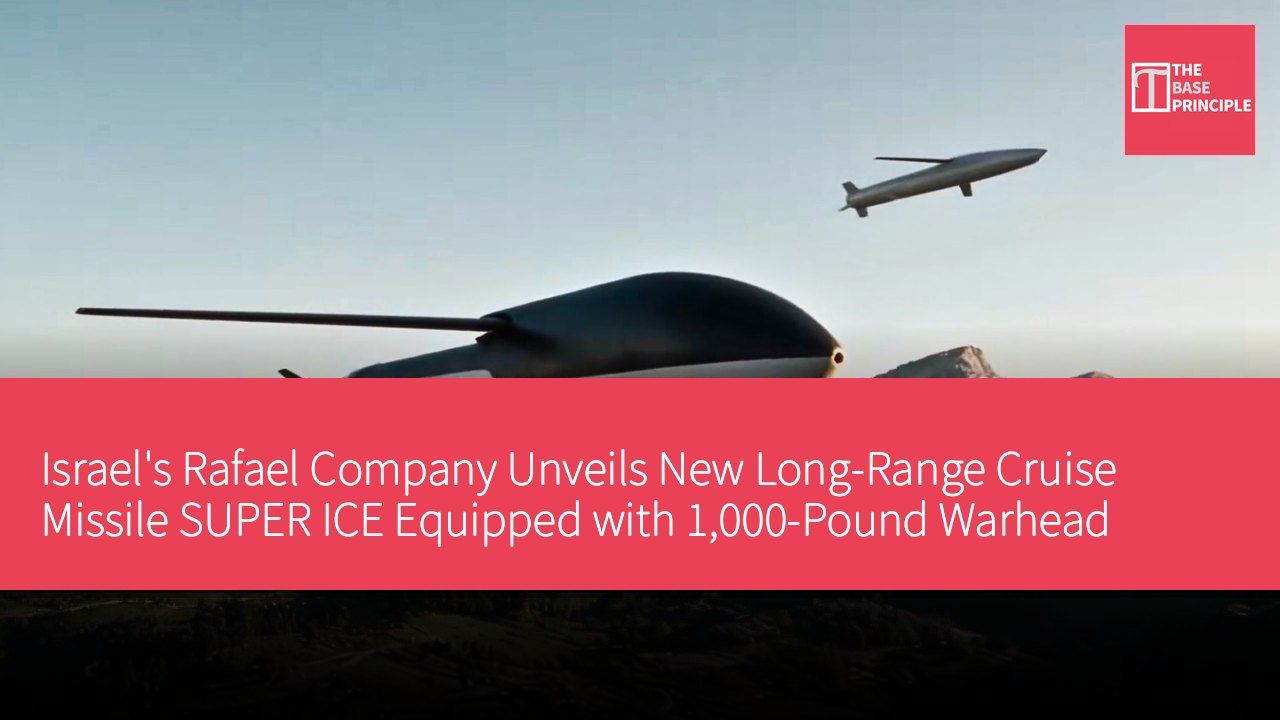
- SUPER ICE is a new long-range cruise missile equipped with a 1,000-pound warhead.
- The missile is designed to expand Israel's long-range strike capabilities and is compatible with existing launch systems.
- SUPER ICE features autonomous navigation and low-altitude terrain-following flight capabilities.
- Rafael emphasizes that the missile can be selected in different variants based on mission requirements.
Israeli defense company Rafael Advanced Defense Systems has recently launched SUPER ICE, a new long-range cruise missile equipped with a 1,000-pound (approximately 454 kilograms) warhead, which is four times heavier than its predecessor, the ICE BREAKER. This weapon is designed to expand Israel's long-range strike capabilities, with options for launch from aircraft, ground systems, and maritime platforms. SUPER ICE was announced on November 11, 2026, and is based on Rafael's ICE BREAKER cruise missile series while maintaining compatibility with existing launch systems, mission planning tools, and logistical infrastructure.
The company stated that this will allow customers to introduce more powerful weapons without the need to rebuild existing support systems. This launch also marks another step forward for the company in expanding its range of long-range precision strike weapons, a development history that can be traced back to the company's POPEYE missile series.
Design of the SUPER ICE Warhead
The most significant change is in the design of the warhead. The 1,000-pound warhead on SUPER ICE is compatible with the U.S.-made Mark 83 bomb, offering a larger payload compared to the 250-pound warhead of the ICE BREAKER, allowing the missile to target a broader range of high-value targets, including fortified military infrastructure. However, Rafael has not disclosed specific dimensions, weight, or exact destructive capabilities of the new missile. The SUPER ICE is designed for launch from air, land, and sea platforms.
According to the company, its multi-domain architecture allows customers to integrate between different aircraft and ground or ship-based launchers without significant modifications to existing platforms. The company has not specified particular aircraft or maritime launch platforms in the announcement, but reports suggest that the missile is intended to be compatible with Israel's F-35, F-16, and F-15 fighter jets.
Missile Navigation and Operational Capabilities
In addition to the larger warhead, SUPER ICE also features autonomous navigation, low-altitude terrain-following flight, all-weather operational capabilities, and an electro-optical guidance system utilizing image-matching technology. Image-matching guidance allows the missile to compare images captured by its onboard sensors with reference images to help determine its position and identify targets. This is particularly useful in scenarios where satellite navigation signals are disrupted or unavailable. Rafael's earlier ICE BREAKER employed imaging infrared seekers, scene-matching algorithms, and navigation designs that operate in environments where global navigation satellite system signals are blocked or interfered with.
Its publicly available specifications include a range of approximately 186 miles (about 300 kilometers), subsonic flight, and a 250-pound warhead. Rafael has not released corresponding data for SUPER ICE.
Market Positioning of SUPER ICE
The company has not disclosed the exact range and speed of SUPER ICE, but it is reported that the new missile is faster and has a longer range. Low-altitude flight capability is another important feature. Terrain-following flight allows the cruise missile to utilize the terrain to reduce its exposure to radar detection, potentially making it more difficult for air defense systems to detect and intercept. The defense company positions SUPER ICE as a complement to existing weapon systems rather than a completely independent system. Compatibility with existing launch equipment, mission planning, and logistics may reduce the costs and complexities of introducing the new missile.
Gad Geva, Rafael's Senior Vice President and Head of the Air Systems Division, stated that customers can choose between SUPER ICE and ICE BREAKER based on target and mission requirements. He also emphasized potential savings in mission planning and lifecycle costs. The company has not disclosed the price of SUPER ICE, confirmed customers, or a defined delivery timeline. However, various reports suggest that the missile could enter service in early 2027. Through SUPER ICE, Rafael has expanded its cruise missile series, featuring a heavier warhead and greater launch flexibility.
Its ultimate value will depend on how effectively the company integrates the system across different platforms and demonstrates its capabilities against increasingly complex air defense networks.
Item Specifications Warhead 1,000 pounds (approximately 454 kilograms) Launch Platforms Air, land, sea Range Not disclosed Speed Not disclosed
Strategic Significance and Market Potential of SUPER ICE
The launch of SUPER ICE marks a significant advancement for Israel in the field of long-range strike weapons, particularly with its larger warhead and compatibility design, enabling seamless integration into existing systems. This not only enhances Israel's military capabilities but may also impact the regional security landscape. The design, featuring autonomous navigation and low-altitude flight capabilities, allows SUPER ICE to operate in complex air defense environments, increasing its operational flexibility. As global demand for efficient weapon systems rises, Rafael's new missile has the potential to gain attention in international markets, especially in the face of increasingly complex security challenges.