
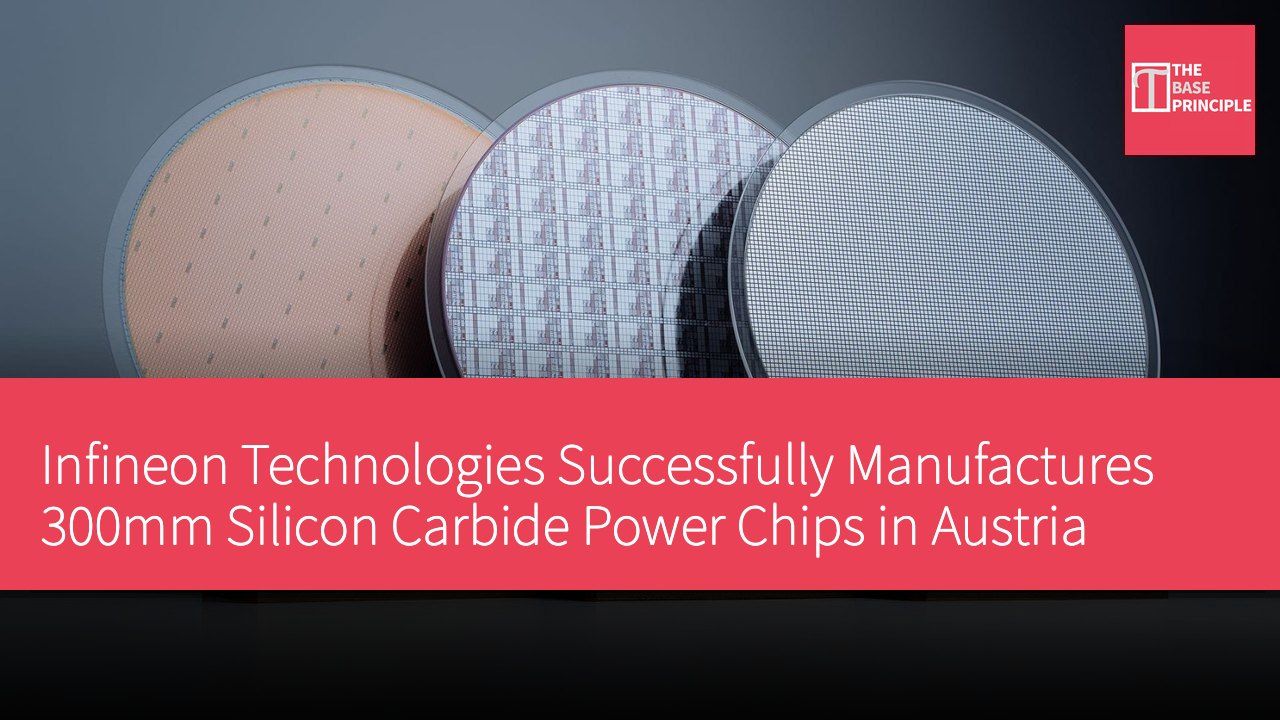
- Infineon has successfully manufactured 300mm silicon carbide power chips in Austria, marking its first attempt at full-scale production.
- This technology helps enhance the supply of power semiconductors for electric vehicles and renewable energy systems.
- Infineon plans to collaborate with customers to expand the production of silicon carbide technology.
- Silicon carbide can withstand high voltage and high temperatures, making it suitable for various power devices.
German chip manufacturer Infineon Technologies announced that its factory in Villach, Austria, has successfully produced functional power chips on 300mm silicon carbide wafers. This achievement, announced on November 9, represents the first attempt at full-scale manufacturing using existing silicon chip production equipment. The larger wafers will help Infineon enhance its supply of power semiconductors for electric vehicles, renewable energy systems, and artificial intelligence data centers. The company stated that the output from 300mm wafers can reach 2.3 times that of 200mm wafers.
Infineon is showcasing a completed wafer at the electronica trade fair taking place in Munich from November 10 to 13.
Showcasing the Successfully Manufactured Wafer
The work in Villach demonstrates Infineon's ability to utilize existing silicon production equipment to convert larger silicon carbide wafers into functional devices. The company plans to collaborate with customers and partners on the timing for technology and production expansion while continuing to develop its 200mm silicon carbide manufacturing processes. Infineon Technologies CEO Jochen Hanebeck stated, "This technological milestone further solidifies our leadership in the power systems domain. Thanks to our passionate team, we have made significant progress in transitioning 300mm silicon carbide from the laboratory to a production environment."
Silicon carbide is the second wide bandgap material in Infineon's 300mm manufacturing plan, with the other being gallium nitride. The company announced on October 27 that it will invest approximately €1.1 billion in Villach to establish a high-volume facility for manufacturing gallium nitride power semiconductors on 300mm wafers.
Advantages of Cold Split Technology
Infineon is also testing its Cold Split process at its factory in Dresden, which allows wafers to be separated from a single boule. According to the company, Cold Split requires less time and wastes less crystal compared to traditional wire sawing, enabling more wafers to be obtained from the same boule. The capital expenditure for this process is also lower than that for wire sawing. These two trials target different steps in the manufacturing process. The Dresden team has demonstrated the company's ability to use Cold Split to separate wafers of this size, while the Villach team has shown that it can successfully process larger silicon carbide wafers into functional power devices using existing equipment.
Silicon carbide helps power devices convert electricity with lower losses and can withstand high voltage and high temperatures. It also allows power electronic devices to output more power within a given space. In electric vehicles, this material can be used in traction inverters and onboard chargers that control motor power. It is also applicable in external electric vehicle charging stations, large energy storage systems, and industrial motor drives. This material is also used in uninterruptible power supplies (UPS) to keep devices running during normal power interruptions or failures. Infineon noted that demand for this material is also rising in artificial intelligence data centers, where it can be used in power units, solid-state transformers, and circuit breakers.
The company has been selling silicon carbide power conversion devices under the CoolSiC brand.
Market Potential of Silicon Carbide Technology
Silicon carbide, as a next-generation power semiconductor material, offers high efficiency and high tolerance, effectively addressing the demands of electric vehicles and renewable energy. With the growing adoption of electric vehicles and large energy storage systems, the market demand for silicon carbide continues to rise. Infineon's successful manufacturing not only demonstrates its technological prowess but also establishes a more solid position in the competitive semiconductor market. Through collaboration with customers, Infineon will be able to further expand its influence in the power electronics sector.