
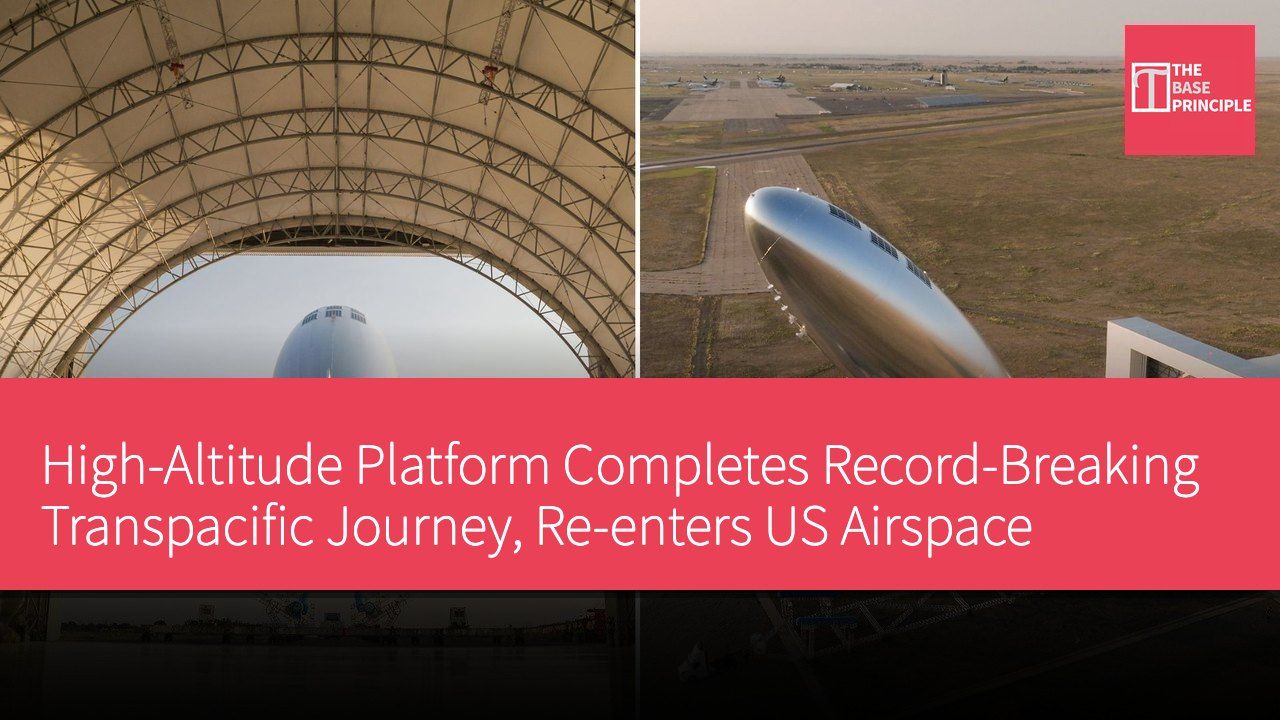
- Sceye's high-altitude platform successfully completed a transpacific flight from New Mexico to Japan.
- The mission demonstrated HAPS's technical performance and its potential for future connectivity services.
- SceyeCELL, as a stratospheric base station, can provide wide-area mobile broadband to standard devices.
- The platform operates similarly to geostationary satellites but offers services at a lower cost.
A Moriarty-based company has reintroduced its stratospheric platform to the US market. The High-Altitude Platform System (HAPS) has completed a record-breaking transpacific flight for stratospheric infrastructure, traveling from New Mexico to Japan and back successfully. The mission, named Service Test 1 (ST1), was developed by Sceye. ST1 launched on August 9, 2026, and arrived in Japan 13 days later. During its time in Japan, Sceye demonstrated mobile broadband connectivity to unmodified devices, as well as HAPS-based edge computing and communications with drones, supporting the development of 3D communication networks, through SoftBank Corp.'s core network.
The mission validated the performance of the technology, vehicle systems, and payload.
Technical Validation of the ST1 Mission
"To describe our ST1 flight as merely groundbreaking and historic is not enough," said Mikkel Vestergaard Frandsen, founder and CEO of Sceye. "This mission not only proves that our technology, vehicle systems, payload, and operational infrastructure are ready to deliver connectivity services, but it also shows that the stratosphere is where the future of non-terrestrial infrastructure lies. The stratosphere will enable an always-on future, including the promise of 6G. The ground, stratosphere, and space—each leveraging their best capabilities—will change the trajectory of human development."
During the journey, Sceye's ST1 traveled nearly 30,000 kilometers and re-entered the continental United States on September 4, 2026. ST1 arrived in the airspace near Sceye's headquarters in Moriarty, New Mexico, on September 5, 2026, after which Sceye conducted additional vehicle testing and the planned termination and descent.
Commercial Potential of Stratospheric Base Stations
The mission was conducted in collaboration with SoftBank Corp., a leading telecommunications and information technology business operator in Japan and globally. ST1 marks Sceye's first flight to Asia and a milestone in the commercial deployment of HAPS as stratospheric infrastructure. ST1 carried SceyeCELL, a first-of-its-kind "base station in the sky," designed to provide wide-area mobile broadband directly to standard devices from the stratosphere. According to the press release, when fully deployed, a single Sceye HAPS design is capable of covering an area equivalent to approximately 500 ground base stations.
The stratosphere offers the best observation angle: it is close enough to Earth to provide high-capacity connectivity and observation, yet high enough to enable wide-area coverage. Importantly, the stratosphere provides conditions similar to those in space without the cost of entering space and the disadvantages of being in orbit. Sceye's HAPS maintains its altitude and operational area in the stratosphere through day-night cycles, operating similarly to geostationary satellites but at a distance 1,800 times closer to Earth and at a much lower cost, as indicated in the press release. The platform traveled nearly 30,000 kilometers over the course of a month, from New Mexico to Japan and back to New Mexico.
World's First Successful Mobile Core Network Test
The platform also tested emergency calls, using an emergency alert information system designed for large-scale disasters, and communications with drones. By installing servers on the HAPS, Sceye and SoftBank processed data directly on the platform, demonstrating an average round-trip processing response time of 68 milliseconds, reducing communication latency by more than 40% compared to internet-based cloud processing. This marks the world's first successful test in which a mobile core network and network servers for processing were installed on the HAPS, allowing response processing to be performed entirely on the HAPS and the results returned to smartphones.
Future Outlook for High-Altitude Platform Technology
Sceye's High-Altitude Platform System (HAPS) demonstrated its potential in connectivity services during this mission, particularly in the development of future 6G networks. The stratosphere provides an ideal observation angle and wide-area coverage, enabling low-cost, space-like operational conditions. This is not only a technological breakthrough but also has the potential to change the way humans communicate, enhancing disaster response and the efficiency of everyday communications, highlighting the important role of HAPS in the global communications infrastructure.