
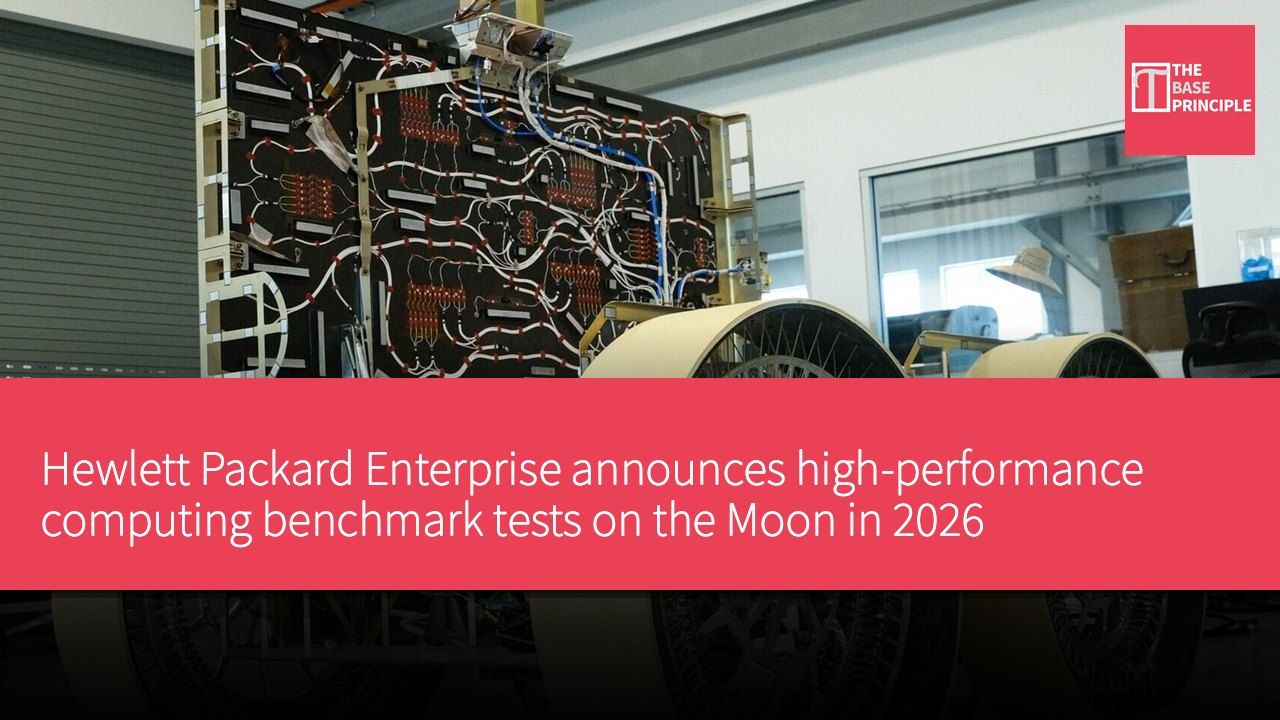
- HPE will conduct high-performance computing benchmark tests on the Moon in 2026.
- The computer is designed for autonomous navigation and data processing.
- The tests will evaluate the system's reliable operation in the lunar environment.
- Deloitte will provide a cybersecurity system to detect anomalous activities.
Hewlett Packard Enterprise (HPE) plans to conduct its first high-performance computing benchmark tests on the lunar surface by the end of 2026, with a system designed to support autonomous navigation, data processing, and advanced computing. HPE announced the launch of HPE Spaceborne Computer-4 on October 20, which will be deployed alongside Astrolab's FLIP rover as part of NASA's Commercial Lunar Payload Services (CLPS) program.
Design and Functionality of the Test System
The spacecraft is expected to land near the lunar south pole and conduct tests to determine the reliable operation of advanced computing systems in the lunar environment. Experiments will include language models, image analysis, and laser-based mapping. The project aims to address a significant challenge for future lunar missions: processing information at close range rather than relying entirely on computing resources on Earth. Local processing will assist the rover in analyzing terrain, interpreting sensor readings, and supporting decision-making without the need to send every piece of data back to Earth.
HPE Spaceborne Computer-4 is a lightweight, self-sufficient module equipped with a low-power central processing unit (CPU) and graphics processing unit (GPU). The system features a fanless design intended to withstand the harsh lunar environment. It also integrates solid-state drives from Japanese storage manufacturer Kioxia, utilizing flash technology. During the mission, the computer will run high-performance computing benchmark tests to assess its capabilities under lunar conditions. These tests will measure the effectiveness of the hardware in handling high-load workloads, although HPE has not disclosed specific processing speeds or expected benchmark results.
The system will also test the use of retrieval-augmented generation language models, a technique that allows the model to retrieve information from documents before generating responses. Other experiments will process LiDAR data, a technology that uses laser measurements to map surrounding terrain. This technology can support navigation, surface mapping, and future lunar infrastructure planning.
Contribution of the Cybersecurity System
Additionally, a software test will be conducted to check whether computational applications can be reliably deployed and managed on the Moon. NASA will conduct experiments involving computational systems in different locations, with its Federated Learning Unbounded and Intelligent Decentralized (FLUID) experiment testing coordination among three neural network models trained on data from Earth, the Moon, and the International Space Station. This approach will help researchers explore how different computing systems can share insights without relying on a single central processing location. NASA also plans to test a specially tuned language model designed to search and interpret onboard documents.
Meanwhile, Deloitte will contribute a cybersecurity system named Silent Shield, designed to detect anomalous activities and potential intrusions through near-real-time analysis. Astrolab's FLIP rover will carry the computer on Voyager Technologies' Griffin-1 lander. HPE will also provide private cloud infrastructure to support Astrolab's mission control operations in Hawthorne, California.
This new system builds on HPE's earlier space computing projects, which operated on the International Space Station. However, these deployments did not establish the performance of the latest hardware on the lunar surface. The planned experiments will help determine whether advanced computing can support future lunar exploration, but the proposed benchmarks and applications have yet to be demonstrated on the Moon.
Computational Challenges and Solutions in the Lunar Environment
HPE's plan marks a significant step toward high-performance computing on the Moon, which is crucial for future space exploration. As the demand for autonomous navigation and real-time data processing increases, the ability to perform computations on the Moon will reduce reliance on Earth-based resources. These tests will not only evaluate the performance of new hardware but also provide valuable data for future lunar missions, particularly in establishing lunar infrastructure and conducting long-term exploration.