
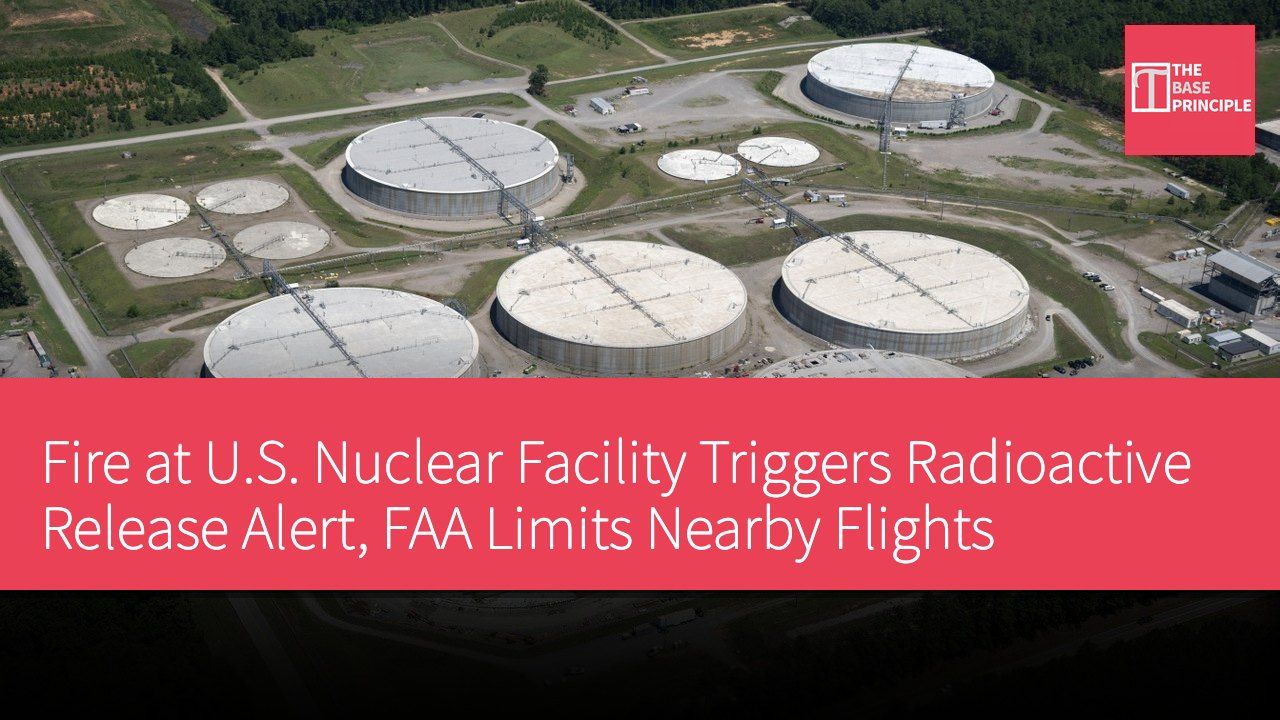
- A fire at the Savannah River Site triggered a radioactive release alert.
- Local officials declared a state of emergency and restricted air traffic.
- The fire occurred in a laboratory within the nuclear facility and has been extinguished.
- No contamination beyond the facility has been reported, and there are no reports of injuries.
A fire at the U.S. Department of Energy's Savannah River Site in South Carolina prompted local officials to declare a regional emergency on Wednesday evening, October 28, with local media reporting a radioactive release incident and restrictions on nearby air traffic. According to updates from the official X account for the area, the emergency was declared at 5:39 PM local time, with the federal nuclear facility located near Aiken, South Carolina. Officials confirmed that the fire occurred at the Savannah River National Laboratory, which operates within the nuclear facility. The fire has now been extinguished. Local radio station WRDW/WAGT reported that emergency dispatch described an "unfiltered ground radiation release" associated with the incident.
However, Savannah River Site officials stated that no contamination beyond the affected facility has been reported, and there are no indications that it would impact areas outside the facility's boundaries. According to WRDW/WAGT, the fire was contained to a single room within the laboratory. Sources told the radio station that the incident occurred shortly after 5 PM. The cause of the fire and whether anyone was injured have not been disclosed.
Emergency Response Triggered by Fire
Savannah River Site officials stated that the incident triggered emergency response activities from the Department of Energy. "The ongoing event has triggered emergency response activities at the Department of Energy's Savannah River Site," officials stated in an initial notification. According to local media reports, employees in Area A of the laboratory were instructed to shelter in place for about 30 minutes. While some employees were later allowed to leave, access to the affected area remains restricted. Officials also set up barricades at the facility's entrances and exits to limit traffic. Employees not involved in the emergency response or shutdown operations were instructed to shelter in place as a precaution.
According to officials, rail, river, and air traffic near the facility have also been restricted. Local media reports indicate that the Federal Aviation Administration has implemented temporary flight restrictions within a 15 nautical mile radius of the facility, limiting altitude to 10,000 feet above sea level. The restriction is scheduled to remain in effect until midnight on Thursday. However, Highway 125 remains open, and officials confirmed that the road has not been closed.
History and Function of the Facility
Savannah River Site officials stated they are coordinating the emergency response and have notified relevant state and local government agencies. The Savannah River Site covers approximately 310 square miles, spanning Aiken, Barnwell, and Allendale counties in South Carolina. The facility was established in the early 1950s during the Cold War, initially for the production of materials needed for nuclear weapons, including plutonium-239 and tritium. Today, the complex handles radioactive waste, spent nuclear fuel, and surplus plutonium. It also continues tritium operations that support the nation's nuclear deterrent. The Savannah River National Laboratory conducts research involving nuclear materials, environmental management, energy technologies, and national security.
Officials stated that more information will be released through the area's public information personnel as it becomes available.
Potential Impact of the Nuclear Facility Fire
This fire incident highlights the safety risks associated with nuclear facilities, particularly in environments handling radioactive materials. While no contamination beyond the facility has been reported, the event may still raise public concerns regarding nuclear safety. Given the historical context of nuclear facilities, such incidents could affect community acceptance of nuclear energy and government response measures. Ongoing monitoring and transparent information dissemination are crucial for maintaining public trust.