
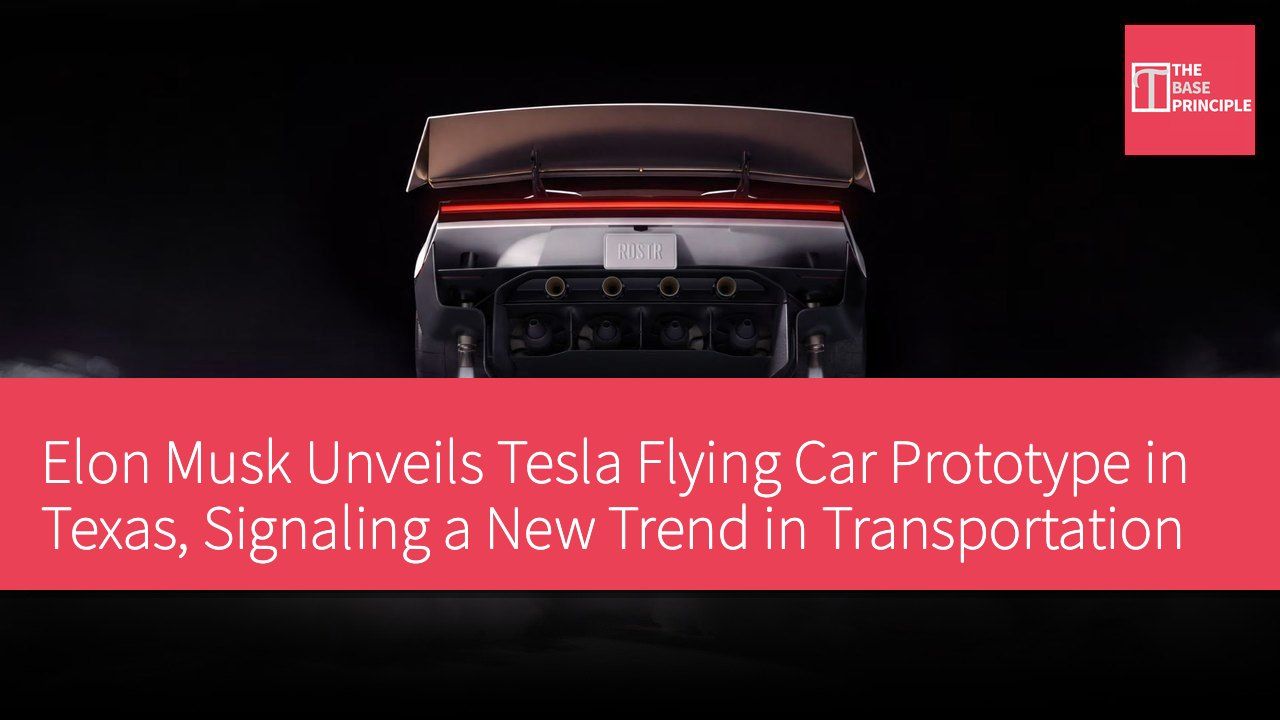
- Elon Musk unveiled the Tesla flying car prototype in Texas, signaling a new trend in transportation.
- The prototype utilizes rocket propulsion technology, achieving 0 to 60 miles per hour in one second.
- Experts express skepticism about the vehicle's practicality, suggesting it may become a poorly performing aircraft and vehicle.
- Musk described the car as a collaboration between "the world's best car company and the world's best rocket company."
Throughout history, visions of the future have often included flying cars. Elon Musk appears determined to make this vision a reality. At a product launch event held at a SpaceX rocket development facility in Texas, the billionaire CEO showcased the long-delayed Tesla Roadster prototype. The event featured aerial stunts, air propulsion cold thrusters, and a seemingly sci-fi demonstration of autonomous driving. Musk posted on X, stating, "Clearly, the future really does have flying cars."
Technology and Design of the Prototype
The rocket-powered spectacle was brief and wild, entirely experimental in nature. The prototype is propelled by 10 ultra-high-pressure air nozzles, supplied by an internal compressed tank, which tightly adheres to steep slopes using bottom suction, flipping in mid-air and spinning rapidly. It soared over a row of parked Teslas, flipped in the air, and used bursts of compressed gas to slow its descent, ultimately landing safely in a cloud of white smoke. These specifications sound quite absurd. Musk claims that the production model will achieve 0 to 60 miles per hour in one second, thanks to rocket propulsion technology.
He told the crowd, "Success is not guaranteed," explaining that tests are conducted automatically to ensure safety. "What I mean is, this might succeed, but if it doesn't, we keep a safe distance."
The next-generation Tesla electric Roadster features an all-wheel-drive powertrain, accommodates four passengers, delivers 10,000 Nm of tire torque, offers a range of 620 miles, and exceeds a top speed of 250 miles per hour. The standard model has a reservation fee of US$50,000 (approximately HK$390,000). Upgrading to the Thrust variant requires an additional US$245,000 (approximately HK$1,911,000), which adds SpaceX cold gas thrusters and an active multi-mode fan system to increase downforce, reducing the acceleration time to under one second.
The invited Rocket variant replaces the standard configuration with a single-seat layout and peripheral thrusters, rendering it illegal for road use.
Expert Opinions on Flying Cars
Despite the undeniable spectacle, aviation experts are skeptical about whether the vehicle can serve as both a practical road car and a true aircraft. Aircraft design prioritizes minimal weight to generate lift and maintain stability. Consequently, heavy components adversely affect performance. Additionally, passenger road vehicles use steel bumpers and crumple zones as safety features to absorb impact forces during collisions. Heavy safety components protect the car in crashes, but the added weight complicates flight. Roger Conner, curator of vertical flight at the Smithsonian National Air and Space Museum, told CNN, "Inevitably, this hybrid vehicle will become a poorly performing aircraft and a poorly performing vehicle, and it will be very expensive."
Future Prospects and Challenges
The demonstration on Thursday did not showcase long-distance flight capabilities. He emphasized, "We're not talking about sustained flight. We're actually talking about jumping." Musk portrayed the vehicle as a direct result of collaboration between "the world's best car company and the world's best rocket company." The current preliminary production target is set for 2028. However, Musk has a long history of setting optimistic release targets for Tesla products, often missing them by several years. Whether drivers will be able to legally hover in morning traffic remains an open question.
Nevertheless, witnessing a sports car flip and safely land on cold gas thrusters is already enough to demonstrate that flying cars are transitioning from science fiction to reality.
Real Challenges and Future Potential of Flying Cars
The demonstration of the Tesla flying car marks a significant advancement in transportation technology; however, practicality remains a major issue. Experts point out that the design requirements for aircraft and road vehicles are fundamentally different, making the idea of combining the two highly challenging. Balancing safety and performance will be key to future developments. Additionally, Musk's past record of optimistic predictions raises doubts about the feasibility of the production timeline. Nonetheless, this innovation continues to inspire imaginations about future modes of transportation.